





Want More? Learn How to Implement a Fleet Preventive Maintenance Program
How Benchmarking Improves Fleet Maintenance Costs
Fleets can drive efficiencies and improve operating costs by capturing detailed expenses on every unit and comparing them to technician and job hours. The Gothic Landscape fleet is on that quest.
May 9, 2024
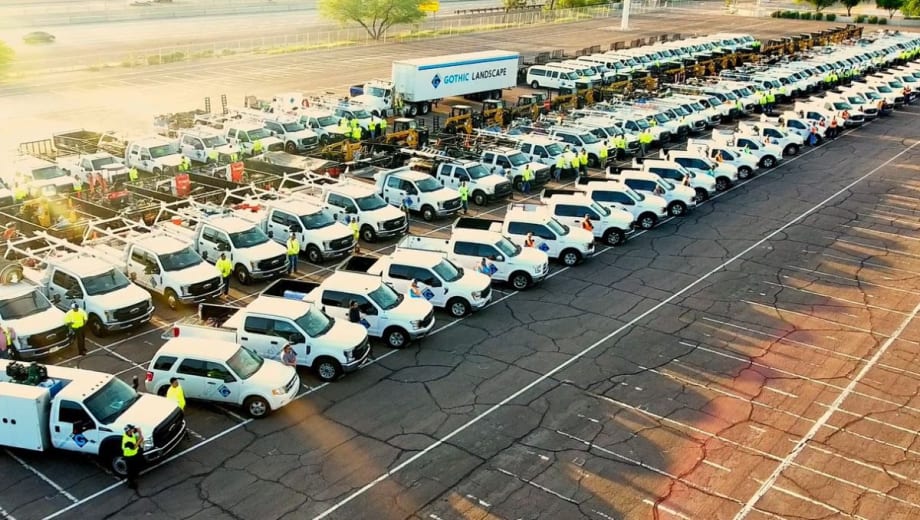
Gothic Landscape covers three Western states and services numerous landscape types with a total fleet of over 2,300 units. Though each division has autonomy to do what's best, Gothic's Ernie Garcia is implementing systems to manage costs for every fleet unit in all divisions.
Photo: Gothic Landscape
5 min to read
Gothic Landscape started in a garage 40 years ago and grew to cover Arizona, Nevada, and California, from San Diego to the Bay Area. It's the largest family-owned Landscape company in the nation and ninth overall.
The Gothic Landscape fleet comprises over 2,300 units, including about 960 vehicles and trailers, industrial mowers, and 400 units of yellow iron.
Gothic supervisors mostly run Ford F-150s, while the maintenance division uses F-250s and the construction crews run F-350s with contractor bodies and pipe and ladder racks. An environmental restoration division uses 4x4 F-350s with stakebeds and landscape trailers to haul plants and shrubbery.
For larger vegetation like palm trees, the company uses semi-tractors. Garcia's fleet vehicle is an F-150 Lightning.
With the variety of vehicles and use cases and a service area that varies from the mountains and deserts to the sea, it's not easy or always advantageous to standardize operations and policies across the entire fleet.
"I don't do anything by a specific directive; I show the fleet managers the facts, and then I help them decide," said Ernie Garcia, director of fleet and business systems. "I hope they decide like I do, but it's not always the case. I don't make any decisions without their input."
But Garcia, who took over the fleet three years ago, is on a mission to gather data on every fleet unit, analyze the fleet as a whole, and, over time, find new efficiencies to drive down technician and operate cost savings.
He's getting there with a few initiatives:
Implementing More Frequent PM Schedules
The saying, "An ounce of prevention is worth a pound of cure," is relevant in fleet maintenance. For Garcia, that means more frequent preventive maintenance intervals to identify issues before they become larger repairs later.
"Some OEM PM schedules were a little too loose for us, so we targeted doing half (the miles) of what they recommend," he said. It's all about the use case. "We run the trucks hard."
He said the F-250s and F-350s do a lot of towing and burn through parts a lot quicker, while other units are constantly off-road in unfinished landscapes.
He'll bring the trucks in every 5,000 miles instead of 10,000 for lube, oil, and filters. For longer intervals, he'll schedule 30,000 miles instead of 60,000 and replace wearables at the sooner intervals. As a result, "we've gotten longer life out of our units," Garcia said.
Spec'ing for the Job & Resale
The trucks and trailers are spec'ed to fall under DOT GVWR regulations, which vary by state.
The company also refined truck specs to incorporate options and trim levels that appeal to fleet drivers and create a more attractive used unit.
Garcia favors crew cabs, which return more at resale, instead of single and extended cabs.
Tracking Miles & Lifecycle Costs
Garcia recently implemented the Fleetio fleet information management system (FMIS) to be able to determine lifecycle costs for every fleet unit.
"Now that we have lifecycle costs in place, we're just barely beginning to track how we're doing (against a benchmark)," he said.
Before establishing lifecycles, units were run "until they died," Garcia said. "We are still trying to get the optimal life out of the unit, but we're trying to reduce (overall miles) so that we still get the bigger return on the back end."
The F-150s regularly reach 180,000 miles, and a few have reached 300,000. With lifecycle costing, Garcia identified that ownership costs spike when the trucks near the seven-year or 225,000-mile mark.
Garcia is in the process of having the system handle parts inventory as well, which will allow Gothic visibility across each division and leverage volume parts pricing with vendors.
The ultimate goal is to get all fleet costs in the system, including maintenance, parts, and labor, the vehicles' initial cost, lease or loan payments, fuel expense, and disposal proceeds. The system is even set up to categorize small jobs such as removing decals from a vehicle before it's sent to auction.
With that data, lifecycle costs per unit and between model years can be compared. When the time comes, "We will be in a much better place," Garcia said.
Migrating from Diesel to Gas
Garcia realized that the F-250s with the gas engines lasted just as long as the diesels.
"We were paying more for the diesels, but we didn't really need them," he said. "We were expecting to see the diesels last at least another 100,000 miles, which is the way it used to be maybe 10 years ago. It's just not that way now."
Regarding the switch to diesel, "Some of the guys weren't too happy about it," he said.
But, with the savings using gas engines, Gothic added some driver perks like running boards.
Employing Benchmarking Techniques
As part of his CAFM accreditation through NAFA, the fleet management association, Garcia learned the concept of maintenance repair equivalents — or benchmarking jobs by the smallest unit and scaling labor and parts costs relative to the size of the unit.
Based on the concept, Garcia customized a calculator to reflect his fleet's specific conditions. Garcia mapped time, labor, and parts costs for his Ford Mavericks, F-150s, F-250s, and F-350s up to the semi-tractors and even his dump bodies.
In the system, a Ford Maverick's PM schedule "A" in the Los Angeles branch would take the labor of 1 technician; the F-250s 1.5 technicians, and the construction equipment, which involves more parts, 2.3 technicians. The technician count is then multiplied by the number of units of each vehicle type.
By comparing technician hours to job metrics, Garcia can benchmark efficiency over time and look for ways to improve.
Early on, "We came to the realization that we were understaffed (with shop technicians) and we needed to make some additions," he said. "We wouldn't be able to do that without the data from the fleet management system."
While there have not yet been any further staff additions or reductions based on the data, the technicians are aware of the system and that efficiencies and performance are being tracked. "We're able to have the conversations now," Garcia said.
Becoming Proactive
With new tools to gather and act on data, another adage is relevant to fleets: "If you can measure it, you can improve it." Garcia's quest continues.
"It's been in my strategic plan to be more proactive," Garcia said. "We've been a reactive fleet for a long time, but since we've been able to take and use our data, we've become more proactive."
Subscribe to Our Newsletter
More Maintenance

Sponsored•October 1, 2026
Fleet Manager’s Ultimate Playbook: Navigating the New Standard in OEM Connectivity
Rising operating costs, driver safety concerns, and unplanned downtime are putting unprecedented pressure on modern fleets. Discover how fleet managers use embedded OEM connectivity and real-time vehicle data to cut TCO, prevent downtime, and protect drivers without aftermarket telematics hardware.
Read More →
How Can Fleet Managers Tell Which Repairs Require Closer Review?
Fleetio’s Brianna Perry demonstrates how Service Advisor evaluates maintenance requests, identifies pricing anomalies, and provides the context fleet managers need to focus their attention on potential problems.
Read More →
Why Roadside Assistance Belongs in a Fleet Risk Strategy
Roadside assistance is more than a tow. See how the right partner can protect drivers, uncover fleet trends, and strengthen your risk strategy.
Read More →
Sponsored•August 7, 2026
Hidden in Plain Sight: Fleet Compliance Risks
Fleet compliance isn't just about having policies — it's about consistently enforcing them. This practical guide reveals six hidden compliance risks common in public sector and shared fleet operations and outlines proven strategies to improve visibility, accountability, and audit readiness
Read More →
How Maintenance Costs Compare Across 27 Fleet Vehicles
Vincentric’s three-year, 60,000-mile projections reveal wide differences for both scheduled and unscheduled maintenance among selected vehicle categories. Projected maintenance visits also play a factor.
Read More →
The EV Breakdown Nobody's Talking About: Why Most Electric Vehicle Roadside Calls Aren't Mechanical Failures
Here's why EV breakdowns are widely misunderstood.
Read More →
How Stellantis Plans to Get Ahead of Fleet Downtime
Keeping fleet vehicles on the road has become as important as buying them. Darren Bradshaw of Mopar North America explains how connected vehicle data, AI, and proactive service strategies are helping Stellantis reduce downtime and move closer to predictive maintenance.
Read More →
Merchants Fleet Expands Maintenance Network with Pep Boys
Merchants Fleet has expanded its relationship with Pep Boys, increasing the service provider's role within its national maintenance network. The move is intended to enhance maintenance coordination and support commercial fleets through Pep Boys' nationwide footprint.
Read More →
The Two Biggest Summer Downtime Threats for Fleets
A conversation with a maintenance expert reveals the two most common summer maintenance pains and how to prevent them.
Read More →
From Marine Corps Motor Pool to Managing 460 Fleet Vehicles
Cesar Ayala of O’Connell Landscape Maintenance shares how he transitioned from the Marine Corps to managing a 460-vehicle fleet—and the real-world challenges of maintenance, compliance, and driver management in California.
Read More →