




'GO'-ing to Alternative Fuels
After dipping its wheels into the alternative-fuels pond, Chicago-based GO Airport Express has jumped in with plans to convert its entire fleet in two years.


Beginning in the 1850s as The Parmelee Company with horse-drawn stagecoaches that ferried Chicago’s rail passengers from line to line, Continental Air Transport, which does business as GO Airport Express, has evolved with the times.
The company recently took the next step in its evolution by introducing more than 30 dedicated propane-autogas-powered Ford E-350 vans into its 120-vehicle fleet, which transports passengers to and from Chicago’s O’Hare International Airport.
Conservative Approach
According to Rob Hann, vice president of marketing for GO Airport Express, the company started evaluating alternative fuels about two years ago.
Initially, compressed natural gas (CNG) was the frontrunner in the alt-fuel evaluation because of a “big push” by the local CNG supplier.
But, there were concerns on GO Airport’s part, according to Hann. “We wanted to know if the CNG vans would be able to operate in the winter,” he said. “You look back at the older technology 10 or 15 years ago and that always tended to scare us.”
But, because of the improved technology and the increased availability of CNG in the Chicago area, GO Airport decided to test two dedicated CNG-powered Ford E-350 vans.
While the CNG E-350 vans survived the cold Chicago winter without incident, the company switched gears and opted to pursue propane autogas, because it made better economic sense.
“Propane autogas appealed to us, because the propane company would set up a fueling location at our site. It would cost a whole lot less than getting a CNG fueling station. The price of propane autogas here in Chicago is actually less than CNG. It just made a lot more sense to go with propane autogas than CNG at this point,” Hann said.
The company also tested a few propane-autogas vans in the same winter conditions as the CNG models and they did very well.
As a result, GO Airport Express has committed to 30 propane autogas Ford E-350 vans, about half of its downtown Chicago fleet, with plans to convert its entire fleet within the next two years to propane autogas or another alternative fuel.
Dedicated to Propane Autogas
While Hann describes GO Airport Express as a “conservative” company, it took a seemingly unconservative approach in its adoption of propane autogas.
The E-350 models were converted by ROUSH CleanTech using dedicated propane autogas, instead of bi-fuel systems. Hann said that the company didn’t want to give drivers the option to choose between the more familiar and expensive gasoline and the less familiar and less expensive propane autogas. “We felt going all-in was the best way to go,” he said. “They’re very technologically sound systems.”
At the same time GO Airport Express was converting to propane autogas and CNG, it won a contract to run shuttle buses at Midway Airport using biodiesel. All of the vehicles operating at Midway Airport use biodiesel. “We’ve really made the commitment [to alternative fuels],” Hann said. The fleet is currently operating 20 Eldorado transit buses using B-20.
GO Airport Express is a member of the GO Group, a national association of 30 airport shuttle operators and transportation companies that operate at 80 airports in North America. Hann noted the use of propane autogas and CNG to power its airport transport vehicles is not unique. A number of other GO Airport fleets, including Milwaukee, Seattle, Los Angeles, San Francisco, and Dallas have converted vehicles to either CNG or propane autogas.
Getting an Edge in the Market
The use of propane autogas as its primary alternative fuel makes economic sense for Chicago’s GO Airport Express, no matter how one looks at it, according to Hann.
“The biggest reason to go to propane autogas is the fuel savings for us. We love the green aspect; we think that has a lot of benefits. We think it is helpful to the environment, but when you look at gasoline prices in Chicago being $4.30 and $4.50 this past summer, and you can get propane autogas at $1.80, it doesn’t take a lot to see how that’s going to pay off,” Hann observed.
This has allowed GO Airport Express the ability to compete against the taxi providers at Chicago’s O’Hare Airport, which haven’t had a fare increase in six years. “Because of this, it’s been very difficult to increase our fares and keep our bottom line, so we’ve been really looking at ways to increase our margins,” Hann said.
But, the environmental benefits propane autogas, CNG, and biodiesel gives Chicago’s GO Airport Express isn’t lost on Hann. “Our customers do appreciate it; we’ve actually picked up some additional business because we are a green fleet,” he said. “We’re helping the airport by improving airport air quality.”
The green aspect of the fleet is starting to figure more prominently in the company’s marketing strategy. “We survey our customers and that seems to be a very important to them,” Hann said. “Chicago’s a big convention town, so when we’re marketing to conventions, that’s another feather we can tout — that we have a green fleet. I think the conventions appreciate that as they’re looking for ways to go green.”
Green Recognition
While customers are responding to GO Airport Express’ green strategy, so is the company’s industry peers.
The company received the Propane Autogas Fleet Award from the Propane Education & Research Council (PERC) and was named one of Green Fleet’s Sustainability All-Stars at the 2012 Green Fleet Conference in Schaumburg, Ill.
[PAGEBREAK]
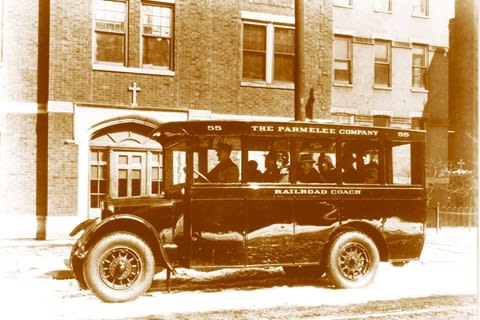
Alt-Fuel Transportation Circa 1930
Chicago’s GO Airport Express began its corporate life as The Parmelee Company in 1853. The company was founded by Frank Parmelee, one of Chicago’s pioneers of mass transit, during the period when horsepower was measured in living, breathing horses. While the company, which recently began converting its airport shuttle fleet to propane autogas, appears to be a newcomer to the alt-fuel market, it actually was a pioneer of alternative-powered motor transportation.
When motorized transportation became commonplace, the company committed to electric vehicles in the 1920s and 1930s, according to Rob Hann, vice president of marketing for GO Airport Express.
Interestingly, to the electric vehicle’s peril, company leadership and drivers didn’t have a healthy case of range anxiety in this pre-electric vehicle infrastructure era, so seeing a Parmelee-owned electric vehicle that had run out of power being towed back to the company garage by one of its stagecoach horses was not uncommon.
Partly because of its lack of range and charging infrastructure, Parmelee’s electric vehicles were phased out, replaced by gasoline-powered internal combustion engine vehicles, which was the exclusive fuel type used by the company until 2012.
Ironically, according to Hann, Parmelee’s horses outlasted the electric vehicle experiment by decades, with the last one dying in the 1950s.
Fact Sheet: GO Airport Express
Founded in 1853 as a railroad transfer service, Continental Air Transport, which does business as GO Airport Express, provides transportation to and from Chicago’s O’Hare and Midway airports. The company also operates charter buses, a limo service, convention shuttles, and provides transportation consulting.
● Number of Vehicles: Up to 120
(depending on the time of year).
● Number of Alt-Fuel Vehicles: 30
dedicated propane-autogas Ford
E-350s; two dedicated CNG Ford E-350s,
and 20 biodiesel transit buses.
● Number of Employees: 250,
including 200 drivers.
More Green Fleet
New Propane Autogas Program Offers Fleet Compensation
Qualified commercial fleets can receive $7,500 per eligible propane autogas vehicle and up to $10,000 for new refueling site prep. Learn how the program works and see whether your fleet qualifies.
Read More →
EV Charging Use Is Outpacing Infrastructure Growth
ChargePoint’s 2026 Charging Forward Report points to rising charger use, higher-powered charging, commercial vehicle electrification, and energy-management technology. Here’s what fleets should know.
Read More →
Merchants Fleet Reports 290M EV Miles as Fleets Navigate Changing Electrification Market
From millions in operating savings to hundreds of millions of EV miles, Merchants Fleet’s latest report reveals what’s working and what’s changing in fleet electrification.
Read More →

The EV Breakdown Nobody's Talking About: Why Most Electric Vehicle Roadside Calls Aren't Mechanical Failures
Here's why EV breakdowns are widely misunderstood.
Read More →
ChargePoint Now Available in Energy Pass
ChargePoint and additional planned charging network integrations were added to GM's Energy Pass.
Read More →

First Look: Slate Auto's Electric Fleet Pickup
Could an affordable, modular EV pickup make electrification more practical for fleets?
Read More →
Slate Debuts Colorful, Unique EV Models
A recent media and client event, studded with electric vehicles dressed up on platforms, planted a new position for the manufacturer in the wider EV market. Fleets will find cost-saving advantages.
Read More →
Slate Electric SUV, Pickup Switchable Model Aims For Light-Duty Fleets
Everything about this EV is counterintuitive and understated, making it stand out from the crowd.
Read More →
Inspiration Mobility Acquires Key Electrada Assets
Inspiration Mobility Group has acquired select assets of Electrada, adding the fleet electrification provider's team, technology, and charging infrastructure development capabilities to its energy management business.
Read More →