




Fuel Prices Trending Upward; Longevity of Trend is Uncertain
This special report will provide an in-depth examination of 2021 operating cost trends for fuel spend, scheduled/unscheduled maintenance, replacement tire prices, PM spend, warranty recovery, and a forecast of CY2022 expenses.


Getty Images
While the COVID-19 pandemic in calendar-year 2020 lowered fleet operating expenses because many vehicles were idled, this was not the case in calendar-year 2021, which witnessed fleet operating expenses increase across the board in all expense categories:
Fuel prices are at their highest in the past seven years.
Tire expenses increased in reaction to the price increases for the raw materials used to manufacture tires.
Preventive maintenance costs have increased due to the ongoing OEM migration to more expensive synthetic motor oils for new models.
Maintenance costs are up due to an uptick in unscheduled maintenance as vehicles are kept in service longer because of the difficulties in sourcing replacement units.
Warranty recovery costs were stressed in 2021 due to extended vehicle cycling and numerous parts shortages delaying repairs and incurring additional soft costs from prolonged downtime.
These, along with other findings. were revealed in Automotive Fleet’s 29th annual operating cost survey and are based on data provided by nine FMC survey partners:
ARI
Donlen
Element Fleet Management
Emkay
Enterprise Fleet Management
LeasePlan USA
Merchants Fleet
Mike Albert Fleet Solutions
Wheels Inc.
This five-part special report will provide an in-depth examination of 2021 operating cost trends in fleet maintenance trends, replacement tire prices, PM expenses, warranty recovery, and a forecast of expenses for CY-2022.
In this article we provide an assessment of the current trends in fuel prices, which represents the largest single operating expense incurred by fleets.
FUEL COSTS TRENDING UPWARD
Gasoline and diesel fuel prices have increased dramatically since the start of the 2021 calendar-year.
“There has been a 34% increase in the cost spent on fuel; however, there has been a decrease of 3.63% on the number of gallons purchased compared to the same time last year. We are seeing a consistent rise in fuel cost which will make it more expensive for overall fleet operations,” said Tori Wroblewski, business analyst for Emkay.
One reason for the decline in gallons purchased has been an increased focus by fleets on route optimization and other fuel reduction strategies.
“Fuel prices have steadily increased since the end of 2020 and some regions are experiencing the highest costs per gallon, we have seen in the last seven years.” said Lindsay Wood, product manager at Wheels. “The increase in fuel cost reinforces the importance of having a well-managed program in place. Fleets are using telematics to optimize routes and educating drivers on proper ways to operate their vehicle to increase fuel efficiency and decrease costs.”
While there has been a dramatic increase in fuel prices in 2021 compared to 2020, it is important to analyze this data in the context of broader macro trends.
“Generally speaking, fuel prices slowly, but steadily increased throughout 2021 while miles driven also normalized for many fleets, returning to pre-pandemic levels. As a result, overall fuel spend increased for the vast majority of organizations as compared to 2020. From a fuel spend perspective, 2020 was a significant outlier as many businesses suspended operations during the pandemic and a number of vehicles sat idle for extended periods. While the delta between this year’s fuel spend and last is certainly noticeable, when you delve deeper into the data, the difference isn’t nearly as troublesome as it appears and likely aligns relatively closely with pre-pandemic metrics,” said Andy Hall, manager, fuel & EV products for ARI.
A big determinant of the overall price of refined fuel, namely gasoline and diesel, is the price of crude oil.
“In 2021, crude oil prices increased over 2020 levels as economic recovery continued,” said Kelley Hatlee, senior service advisor for Enterprise Fleet Management. “It’s also important to note that fuel prices tend decrease during this time of year, but like many aspects of the industry, things may look different in 2021. After Labor Day, fuel prices typically decrease as demand decreases. However, we may see some short-term elevated fuel prices this year resulting from the dramatic reduction of oil production in the Gulf of Mexico during Hurricane Ida and as suppliers recover from the damage done to infrastructure and transportation systems in the region.”
TOOLS TO MITIGATE COST OF FUEL
For many years, fleets have adopted a multi-faceted approach to reduce fuel costs, but lately there has been a renewed interest in investigating the use of alternative powertrains.
“Fleets continue to evaluate improved fuel economy of newer vehicles versus older models. This typically means understanding the impact a hybrid, plug-in hybrid, or electric vehicles would make in specific routes or drivers identified with telematics data looking at daily range, time idling and other considerations,” said Jason Kraus, director – OEM and product management for Mike Albert Fleet Solutions. “Route planning and optimization coupled with gamification for drivers to support positive behaviors also plays a role, as does ensuring that tire pressure is checked regularly based on the impact to fuel economy and tire life. Another area of opportunity is utilizing the available data from fuel and telematics providers to reduce instances of rogue spending through purchases of premium unleaded fuel when standard would suffice and the use of fuel cards in non-fleet vehicles, as well as the impact of unnecessary idling.”
There is a widespread consensus that more companies are investigating the adoption of hybrids and battery-electric vehicles in their fleet operations.
“Companies are rethinking their fleets by going with more fuel-efficient options, such as hybrids and the overall right-sizing of their fleet; a common trend the industry has experienced during hard economic times. With electric vehicles becoming more readily available with various vehicle segment options, the door for many companies to get started with the transition to EVs has already begun,” said Wroblewski of Emkay.
Wheels also observed that more fleets are examining the adoption of alternative powertrains as part of a fuel reduction strategy. “Many fleets are exploring alternative powertrains – hybrids, plug-in hybrid electric, and full battery electric vehicles – to mitigate the cost of fuel. These alternative powertrains do bring some new costs of their own, specifically around infrastructure, but many fleets see the value in the investment that can deliver long-term savings in fuel, as well as CO2,” said Sara Sweeney, senior product manager at Wheels.
In the coming years, the biggest factor that will put downward pressure on fuel prices will be the increased use battery-electric vehicles in both the fleet and retail markets.
“We are seeing an accelerated interest in electrification – meaning both more hybrids being ordered and more interest in battery electric vehicles (BEVs),” said John Wuich, CAFM, vice president of strategic consulting services for Donlen. “About one in four light passenger vehicles ordered in 2021 are hybrids, double that of 2019/2020 and battery electric orders are up 10-fold in 2021 over 2020.”
FUEL PRICE FORECAST FOR 2022
Getty Images
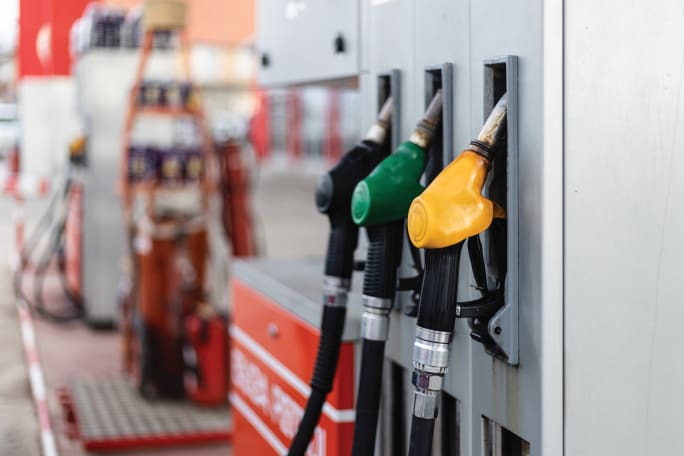
Most industry observers say the ongoing uncertainty in the market makes it difficult to provide short-term forecast on fuel pricing trends. “Similar to other areas of the automotive landscape, there’s still a great deal of uncertainty in terms of fuel projections; however, current forecasts indicate fuel prices may decline slightly in 2022 as production begins to outpace demand. As always, there are numerous variables that contribute to the price of fuel and one minor disruption could quickly reverse that outlook. For example, one area we continue to monitor closely is the potential impact of inflation. That being said, price is certainly top-of-mind for many fleet operators and we have received some inquiries around fuel hedging but for the most part, hedging likely will not be pursued outside a few extremely niche scenarios,” said Hall of ARI.
One unknown variable are the unpredictable external forces may exert upward pressure on fuel prices in CY-2022. “We expect fuel pricing to continue to increase over the next year due to global demand outpacing supply. As cybersecurity risks and weather events threaten global production, fuel pricing will be especially sensitive to increases in the upcoming year,” said Jillian Grenier, assistant director, fleet products for Merchants Fleet. “Geopolitical volatility in petroleum-producing regions will also contribute to rising fuel costs. These factors will continue to drive fleet interest in alternative fueled vehicles and more fuel-efficient internal combustion vehicles.”
Higher Costs Per Transaction
While vehicle quality is at an all-time high, the forecast for overall fleet car and truck maintenance expenses is for per transaction costs to continue to increase even though the frequency of unscheduled maintenance declines or remains flat.
“We foresees maintenance expenses going down; however, the cost per repair going up. As more and more fleet clients move towards higher technology and more fuel-efficient vehicles, which doesn’t require ongoing repairs, it does require a significant amount of diagnosis to determine the cause of an issue. The everyday mechanic must now evolve into a service technician that will require the understanding of completely new systems, diagnostic equipment, and technology. This training will come at a cost to the consumer as an increased cost on repair. In short, the repair may be costly, however, they will be few and far between,” said Tony Hernandez, team lead, truck maintenance for Emkay.
Also, supply chain constraints, such as the current microchip shortage, are a new factors impacting fleet maintenance turnaround rates and uptime.
“The industry continues to see the availability of materials and transportation costs as challenges. Many items such as computer chips and other technology components are on lengthy backorder across several OEMs,” said Dale Jewell, senior director, fleet services operations for Emkay.
2021 OPERATING COSTS: INTERMEDIATE CARS<24,000 MILES24,001-48,000 MILES48,001-88,000 MILES80,001-110,000 MILES CENTS / MILE DOLLARS / MONTH CENTS / MILE DOLLARS / MONTH CENTS / MILE DOLLARS / MONTH CENTS / MILE DOLLARS / MONTH GASOLINE $0.0985 $94.66 $0.0922 $120.53 $0.0913 $139.39 $0.0884 $158.59 OIL $0.0780 $6.49 $0.0086 $10.16 $0.0083 $11.50 $0.0079 $12.67 TIRES $0.0032 $2.67 $0.0063 $7.46 $0.0114 $115.73 $0.0098 $15.69 MAINTENANCE/REPAIR $0.0129 $10.77 $0.0186 $21.94 $0.0293 $40.49 $0.0344 $55.22 WARRANTY/RECOVERY ($0.0000) ($0.01) ($0.0000) ($0.02) ($0.0000)
($0.03)
($0.0000) ($0.01) TOTAL OPERATING COSTS $0.1926 $114.58 $0.1257 $160.07 $0.1403 $207.08 $0.1405 $242.16
2021 OPERATING COSTS: MINIVANS<24,000 MILES24,001-48,000 MILES48,001-88,000 MILES80,001-110,000 MILES CENTS / MILE DOLLARS / MONTH CENTS / MILE DOLLARS / MONTH CENTS / MILE DOLLARS / MONTH CENTS / MILE DOLLARS / MONTH GASOLINE $0.1428 $164.55 $0.1261 $192.80 $0.1220 $213.26 $0.1217 $236.66 OIL $0.0067 $6.78 $0.0077 $10.78 $0.0074 $12.04 $0.0072 $12.98 TIRES $0.0051 $5.23 $0.0090 $12.55 $0.0121 $19.64 $0.0111 $19.93 MAINTENANCE/REPAIR $0.0168 $17.12 $0.0273 $38.25 $0.0430 $69.63 $0.0540 $96.71 WARRANTY/RECOVERY ($0.0000) ($0.00) ($0.0000) ($0.01) ($0.0000) ($0.01) ($0.0000) ($0.00) TOTAL OPERATING COSTS $0.1714 $193.68 $0.1701 $254.37 $0.1845 $314.56 $0.1940 $366.28
2021 OPERATING COSTS: FULL-SIZE VANS<24,000 MILES24,001-48,000 MILES48,001-88,000 MILES80,001-110,000 MILES CENTS / MILE DOLLARS / MONTH CENTS / MILE DOLLARS / MONTH CENTS / MILE DOLLARS / MONTH CENTS / MILE DOLLARS / MONTH GASOLINE $0.2139 $248.11 $0.1880 $284.20 $0.1902 $328.77 $0.1887 $346.76 OIL $0.0035 $33.25 $0.0025 $3.71 $0.0046 $8.33 $0.0073 $12.50 TIRES $0.0020 $1.86 $0.0035 $5.34 $0.0092 $16.57 $0.0138 $23.86 MAINTENANCE/REPAIR $0.0169 $15.78 $0.0151 $22.82 $0.0317 $57.07 $0.0569 $98.36 WARRANTY/RECOVERY ($0.0000) ($0.00) ($0.0000) ($0.00) ($0.0000) ($0.00) ($0.0000) ($0.00) TOTAL OPERATING COSTS $0.2363 $299.00 $0.2091 $316.07 $0.2357 $410.74 $0.2667 $481.48
2021 OPERATING COSTS: SUVS <24,000 MILES 24,001-48,000 MILES 48,001-88,000 MILES 80,001-110,000 MILES CENTS / MILE DOLLARS / MONTH CENTS / MILE DOLLARS / MONTH CENTS / MILE DOLLARS / MONTH CENTS / MILE DOLLARS / MONTH GASOLINE $0.1215 $129.92 $0.1116 $160.92 $0.1101 $188.19 $0.1089 $214.61 OIL $0.0075 $7.19 $0.0088 $11.75 $0.0086 $13.67 $0.0083 $14.86 TIRES $0.0028 $2.67 $0.0078 $10.43 $0.0124 $19.69 $0.0109 $19.47 MAINTENANCE/REPAIR $0.0121 $11.68 $0.0204 $27.18 $0.0354 $56.32 $0.0453 $81.00 WARRANTY/RECOVERY ($0.0000) ($0.01) ($0.0000) ($0.01) ($0.0000) ($0.02) ($0.0000) ($0.02) TOTAL OPERATING COSTS $0.1439 $151.45 $0.1486 $210.27 $0.1665 $277.85 $0.1734 $329.92
2021 OPERATING COSTS: COMPACT CARS <24,000 MILES 24,001-48,000 MILES 48,001-88,000 MILES 80,001-110,000 MILES CENTS / MILE DOLLARS / MONTH CENTS / MILE DOLLARS / MONTH CENTS / MILE DOLLARS / MONTH CENTS / MILE DOLLARS / MONTH GASOLINE $0.1004 $115.20 $0.0929 $128.79 $0.0889 $135.23 $0.0833 $153.60 OIL $0.0067 $6.87 $0.0076 $9.89 $0.0074 $10.80 $0.0072 $12.62 TIRES $0.0026 $2.73 $0.0078 $10.11 $0.0090 $13.22 $0.0079 $13.89 MAINTENANCE/REPAIR $0.0117 $12.07 $0.0210 $27.27 $0.0321 $47.11 $0.0368 $64.45 WARRANTY/RECOVERY ($0.0000) ($0.00) ($0.0000) ($0.00) ($0.0000) ($0.01) ($0.0000) ($0.02) TOTAL OPERATING COSTS $0.1214 $136.87 $0.1293 $176.06 $0.1374 $206.35 $0.1352 $244.54
2021 OPERATING COSTS: LIGHT TRUCKS<24,000 MILES24,001-48,000 MILES48,001-88,000 MILES80,001-110,000 MILES CENTS / MILE DOLLARS / MONTH CENTS / MILE DOLLARS / MONTH CENTS / MILE DOLLARS / MONTH CENTS / MILE DOLLARS / MONTH GASOLINE 0.2023 286.26 0.1781 284.43 0.1763 321.61 0.1792 344.88 OIL 0.0091 9.09 0.0100 14.40 0.0100 16.41 0.0098 17.05 TIRES 0.0051 5.04 0.0104 14.89 0.0156 25.73 0.0154 26.81 MAINTENANCE/REPAIR 0.0176 17.61 0.0267 38.37 0.0405 66.60 0.0518 90.09 WARRANTY/RECOVERY ($0.0000) ($0.00) ($0.0000) (0.00) (0.0000) ($0.01) ($0.0000) ($0.03) TOTAL OPERATING COSTS $0.2341 $267.97 $0.2252 $352.09 $0.2424 $430.34 $0.2562 $478.86
More Global Fleet
GeoFencing Adds to Your Truck Security Arsenal
Geofencing is a familiar fleet tool today, but its early adoption marked a major shift in vehicle tracking, route monitoring, and the debate over employee privacy.
Read More →
Holman Takes Full Ownership of ARIZA in Mexico
Holman is bringing its Mexican fleet management operation fully under its own brand after more than 30 years as a joint venture. The change gives multinational fleet customers a single Holman operation across the U.S., Canada, and Mexico.
Read More →
5 Tire Maintenance Tips to Help Prevent Work Truck Downtime
Regular tire checks can do more than extend tread life. These five maintenance practices can help work truck fleets catch problems early, reduce costs, and prevent downtime.
Read More →

Proven Ways to Reduce Work Truck Downtime
The age-old problem of downtime will always be a reality, but with new strategies at hand, fleets have more ways to keep trucks on the road longer.
Read More →


Cameras, Safety and Insurance: From Reactive Claims to Real-Time Prevention (Part 2 of 2)
Part Two: Commercial auto remains one of the most challenging and costly lines of coverage for fleet operators and insurers alike. Continue learning more about how to effectively address these issues from Onur Aksan, Enterprise Business Development Executive, Geotab
Read More →
Cameras, Safety and Insurance: From Reactive Claims to Real-time Prevention
Commercial auto remains one of the most challenging and costly lines of coverage for fleet operators and insurers alike. Learn more about how to effectively address these issues from Onur Aksan, Enterprise Business Development Executive, Geotab.
Read More →
Fleet Costs Are Rising: Here’s How Leaders Are Responding
Fleet leaders are under pressure to reduce costs, adapt to economic uncertainty, and make smarter decisions. See how peers across North America are responding with real data, proven strategies, and forward-looking insights. Download the 2026 Market Pulse Report to benchmark your strategy and uncover where you can gain an edge.
Read More →
Enterprise Fleet Management Surpasses 900,000 Vehicles in U.S. & Canada
Enterprise Mobility connects with mobility solutions around the globe
Read More →