




Fleet Safety a Winning Value for Modern Transportation's Employees & Company
Modern Transportation, winner of the first annual Fleet Safety Award, has instilled a “culture of safety” within its organization through driver participation, incentives, and education.

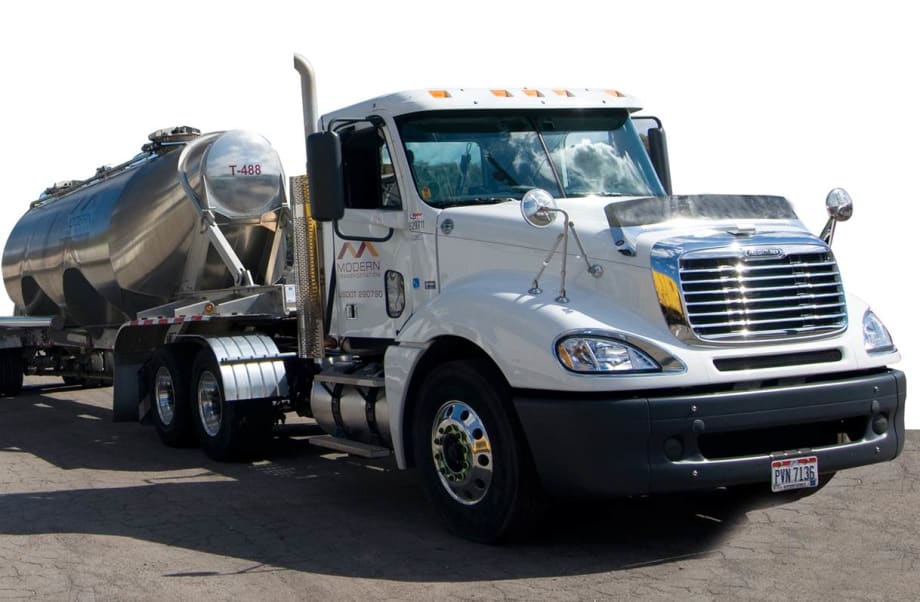
Modern Transportation’s 400 drivers pick up and deliver wet/dry raw materials to manufacturing customers with the use of 300 tractors and 500 trailers.
Modern Transportation’s 400 drivers pick up and deliver wet/dry raw materials to manufacturing customers with the use of 300 tractors and 500 trailers.
Employee safety is so deeply embedded in every aspect of Modern Transportation Services’ corporate culture; it is nearly a living, breathing entity. The company was recently presented the Fleet Safety Award, sponsored by the American Automotive Leasing Association (AALA) and Bobit Business Media, publisher of Automotive Fleet, and selected by the presidents of 10 of the largest fleet management companies.
“Modern Transportation believes the safety and well-being of all its personnel is of the utmost importance. In short, nothing we do is worth hurting ourselves or others,” according to Tammy Evans, vice president of operations, in the company’s “Mission Document.” Indeed, the company’s statement of “mission” begins with a safety-based promise to employees and customers.
Headquartered in suburban Pittsburgh, Modern Transportation provides bulk logistics solutions to customers out of 28 terminals located from the East Coast to the Rocky Mountains. The 25-year-old company’s 400 drivers pick up and deliver wet/dry raw materials to manufacturing customers with the use of 300 tractors and 500 trailers.
Safety Priority Starts at the Top
When he arrived to lead the company in 2006, Modern Transportation President Patrick Cozzens brought a strong background in technology and systems, and a fundamental regard for safety, motivated by the loss of a college friend in a heavy-duty truck crash. A priority from the start was building upon Modern Transportation’s safety culture.
The company evaluated existing safety policies, procedures, and measures, according to Rich Kushner, Modern Transportation’s vice president of sales and marketing. “We took a look at where we were safety-wise and where we wanted to be,” he said.
Spurred by Cozzens’ software systems expertise, the company began building its new safety program on a backbone of safety-oriented technology solutions. Modern Transportation has been an early adopter of — and in some cases, a pilot tester for — Vorad, GreenRoad, PeopleNetwork, DriveCam, SmartDrive, Iteris, and ProTread, among others.
“We’ve pretty much put all the leading onboard safety systems into the truck for the purpose of helping ensure road safety,” Kushner said.
Vorad, the first technology Modern Transportation implemented, is a collision warning system. PeopleNet, the second technology adopted at Modern Transportation, provides real-time truck locations and electronic hours of service logs.
Focusing on the driver, GreenRoad provides an in-vehicle feedback system — a “coach with each driver, each mile, every day,” Evans explained. A simple green-yellow-red light display signals the driver of potentially dangerous events, e.g., harsh braking, abrupt lane changes, or cornering. Real-time data is translated into a driver safety score, based on a scale of 1 to 60. A score of 20 or below is considered safe; over 40 is unsafe.
“We are managing our drivers to scores of less than 10, which is considered very good,” said Evans. “This plays a vital role in our overall safety program as drivers work to improve their driving skills and deliver the lowest scores possible.”
Building a Driver Safety Culture
Driver buy-in and participation begins before drivers are hired. Very strict hiring guidelines are employed, and each job candidate undergoes an online psychometric assessment to determine his or her risk profile, helping spot those with predispositions to risk-taking, road rage, and overall poor attitudes toward safety, Evans explained.
Drivers receive extensive education, including new-hire, needs-based, preventive action, vehicle/equipment-specific, and regularly scheduled training.
“We are strong proponents of corrective action,” Evans said. “If a driver has an issue, we follow a two-path corrective process. First, they must take an online class module on that topic [produced by ProTread] and pass. At the same time, we assign a driver ride-along for peer-to-peer coaching or a manager ride-along.”
Committed driver involvement is further promoted through the company’s performance and safety bonus program, a financial incentive awarded twice a year.
“We establish baseline measures, then we constantly look at GreenRoad scores, motor vehicle reports are crosschecked with our own collision reports, citations, vehicle damage reports, and other factors to determine bonuses,” Evans said.
Competition for such achievements as lowest driver scores or fewest unsafe incidents has originated organically among managers and terminal staffs and helps further underpin the company’s safety ethos.
[PAGEBREAK]
Management Directly Involved
Ongoing, direct management involvement monitors the safety initiatives and helps determine when improvement or refinements can benefit the program.
The company’s safety committee, led by Modern Transportation’s Safety Director Tim Kulhman and comprising Evans, four directors of operations, and the director of equipment and maintenance, meets weekly to review every citation, injury, collision, and equipment issues, and to determine preventability.
During those Monday conference calls, managers also review collisions, accidents, incidents, and GreenRoad scores. Issues at terminals also are discussed (e.g., hazardous road conditions or potentially problematic route changes) and posted within the relevant terminal.
During quarterly ride-alongs with drivers, managers observe driving habits and advise employees. “We observe how they interact with clients. We make sure they are wearing their safety gear. We coach them in real-time so there is a sense of continuous, shared improvement,” Evans said.
She also visits terminals and participates in drive-alongs. “We encourage drivers to identify and communicate unsafe road conditions,” she said.
On a recent drive-along, for example, an employee showed Evans a pothole that was causing unsafe turns and was recording a high GreenRoad score.
“The driver demonstrated why the score was high and enabled us to talk with all the drivers on how they could adjust, slow down at that turn, to be safe in that zone,” Evans said.
Selling the ‘Why’ is Essential
No matter how effective the technology, Modern Transportation has learned “we cannot simply instill within the organization’s culture a mindset of ‘safety first and safety always,’ ” Evans pointed out. “Drivers must understand the ‘why’ behind a safety policy before they will fully commit to the new behavior.”
For example, Evans partnered with the company’s insurance provider, Great West, to prepare a PowerPoint presentation before launching a 2011 safety initiative — a 62-mph speed limit for nearly all Modern Transportation drivers.
The educational presentation demonstrated the escalating relationship of impact damage from kinetic energy released as truck velocities rise. The powerful lesson was embraced by managers and drivers, Evans reported, and helped ease adoption of the new 62-mph limit.
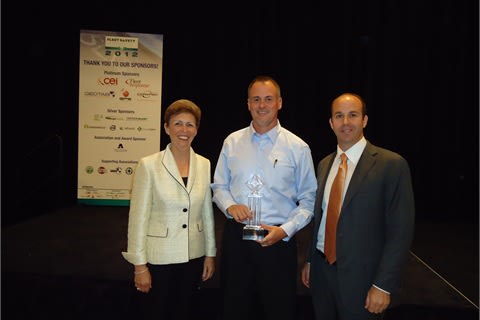
Alex Forrest (center), director of operations for Modern Transportation, accepted the 2012 Fleet Safety Award on behalf of the company from the American Automotive Leasing Association’s Pam Sederholm and Dan Frank of Wheels.
Safety First Saves Lives & Costs
Technology systems, driver training, accident and incident data-mining, and manager involvement have significantly improved Modern Transportation’s safety record. The benefits surely mean lives saved, injuries avoided, and accident expenses cut. Other benefits, however, relate directly to the bottom line. The company is now ranked in Great Western’s elite category for safety performance and enjoys reduced rates.
Additionally, the 62-mph speed restriction not only helped boost Modern Transportation’s safety record, but also “improved fuel efficiency dramatically,” Kushner said.
The commitment to safety will continue. “We are always looking for ways to improve,” Evans said. “We embrace new technologies and solutions and are always leaders in piloting and adopting new ways to improve safety performance.”
The bedrock of that commitment rests firmly on the company’s promise to employees, “We value you and your safety above anything else.”
More Safety

Fleet Manager’s Ultimate Playbook: Navigating the New Standard in OEM Connectivity
Rising operating costs, driver safety concerns, and unplanned downtime are putting unprecedented pressure on modern fleets. Discover how fleet managers use embedded OEM connectivity and real-time vehicle data to cut TCO, prevent downtime, and protect drivers without aftermarket telematics hardware.
Read More →
From Driver Well-Being to EV Charging | AF News Recap
Mental health belongs in the fleet safety conversation. This week, we’re looking at five ways fleets can support employee well-being before a crisis, plus Holman’s expansion in Mexico, new one-day Fleet Forward passes, and why EV charging demand is outpacing infrastructure growth.
Read More →
Nexar-Nauto Merger Aims to Give Fleets Better Safety Intelligence Through Larger Driving Dataset
Stefan Heck tells Automotive Fleet that combining more than 10 billion miles of driving history with Nexar's AI models will give fleets deeper insights into driver risk and roadway conditions than either company could provide independently.
Read More →
Don't Wait for a Crisis: 5 Ways to Build Mental Health Into Your Fleet Safety Program
For Suicide Prevention Month, fleet and safety leaders have an opportunity to put mental health where it belongs: at the center of workplace safety.
Read More →
How Camera Data Can Strengthen a Fleet’s Insurance Renewal
Insights from a commercial insurance carrier and a broker show how fleets can turn video telematic data, driver coaching, and improved claims results into a stronger case at insurance renewal.
Read More →
The Safest Fleets Aren’t the Ones with the Most Technology
You’ve made the telematics investment. Here’s how to capture the other half of its value and build the safest fleet on the road.
Read More →
Hidden in Plain Sight: Fleet Compliance Risks
Fleet compliance isn't just about having policies — it's about consistently enforcing them. This practical guide reveals six hidden compliance risks common in public sector and shared fleet operations and outlines proven strategies to improve visibility, accountability, and audit readiness
Read More →
NETS Sets 2026 Fleet Safety Benchmark Conference for Indianapolis
The Sept. 15–17 program will feature fleet benchmarking data, case studies, emerging technologies, and implementation strategies while running alongside the NSC Safety Congress & Expo.
Read More →
Off-the-Job Crashes Account for 43% of Employers’ $61.7 Billion Crash Burden
NETS quantifies costs dispersed across fleet, risk, HR, and other departments while providing new per-crash benchmarks for employers.
Read More →
Ram Recalls More Than 1.27 Million 1500 Pickups for Seat Belt Anchor Issue
The recall affects certain 2019-2026 Ram 1500 pickups that may have improperly attached second-row seat belt buckle anchors.
Read More →