




Fleet Managers Prove Their Mettle at Mercedes' AMG Driving Academy
Participating in an intense one-day program were 25 fleet professionals, who learned about performance driving dynamics and how to safely react during emergency traffic situations, such as wet cornering and sudden lane changes.

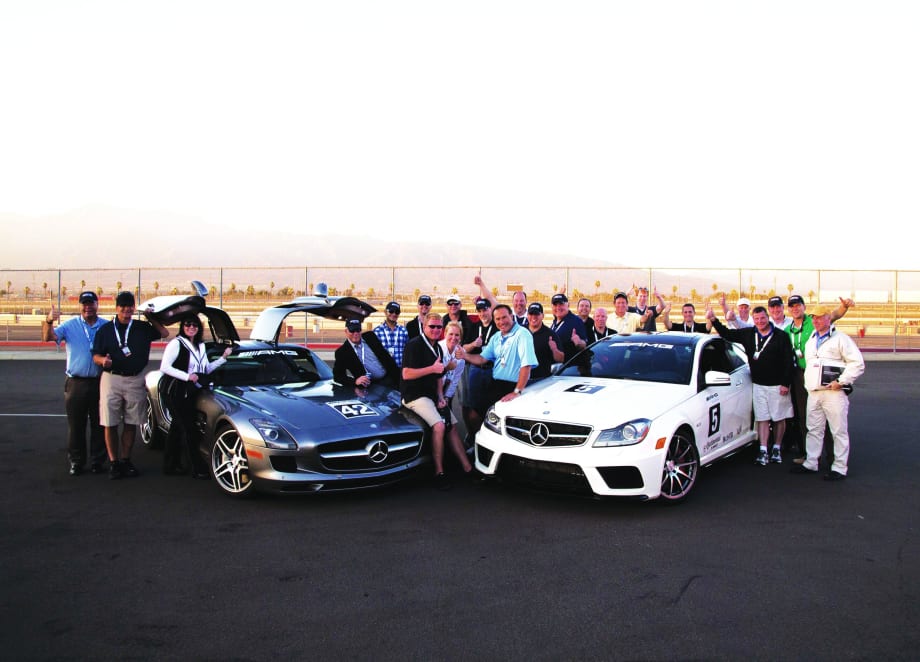
Gathered around an SLS AMG (left) and CL63 AMG, fleet professionals give a thumbs up after completing a one-day AMG Driving Academy at the Auto Club Speedway in Fontana, Calif.
Gathered around an SLS AMG (left) and CL63 AMG, fleet professionals give a thumbs up after completing a one-day AMG Driving Academy at the Auto Club Speedway in Fontana, Calif.
In the auto industry, if you want to showcase the capabilities of your vehicles, you put people behind the wheel. Likewise, from a fleet manager perspective, if you want employees to be safer drivers, it helps to know the driving skills necessary to be a safe driver. With this in mind, Mercedes-Benz Fleet Operations took the opportunity to showcase the performance capabilities of its line of AMG vehicles, along with teaching safe driving skills, during an intense one-day track program offered by the AMG Driving Academy.
The event was held Oct. 24, 2012, at the Auto Club Speedway in Fontana, Calif., which has the reputation of being the fastest race track on the West Coast.
Founded by Mercedes-AMG in 2007, the Driving Academy offers three levels of courses — Basic, Advanced, and Pro. Attending fleet managers participated in the one-day Basic course. The program focused on learning about performance driving dynamics and training drivers on how to react safely while behind the wheel.
The AMG Driving Academy provided participants with a large selection of AMG models to drive, including the 583 horsepower SLS AMG, SLK55 AMG, CL63 AMG, CLS63 AMG, E63 AMG, and SL63 AMG with an amazing 664 lb.-ft. of torque.
Fleet Driving Academy
The event opened with a technical presentation about the fundamentals of vehicle dynamics and controlled maneuvers. The instructors also explained the importance of proper seating position, steering wheel control, and maintaining a correct line of sight.
The morning was broken out into four 50-minute exercises. The training focused on understeer and oversteer, slalom and lane-change maneuvers, as well as braking and evasive maneuvers around cones.
One exercise was the agility slalom. Attendees drove the SLK55 AMG equipped with a V-8 engine with 398 lb.-ft. of torque during the high-speed slalom. The purpose of the agility slalom is to demonstrate the dynamic driving capabilities of AMG vehicles.

A line of SLS AMGs in the paddock await the go-ahead to conduct high-speed exercises on the oval track.
Next, attendees tested the performance of the E63 AMG and CLS63 AMG during a drag race while braking within a stop box. The purpose of the exercise was to demonstrate the power of AMG vehicles’ low-end torque. From a driver’s perspective, the drag race was designed to improve estimation of stopping distance versus speed.
Another exercise included a skid pad to practice wet cornering skills, demonstrating the benefit of the vehicle’s electronic stability program. The exercise was also designed to provide drivers with a better understanding of how to address understeer and oversteer situations. In addition, the skid pad exercise included the proper use of ABS brakes during a sudden lane change. The lane change exercise, replicating an unanticipated traffic event, demonstrated how maximum brake application while in a proper seating position allows a driver to safely negotiate this situation. It was also designed to develop the driving habit of looking ahead to see where you want to go. The C63 AMG was used in the wet skid pad exercise and the autocross course.
Once fleet attendees perfected vehicle control and handling, they progressed to a set of high-speed exercises on the oval track. All fleet managers were supplied head socks and safety helmets for high-speed follow-the-lead-car laps, which included walkie-talkie communication from the instructor in the lead car to identify braking zones, and turn-in points. The C63 AMG was used on the oval track, along with the SLS AMG and SL63 AMG. Groups practiced lead-follow exercises, culminating in an autocross competition.
One highlight of the event was riding as a passenger in an SLS driven by a professional AMG instructor, who pushed the car near its limit.
The day ended with a victory ceremony and award presentations.
Origin of the AMG Performance Division
In 1967, Hans Werner Aufrecht and Erhard Melcher, two former Mercedes-Benz engineers with a passion for motorsports, began fine-tuning engines for Mercedes-Benz racecars in an old mill. The acronym “AMG” stands for Aufrecht, Melcher, and Großaspach, Aufrecht’s birthplace.
Today, Mercedes-AMG GmbH, commonly known as AMG, is the performance division of Mercedes-Benz and a wholly owned subsidiary of Daimler AG. It is headquartered in Affalterbach, Germany.
AMG models are typically the most expensive and highest performance of each Mercedes class. AMG models are usually badged with two numerals, as opposed to non-AMG Mercedes-Benz models, which have three.
Mercedes-Benz USA’s Four-Pronged Fleet Strategy
Mercedes-Benz USA Fleet Operations employs a four-pronged fleet program.
The first prong is the VIP (Volume-Based Incentive Program) Fleet Program for companies with a Corporate Account Number (CAN) or 15 vehicles in the fleet, which are registered in the company name.
The second prong is the Fleet Employee Program (FEP). For employees to be eligible, their company must be on the FEP eligibility list. This program can be combined with retail programs.
The third prong is the Affinity Program. This is available to a certified association member.
The fourth prong is the Executive Allowance Bonus (EAB). Executives must work for a company that has a CAN or be able to qualify for CAN. In addition, the driver must receive a monthly car allowance.
More Safety

Fleet Manager’s Ultimate Playbook: Navigating the New Standard in OEM Connectivity
Rising operating costs, driver safety concerns, and unplanned downtime are putting unprecedented pressure on modern fleets. Discover how fleet managers use embedded OEM connectivity and real-time vehicle data to cut TCO, prevent downtime, and protect drivers without aftermarket telematics hardware.
Read More →
From Driver Well-Being to EV Charging | AF News Recap
Mental health belongs in the fleet safety conversation. This week, we’re looking at five ways fleets can support employee well-being before a crisis, plus Holman’s expansion in Mexico, new one-day Fleet Forward passes, and why EV charging demand is outpacing infrastructure growth.
Read More →
Nexar-Nauto Merger Aims to Give Fleets Better Safety Intelligence Through Larger Driving Dataset
Stefan Heck tells Automotive Fleet that combining more than 10 billion miles of driving history with Nexar's AI models will give fleets deeper insights into driver risk and roadway conditions than either company could provide independently.
Read More →
Don't Wait for a Crisis: 5 Ways to Build Mental Health Into Your Fleet Safety Program
For Suicide Prevention Month, fleet and safety leaders have an opportunity to put mental health where it belongs: at the center of workplace safety.
Read More →
How Camera Data Can Strengthen a Fleet’s Insurance Renewal
Insights from a commercial insurance carrier and a broker show how fleets can turn video telematic data, driver coaching, and improved claims results into a stronger case at insurance renewal.
Read More →
The Safest Fleets Aren’t the Ones with the Most Technology
You’ve made the telematics investment. Here’s how to capture the other half of its value and build the safest fleet on the road.
Read More →
Hidden in Plain Sight: Fleet Compliance Risks
Fleet compliance isn't just about having policies — it's about consistently enforcing them. This practical guide reveals six hidden compliance risks common in public sector and shared fleet operations and outlines proven strategies to improve visibility, accountability, and audit readiness
Read More →
NETS Sets 2026 Fleet Safety Benchmark Conference for Indianapolis
The Sept. 15–17 program will feature fleet benchmarking data, case studies, emerging technologies, and implementation strategies while running alongside the NSC Safety Congress & Expo.
Read More →
Off-the-Job Crashes Account for 43% of Employers’ $61.7 Billion Crash Burden
NETS quantifies costs dispersed across fleet, risk, HR, and other departments while providing new per-crash benchmarks for employers.
Read More →
Ram Recalls More Than 1.27 Million 1500 Pickups for Seat Belt Anchor Issue
The recall affects certain 2019-2026 Ram 1500 pickups that may have improperly attached second-row seat belt buckle anchors.
Read More →