




Fleet Crashes Flat Year Over Year
Despite being flat, crashes are still a problem for fleets, and data reported for the 2017 calendar-year has identified some of the biggest obstacles.


Photo courtesy of iStockphoto.com via Creativaimage.
Curbing driver crashes remains a major focus for fleets, despite recent data showing that these incidents in 2017 have been flat year-over-year.
Further still, preliminary data for 2018 from the National Highway Traffic Safety Administration (NHTSA) has observed a 3.6% drop in traffic fatalities. So while things may have evened out, crashes remain a persistent problem for fleets, and the reduction of preventable accidents such as distracted driving is one way to reduce the issue.
“Preventable accidents are always going to be the most crucial accident type to address, since it is the accident type drivers have the most control over,” said Chris Villella, VP, strategic relationship management for The CEI Group. “That style of training is usually followed by defensive driving techniques that can help drivers prevent accidents, even when the type of accident that would have occurred would not be deemed preventable.”
Jerry Veres, certified director of safety for Fleet Response, observed one of the largest reasons for preventable accidents is distracted driving.
“Whether it’s hitting a stationary object or backing into something, most of it can be avoided when a driver removes all distractions,” said Veres. “However, the one other piece that drivers can be taught is how to avoid situations that increase their chances for an accident. For example, parking away from other cars, or in a spot that avoids backing when you leave, can help to avoid the rear-end accidents in busy parking lots.”
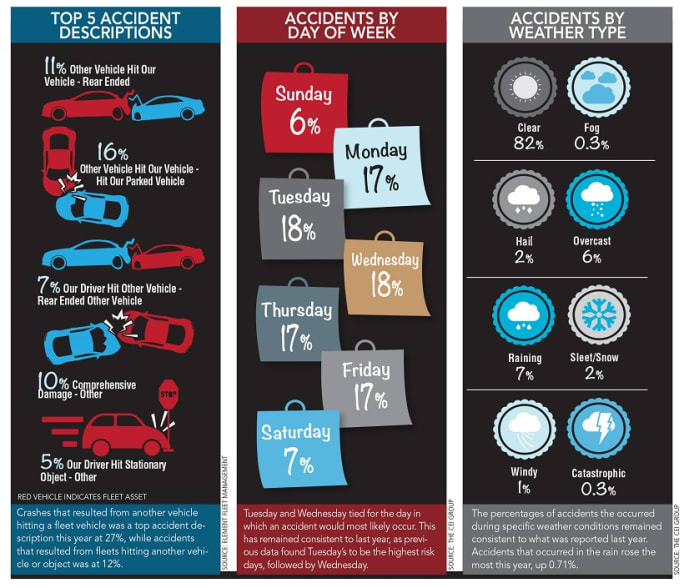
Data courtesy of The CEI Group
Data this year found that two of the top five incident descriptions listed for the survey were the result of crashes involving stationary objects and within parking lots.
Beyond distracted driving, an increase in drivers on the road in recent years has contributed to the rising number of accidents over the last few years, despite it being flat as of late.
“It’s been pretty flat, but if you would compare the data over a three or four-year period, accidents have gone up and that is due to the lowering of prices for gas,” said Veres. “When you have lower gas prices you have more people on the road, which means opportunity for accidents.”
Meanwhile, the increasing ubiquity of in-vehicle safety technology is one such solution designed to reduce this issue, but has not necessarily been the case. Proper training may improve the effectiveness of the technology.
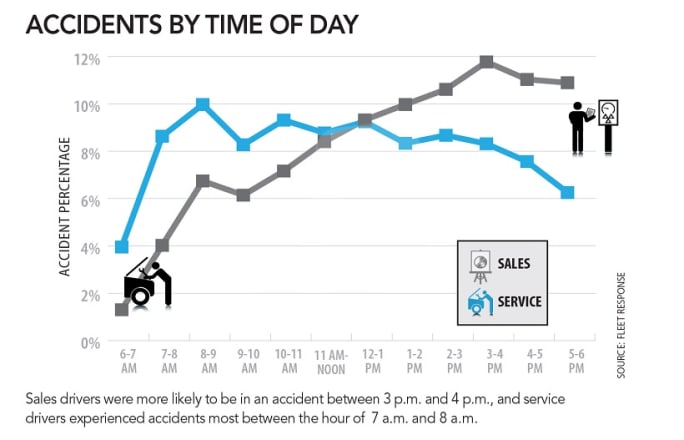
Data courtesy of Fleet Response
“New vehicle technology is making drivers complacent. As back-up cameras have become more prevalent, more and more backing accidents have been cropping up, which seems surprising until you realize the cause – drivers are using just the camera and not turning around to check all the angles,” said Villella. “Now we have cars with adaptive cruise control and emergency braking systems becoming more commonplace, so we remind fleets that drivers need training on new vehicle systems.”
Looking at the Data
Other tangential fleet safety data reported for calendar-year 2017 showed fluctuations compared with what was reported the previous year. For example, there has been a small rise in accidents of drivers between the ages of 46 to 54, though the numbers reported don’t tell the entire story.
“It is important to point out that we are giving percentage of accidents by age, but we aren’t sharing the percentage of drivers in each age group on the road,” said Veres. “With the working population getting older as employees are delaying retirement, distribution of accident percentages can seem higher in certain age ranges.”
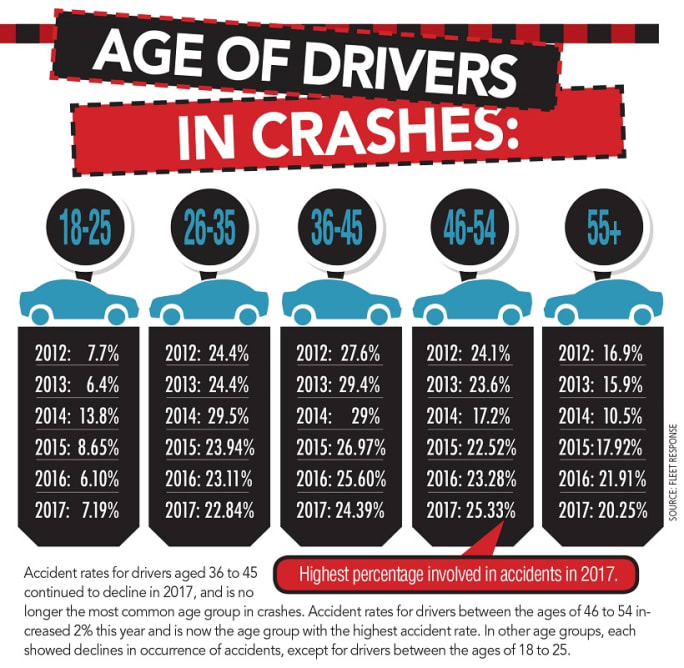
Data courtesy of Fleet Response
This, and other data in this study, creates a niche window that fleets can analyze to benchmark against their operations.
“Charting the data helps us look for trends in data and changes year-to-year to help companies be proactive in areas where they can train employees relative to incidents based on age and time of day,” said Veres. “Companies can utilize this data as benchmarking percentages and compare our provided information relative to their fleets.”
After further benchmarking and analysis, fleets can work with safety professionals in order to implement the appropriate safety policies in an effort to eliminate problem areas.
“We are working with our customers to ensure that all safety policies have a very thorough and clearly stated no tolerance policy on distracted driving, and we support those who are implementing in-vehicle solutions such as cell service blockers and phone apps that ensure limited phone interaction and blocks all incoming calls while driving,” said Villella.
Related: Parked Vehicle Damage Leads Fleet Accidents
More Safety

Fleet Manager’s Ultimate Playbook: Navigating the New Standard in OEM Connectivity
Rising operating costs, driver safety concerns, and unplanned downtime are putting unprecedented pressure on modern fleets. Discover how fleet managers use embedded OEM connectivity and real-time vehicle data to cut TCO, prevent downtime, and protect drivers without aftermarket telematics hardware.
Read More →
From Driver Well-Being to EV Charging | AF News Recap
Mental health belongs in the fleet safety conversation. This week, we’re looking at five ways fleets can support employee well-being before a crisis, plus Holman’s expansion in Mexico, new one-day Fleet Forward passes, and why EV charging demand is outpacing infrastructure growth.
Read More →
Nexar-Nauto Merger Aims to Give Fleets Better Safety Intelligence Through Larger Driving Dataset
Stefan Heck tells Automotive Fleet that combining more than 10 billion miles of driving history with Nexar's AI models will give fleets deeper insights into driver risk and roadway conditions than either company could provide independently.
Read More →
Don't Wait for a Crisis: 5 Ways to Build Mental Health Into Your Fleet Safety Program
For Suicide Prevention Month, fleet and safety leaders have an opportunity to put mental health where it belongs: at the center of workplace safety.
Read More →
How Camera Data Can Strengthen a Fleet’s Insurance Renewal
Insights from a commercial insurance carrier and a broker show how fleets can turn video telematic data, driver coaching, and improved claims results into a stronger case at insurance renewal.
Read More →
The Safest Fleets Aren’t the Ones with the Most Technology
You’ve made the telematics investment. Here’s how to capture the other half of its value and build the safest fleet on the road.
Read More →
Hidden in Plain Sight: Fleet Compliance Risks
Fleet compliance isn't just about having policies — it's about consistently enforcing them. This practical guide reveals six hidden compliance risks common in public sector and shared fleet operations and outlines proven strategies to improve visibility, accountability, and audit readiness
Read More →
NETS Sets 2026 Fleet Safety Benchmark Conference for Indianapolis
The Sept. 15–17 program will feature fleet benchmarking data, case studies, emerging technologies, and implementation strategies while running alongside the NSC Safety Congress & Expo.
Read More →
Off-the-Job Crashes Account for 43% of Employers’ $61.7 Billion Crash Burden
NETS quantifies costs dispersed across fleet, risk, HR, and other departments while providing new per-crash benchmarks for employers.
Read More →
Ram Recalls More Than 1.27 Million 1500 Pickups for Seat Belt Anchor Issue
The recall affects certain 2019-2026 Ram 1500 pickups that may have improperly attached second-row seat belt buckle anchors.
Read More →