




Finding the Right Car to Match Your Rental Rate
As a small fleet, how much can your company pay for a vehicle and still profit in a rate-competitive environment? Here are some tips to help work toward a holding cost that is 40% of revenue.

You have the proper fleet size to match the annual rental demand curve. You have the proper fleet mix to match the rental demand by car class. Your fleet operating expenses for maintenance, repair, insurance and other factors are all in line.
Additionally, your non-fleet related expenses for personnel, occupancy, advertising and administration are in order.
Will you be profitable? Maybe yes or maybe no.
For proper fleet planning in the car and truck rental industry, the right fleet size and fleet mix serve as the benchmarks. But there is a third component that’s also important in today’s rate-competitive marketplace: paying the right price for your fleet vehicles.
The right price is achieved by acquiring vehicles whose holding costs conform to the rate constraints of each car class. Defined as the cost of having a car in the fleet that’s available to rent, “holding cost” includes the gain or loss on disposal plus vehicle depreciation, interest and lease expense.
I run profit group meetings (similar to auto dealer “20 groups”) for corporate- and individually-owned rental operations with as few as 50 cars to several thousand cars. The holding costs of the most profitable members of the group average 40% of revenue or below.
With these tips, you, too, could work toward a holding cost that is 40% of revenue.
Conforming Holding Costs to Rate
The first step is to establish the prevailing rental rates by car class and rate category for each competitor in your market. As an example, let’s look at Richmond, Va. On May 26, I surveyed nine car rental companies in Richmond for daily, weekly and weekend rates for an intermediate size car.
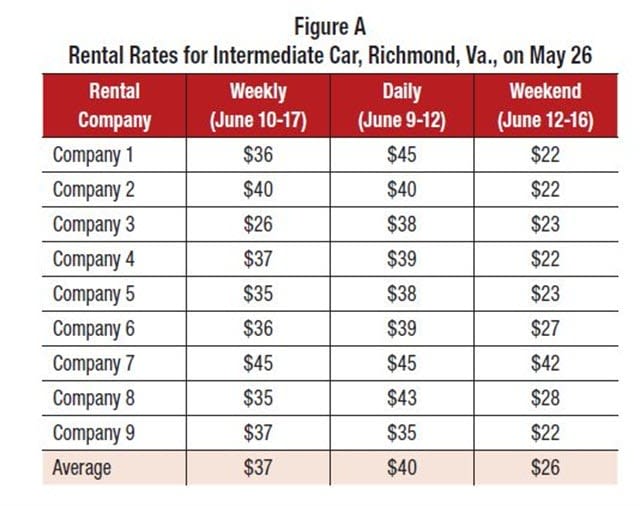
In the first step, I established the average daily rate for an intermediate car when looking at a weekly, daily and weekend rental. This is just a simple average of each rate category and competitor. The rates and the time periods are listed in Figure A.
[PAGEBREAK]
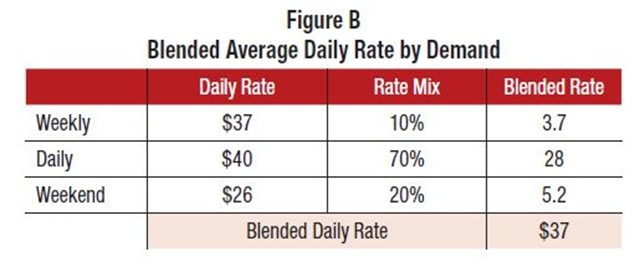
The second step is to find the blended daily rate from the weekly, daily and weekend rates. To begin, establish your fleet’s demand by rate category. A general rule of thumb is that 70% of rental business comes at a daily rate, 20% are at weekend rates and 10% are at weekly rates.
You can change these percentages based on your scenario.
These weightings are applied to Figure B. In this analysis, an intermediate car’s blended daily rate is $37.
This revenue per day (RPD) — also known as “daily dollar average” — must also consider incremental sales.
Incremental sales consist of coverage options such as a collision damage waiver, personal accident insurance, personal effects coverage, supplemental liability insurance, underage driver, roadside assistance coverage and product offerings such as GPS, Wi-Fi hotspots and baby seats.
In 2013, the average incremental sale for the U.S.-based profit group members was $6 per day. In this scenario, by adding our blended average daily rate to $6, the average RPD is $43.
Next, understand the revenue per unit, per month (RPU) — the basis to establish a holding cost that is 40% of revenue. We do this by factoring in utilization:
revenue per day (RPD) x utilization = revenue per unit (RPU)
Surviving in Richmond
So, how much can you afford to pay for a car and still profit in a rate-competitive environment? We’re ready to answer the question.
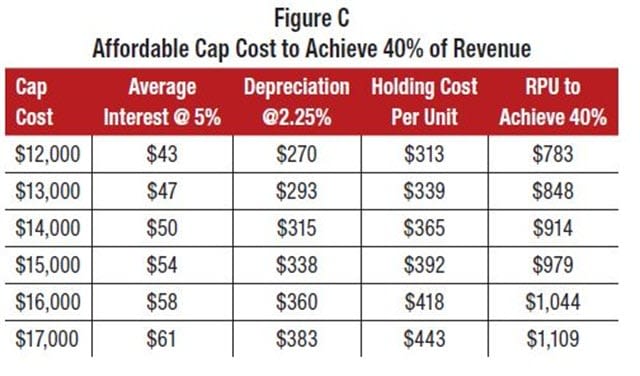
The data in Figure C shows the RPU needed to achieve our desired holding cost per unit that is 40% of revenue. Let’s assume a 5% interest rate and the cars are depreciating at 2.25% per month. For a car with a capitalized cost of $12,000, you’ll need an RPU of $783.
[PAGEBREAK]
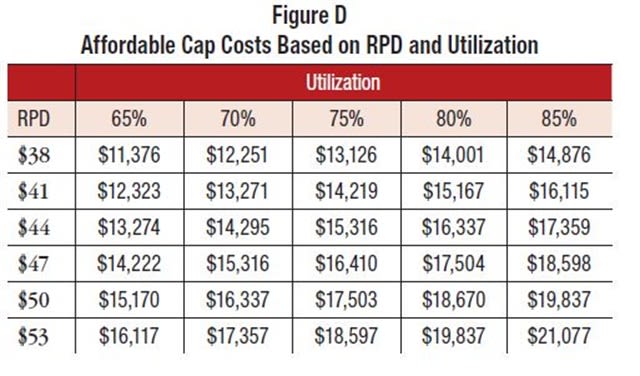
Let’s now look at our 40% threshold through the lens of utilization (Figure D). For example, with an average RPD of $44 — just over the average of the profit group — you can afford a car with a capitalized cost of $14,295, assuming 70% utilization.
As you can see, the higher the utilization, the lower the RPD you’ll need. And the greater the capitalized cost, the higher the RPD you’ll need for a more costly vehicle.
To establish the maximum cap cost per car, this exercise should be conducted for each rate category.
About the Author

Since 1985, Wayne Webb has conducted profit group (20 group) meetings for corporate- and individually-owned rental operations in the U.S., Canada, South and Central America and Europe.
Wayne Webb will be participating in the 2014 Auto Rental Summit's "Fleet Jam Session," an intensive, three-hour workshop on fleet planning, funding, sales and remarketing. Visit www.autorentalsummit.com for more information.
Originally posted on Auto Rental News
More Global Fleet

Holman Takes Full Ownership of ARIZA in Mexico
Holman is bringing its Mexican fleet management operation fully under its own brand after more than 30 years as a joint venture. The change gives multinational fleet customers a single Holman operation across the U.S., Canada, and Mexico.
Read More →
Proven Ways to Reduce Work Truck Downtime
The age-old problem of downtime will always be a reality, but with new strategies at hand, fleets have more ways to keep trucks on the road longer.
Read More →
The Top 300 Commercial Fleets
The Top 300 Commercial Fleets: See the List
Read More →

Cameras, Safety and Insurance: From Reactive Claims to Real-Time Prevention (Part 2 of 2)
Part Two: Commercial auto remains one of the most challenging and costly lines of coverage for fleet operators and insurers alike. Continue learning more about how to effectively address these issues from Onur Aksan, Enterprise Business Development Executive, Geotab
Read More →
Cameras, Safety and Insurance: From Reactive Claims to Real-time Prevention
Commercial auto remains one of the most challenging and costly lines of coverage for fleet operators and insurers alike. Learn more about how to effectively address these issues from Onur Aksan, Enterprise Business Development Executive, Geotab.
Read More →
Fleet Costs Are Rising: Here’s How Leaders Are Responding
Fleet leaders are under pressure to reduce costs, adapt to economic uncertainty, and make smarter decisions. See how peers across North America are responding with real data, proven strategies, and forward-looking insights. Download the 2026 Market Pulse Report to benchmark your strategy and uncover where you can gain an edge.
Read More →
Enterprise Fleet Management Surpasses 900,000 Vehicles in U.S. & Canada
Enterprise Mobility connects with mobility solutions around the globe
Read More →
Automotive Fleet's Guide to Fleet Electrification
Unlock the secrets to a successful transition to electric fleets with Automotive Fleet's comprehensive Fleet Electrification Guide!
Read More →
Sumitomo Rubber Industries to Acquire Viaduct
Viaduct will join Sumitomo as an independent subsidiary. Partnership strengthens global reach and accelerates AI-driven innovation for fleets and manufacturing.
Read More →