




E-85 Coming to a Station Near You
Though ethanol use has been largely viewed as a Midwestern phenomenon, ethanol biorefineries are now popping up all across the country.
For fleet owners and fleet managers who have invested in flexible-fuel vehicles (FFVs) capable of running on ethanol blends up to 85 percent (E-85), the enactment of new energy legislation late in 2007 was welcome news. The new law will provide the U.S. ethanol industry the foundation it needs to become a significant component of the motor fuel market and move ethanol beyond just a blending component in gasoline.
The Nuts and Bolts
The Energy Independence and Security Act of 2007 (EISA) will be looked upon as an historic moment in respect to how the U.S. fuels its future. For the first time, a roadmap is in place that begins to make dramatic strides in reducing our dependence on motor fuels derived from fossil fuels.
Specifically, the EISA calls for the use of 36 billion gallons of renewable fuel annually by 2022. The vast majority of that fuel will be ethanol. For fleet managers and operators, several provisions are worth noting.
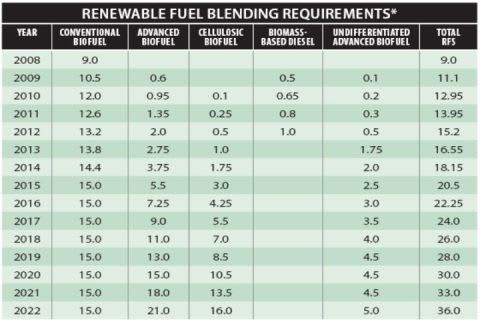
First, the EISA accelerates current renewable fuels standard (RFS) dramatically. Beginning this year, gasoline marketers and refiners are required to blend 9 billion gallons of renewable fuel. From there, the schedule for use requirements progresses until the nation reaches its goal of 36 billion gallons of annual renewable fuel use in 2022.
While 10-percent blends may not concern fleet operators, it is important to realize increasing lower-level ethanol blends will help accelerate the development of E-85 infrastructure and distribution. With more markets blending ethanol, retailers will find it easier to offer E-85 since sufficient volumes of ethanol will be available in the local marketplace. (See chart for renewable fuel blending requirements.)
Second, the EISA amends the Petroleum Marketing Practices Act, making it unlawful for a franchiser to prohibit a franchise from installing E-85 or B-20 (20-percent biodiesel/80-percent diesel) tanks and pumps within the franchise agreement. This provision clears up any confusion franchises may have encountered when seeking to offer E-85 at their retail stations. Additionally, the new law requires the Secretary of Energy report to Congress on the market penetration of FFVs and the feasibility of requiring fuel retailers to install E-85 infrastructure.
To encourage expansion of E-85 refueling infrastructure, a $200 million grant program was established to help defray some of the cost.
Of direct impact on federal fleet operators, the EISA instructs each federal agency head to install at least one renewable fuel pump at every federal fleet refueling station across the country by Jan. 1, 2010. Federal fleet operators are already aware they are required to use renewable fuels where available, but have problems gaining access to high-level ethanol or biodiesel blends. This provision makes it easier on federal fleets.
Building Nationwide Infrastructure
To date, ethanol has largely been viewed as a niche, Midwestern phenomenon. Understandably so, since much of the production and availability of high- level ethanol blends is concentrated in the traditional “Corn Belt.” As our nation looks for ways to diversify its motor fuel supply, ethanol and other renewable fuels are growing in importance.
Ethanol biorefineries are opening across the country from the coastal regions of the Pacific Northwest to the pine forests of southern Georgia. With the development of ethanol production from cellulosic feedstocks — switchgrass, wood waste, and municipal solid waste — in addition to grain, the ability to produce ethanol anywhere from anything will open up new markets to ethanol blending and ensure sufficient volumes of production materialize to supply a growing E-85 market.
With production of fuel ethanol growing at a rapid pace, the need to develop the infrastructure to transport, store, blend, and distribute ethanol-blended fuels grows as well. The good news: it is coming.
Today, some 1,500 stations offer E-85 across the country. Increasingly, these stations are located in areas unfamiliar with ethanol, for example, Texas, Arizona, and the Gulf Coast. As the use of ethanol increases as a blending component with gasoline, so too, will the availability of high-level ethanol blends such as E-85.
To ensure lower-level ethanol blends reach the market, infrastructure must be developed in places such as New York, Florida, Nevada, and Oregon to store and deliver the products to market. That infrastructure, too, is expanding.
Petroleum and gasoline storage terminals are maximizing capacity for larger volumes of ethanol and investing in ethanol offloading facilities that can handle 90-plus unit trains of ethanol tank cars. Likewise, ethanol producers are investing in the infrastructure needed to ship these larger ethanol cargoes.
Certifying High Level Ethanol Blends
Managers of large FFV fleets are most assuredly aware of the current testing Underwriters Laboratory (UL) is conducting on E-85 pump components. The nation’s ethanol industry, along with its fuel retailing customers, is committed to safety and supports the work UL is undertaking. The ethanol industry, and the more than 1,500 retailers offering E-85, are all confident in the performance and safety of E-85 refueling pumps and believe that UL will complete its work in as rapid a timeframe as is responsible.
Upon UL certification, the path then clears for many large box stores to move forward on plans to install E-85 refueling pumps at a number of their locations. Such moves will undoubtedly make life much easier for individuals and fleets who purchase FFVs.
Ethanol and other renewable fuels are quickly becoming a more meaningful component of our nation’s motor fuel supply. As the new law begins to work its way through the entire distribution chain, the availability of ethanol at all certified blend levels will increase. More stations will feel confident in installing E-85 refueling infrastructure since supply won’t be in question and as automakers offer more vehicles capable of utilizing the fuel.
In all, investments made by fleet owners and operators in renewable fuel vehicles will be proven wise. The fuel and infrastructure are coming.
For more information on the EISA of 2007 or the U.S. ethanol industry, log on to www.ethanolRFA.org.
More Green Fleet

EV Charging Use Is Outpacing Infrastructure Growth
ChargePoint’s 2026 Charging Forward Report points to rising charger use, higher-powered charging, commercial vehicle electrification, and energy-management technology. Here’s what fleets should know.
Read More →
Merchants Fleet Reports 290M EV Miles as Fleets Navigate Changing Electrification Market
From millions in operating savings to hundreds of millions of EV miles, Merchants Fleet’s latest report reveals what’s working and what’s changing in fleet electrification.
Read More →
The EV Breakdown Nobody's Talking About: Why Most Electric Vehicle Roadside Calls Aren't Mechanical Failures
Here's why EV breakdowns are widely misunderstood.
Read More →
ChargePoint Now Available in Energy Pass
ChargePoint and additional planned charging network integrations were added to GM's Energy Pass.
Read More →

First Look: Slate Auto's Electric Fleet Pickup
Could an affordable, modular EV pickup make electrification more practical for fleets?
Read More →
Slate Debuts Colorful, Unique EV Models
A recent media and client event, studded with electric vehicles dressed up on platforms, planted a new position for the manufacturer in the wider EV market. Fleets will find cost-saving advantages.
Read More →
Slate Electric SUV, Pickup Switchable Model Aims For Light-Duty Fleets
Everything about this EV is counterintuitive and understated, making it stand out from the crowd.
Read More →
Inspiration Mobility Acquires Key Electrada Assets
Inspiration Mobility Group has acquired select assets of Electrada, adding the fleet electrification provider's team, technology, and charging infrastructure development capabilities to its energy management business.
Read More →
Turning Connected Vehicle Data Into Decisions That Matter
Fleet leaders have more data than ever, but turning that data into clear, actionable decisions remains a challenge. This white paper shows how leading organizations are using connected vehicle data to improve safety, reduce costs, and optimize fleet performance. Learn how to turn insight into action across your fleet.
Read More →