




Driver Education vs. Driver Training
There’s a difference between educating fleet drivers and training them. Fleet managers need to do both in order to ensure a safe fleet.

Driver education in the classroom can include topics such as a review of laws, defensive driving, and being prepared for the unexpected.

Driver education in the classroom can include topics such as a review of laws, defensive driving, and being prepared for the unexpected.
The terms are often used interchangeably: driver training and driver education. You want your fleet to operate as safely as possible, so you implement a driver training - or driver education - program. Same thing, it seems - either way, drivers are learning.
However, there are key differences between safe driver training and safe driver education, and knowing and understanding those differences will make both more effective methods and keep the fleet safer.
The General Difference
One of the simplest differences between the two is that education is learning what, and training is learning how. It might seem a distinction without a difference, but upon deeper reflection, the difference becomes clearer. Further, it becomes clear that they go hand in hand in keeping drivers safe.
Harken back to high school; you likely took "Driver's Ed," or driver education. Part of the course entailed sitting in a classroom, learning the rules of the road, reading and studying course material, and taking written exams. However, Driver's Ed didn't begin and end there. Sitting in a classroom studying about driving is pretty much an exercise in futility if that learning is not put to practical use - and that's where training enters the picture. You sat behind the wheel, next to the instructor, and you learned how to drive, taking that classroom knowledge and using it to actually operate a vehicle.
You can take this logic and apply it to fleet safety. Safety education teaches drivers the importance of taking safety seriously, teaches the techniques of defensive driving, and tests the "what" of safe driving. Safety training, on the other hand, puts a driver behind the wheel (or some simulation thereof) and applies the education: learning what pressure to apply to a brake pedal, how far to turn the wheel, how to use the mirrors, and how to react in an emergency - the "how" of safety.
Which is Appropriate and When?
Neither education nor training is a standalone process. Education is useless without training, and training impossible without education. By the time they are hired by the company, most drivers have received some level of safety education, but likely not training specific to that education.
Newly hired employees to be assigned company vehicles should be the starting point for driver education. Most of them have not received any such education since the aforementioned Driver's Ed course in high school, and that course focused on laws and regulations. Although this is certainly part of learning to drive safely, the responsibilities that come with driving a company-provided vehicle go beyond initial training.
The company's fleet policy should be added to state and local laws, including:
● Why and under what criteria the company provides a vehicle.
● Personal use rules.
● The employee's responsibilities in carrying out proper vehicle care.
● How accidents are classified (chargeable/non-chargeable), and what the consequences are if chargeable accidents occur.
● How violations are classified, motor vehicle record (MVR) reviews, and consequences for incurring such violations.
These and other fleet policy details should be first on the driver education list. Newly hired drivers should have the policy explained to them, know where to access it going forward, and sign off on it in writing.[PAGEBREAK]
Begin with Safety Education
The next step in driver education is safety. Drivers should obey traffic laws not just to avoid citations and fines, but to help keep drivers and pedestrians safe from damage and injury. However, the science of safe driving goes well beyond that into how drivers can not only avoid liability for accidents, but avoid accidents altogether.
There are more definitions of defensive driving than time and space here permits. The overall concept, however, holds that drivers should proceed with an awareness of their surroundings as well as other drivers, taking each into consideration and anticipating actions and conditions that may lead to accidents. It is this concept that forms the foundation of safety education.
Because defensive driving requires that drivers assume the "other guy" will do something unexpected (such as run the stop sign or the red light, jaywalk, turn left from the right lane, etc.), the purpose of safety education is to teach drivers what to anticipate and when. The driver should be aware of the possibility that he or she will have to deal with another driver ignoring traffic controls and should anticipate what to do if the situation arises.
What's more, safe driving begins even before the driver hits the gas pedal, with a pre-trip vehicle inspection. Perhaps the signal light is out, or the brakes won't hold, or the power steering fluid is low and handling will be sluggish. Drivers should inspect the vehicle regularly, making certain all systems are operating properly, all lights work, and the vehicle is safe to drive. This is part of the overall safety education process.
For the most part, drivers know how to drive safely; it is the repetition that keeps safety in their minds. The regular communication of safety concepts can be the difference between hitting another driver who runs a red light and avoiding the incident.
Reinforce with Safety Training
The process for teaching the "what" of safe driving is linked to the process of training the "how." You can educate drivers without training them, but you cannot train them without educating them. Driver training is the more difficult of the two, as the logistics of training hundreds or thousands of drivers scattered across a wide area are challenging. However, merely stopping with education does little unless drivers are trained to put into use what they've learned.
Ideally, of course, training occurs behind the wheel, as drivers are challenged to put into practice what they've seen in the classroom. This is particularly important when employees will be driving trucks that aren't large enough to require a commercial driver's license (CDL) but larger than the typical light truck or van. Delivery trucks require skilled use of mirrors and a well-developed depth perception for parking, backing, and driving in traffic. Training for drivers of this type of specialty vehicle should be done behind the wheel whenever possible.
Behind-the-wheel training is preferable, but remote training is an alternative. There are a number of good video training modules available that enable employees to watch other drivers behind the wheel. The fleet's insurance company can often provide good training materials, and the company's marketing department may be able to produce training material in-house.
Driving simulators are an excellent means by which training can be accomplished, particularly remotely. Interactive training via the Web is becoming more sophisticated and can help overcome the logistics of training large numbers of remote drivers. Indeed, if flight simulators can train airline pilots, driving simulators can do the same for fleet drivers.
A Distinction, with a Difference
We can now see the difference between driver education and driver training. Driver education is a classroom exercise, where employees are taught the rules of the road and the importance of safety to both themselves and others, and where a "safety culture" can be initiated. The key to its success is communication and repetition of the overall fleet policy, safety policy, "rules of the road," vehicle condition inspection, and defensive driving tactics.
Driver training is more of a hands-on activity, where drivers are trained to take what they've learned and put it to practical use, practice the techniques, and are scored on how well they do so. Training is best done behind the wheel, but a variety of other methods are available, including online remote training, group video training, coaching (training trainers within the company), and observation of driving performance by a supervisor.
Too many companies give only lip service to the importance of driver education and sometimes ignore driver training completely. A single accident costing few thousand dollars can, depending upon the company's profit margins, require tens or hundreds of thousands of dollars in additional sales to generate the profits necessary to pay for it. Giving attention to driver education and coupling it with driver training can help save the company money and avoid physical damage or injury to employees, their families, and the public. Learn the difference between the two, and make them both a regular part of a fleet driver's job.
More Safety

Fleet Manager’s Ultimate Playbook: Navigating the New Standard in OEM Connectivity
Rising operating costs, driver safety concerns, and unplanned downtime are putting unprecedented pressure on modern fleets. Discover how fleet managers use embedded OEM connectivity and real-time vehicle data to cut TCO, prevent downtime, and protect drivers without aftermarket telematics hardware.
Read More →
From Driver Well-Being to EV Charging | AF News Recap
Mental health belongs in the fleet safety conversation. This week, we’re looking at five ways fleets can support employee well-being before a crisis, plus Holman’s expansion in Mexico, new one-day Fleet Forward passes, and why EV charging demand is outpacing infrastructure growth.
Read More →
Nexar-Nauto Merger Aims to Give Fleets Better Safety Intelligence Through Larger Driving Dataset
Stefan Heck tells Automotive Fleet that combining more than 10 billion miles of driving history with Nexar's AI models will give fleets deeper insights into driver risk and roadway conditions than either company could provide independently.
Read More →
Don't Wait for a Crisis: 5 Ways to Build Mental Health Into Your Fleet Safety Program
For Suicide Prevention Month, fleet and safety leaders have an opportunity to put mental health where it belongs: at the center of workplace safety.
Read More →
How Camera Data Can Strengthen a Fleet’s Insurance Renewal
Insights from a commercial insurance carrier and a broker show how fleets can turn video telematic data, driver coaching, and improved claims results into a stronger case at insurance renewal.
Read More →
The Safest Fleets Aren’t the Ones with the Most Technology
You’ve made the telematics investment. Here’s how to capture the other half of its value and build the safest fleet on the road.
Read More →
Hidden in Plain Sight: Fleet Compliance Risks
Fleet compliance isn't just about having policies — it's about consistently enforcing them. This practical guide reveals six hidden compliance risks common in public sector and shared fleet operations and outlines proven strategies to improve visibility, accountability, and audit readiness
Read More →
NETS Sets 2026 Fleet Safety Benchmark Conference for Indianapolis
The Sept. 15–17 program will feature fleet benchmarking data, case studies, emerging technologies, and implementation strategies while running alongside the NSC Safety Congress & Expo.
Read More →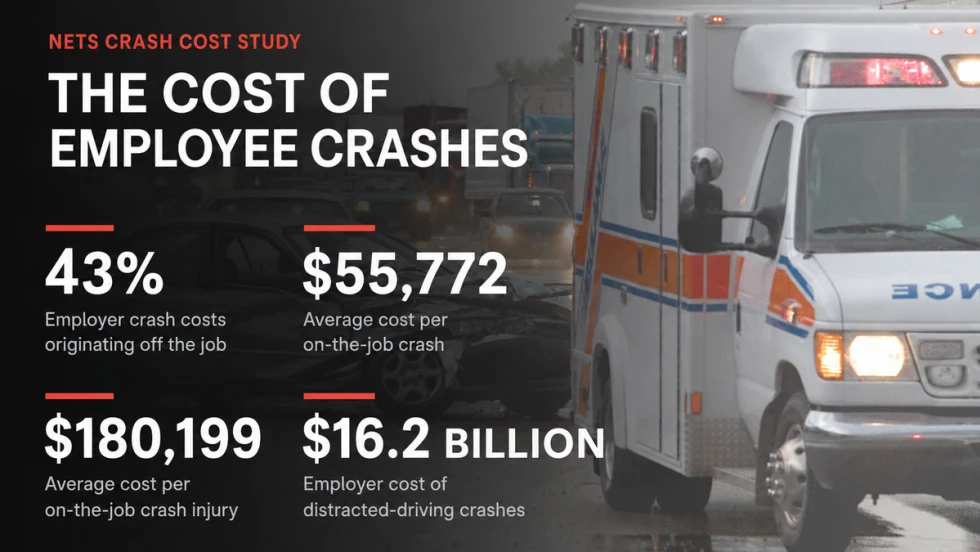
Off-the-Job Crashes Account for 43% of Employers’ $61.7 Billion Crash Burden
NETS quantifies costs dispersed across fleet, risk, HR, and other departments while providing new per-crash benchmarks for employers.
Read More →
Ram Recalls More Than 1.27 Million 1500 Pickups for Seat Belt Anchor Issue
The recall affects certain 2019-2026 Ram 1500 pickups that may have improperly attached second-row seat belt buckle anchors.
Read More →