Learn about the six key considerations in planning an electric vehicle maintenance facility.
by Sheena Zimmerman and Mark Ellis
September 28, 2020
6 min to read
Photo: HDR
Planning for innovation and new technology is a necessity for today’s vehicle maintenance facilities. Fleets with predictable routes and consistent domicile and maintenance locations, such as bus transit, solid waste, and public works, are prime candidates for conversion to new zero emissions vehicles, especially battery electric technologies. Too often, today’s facility designs don’t consider the needs of the future, despite being expected to last.
Ad Loading...
Operations and maintenance facilities need to be planned differently to support electric vehicles. Fleets of the future will require highly specialized maintenance, and fleet owners need to consider creative and functional design solutions to accommodate that maintenance. Here are six of the most common considerations for designing new fleet facilities or modifying existing facilities to accommodate future electric vehicles.
Ad Loading...
Photo: HDR
Electrical Infrastructure
Adequate electrical infrastructure is one of the most important elements in a successful transition to an electric vehicle fleet. It plays a key role in determining a realistic timeline for electric vehicle implementation. Electrical infrastructure items such as transformers, power storage, and electrical distribution devices all require space. Other site and facility impacts will also need to be addressed, like ensuring new equipment does not block the flow of traffic and planning not just for initial operations, but future expansion goals as well.
When planning electric vehicle conversions, fleet owners are finding communication with the local utility provider and an understanding of infrastructure needs is vital. On a recent project, HDR worked with the utility company to determine when the necessary power infrastructure could be upgraded so the operations and maintenance facility would have enough power supply. An analysis of space and location requirements for equipment was also completed to show possible siting of infrastructure. This included developing a timeline for necessary future facility upgrades and modifications. By performing the infrastructure planning ahead of time, the agency obtained a clear expectation of what changes were necessary, when the system installation would be complete, and when upgrades would be required.
Vehicle Parking and Charging
The type and location of charging systems will influence vehicle parking configurations at O&M facilities. There are currently several different vehicle charging options, each with unique space requirements:
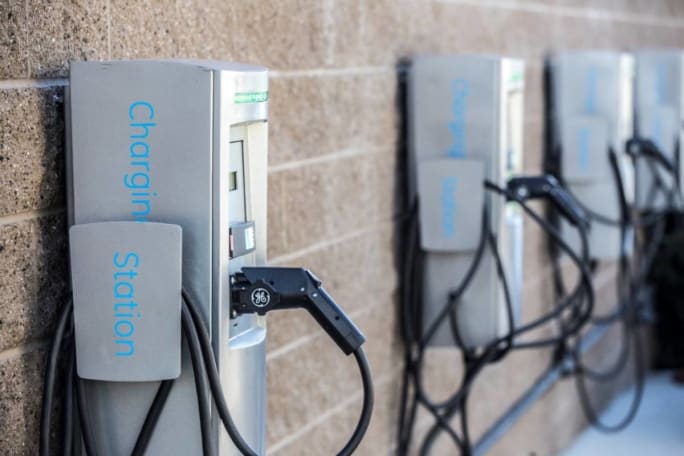
● Plug-in charging — Operator/driver or maintenance staff physically plugs the charging cable into the vehicle. Depending on how these are organized, plug-in cables can be obstacles in parking areas. Room is often required next to the parking space for the charging unit and can require redesigning current parking. Some facilities have also used overhead gantries to allow charging cords to be pulled down from the ceiling to limit parking space impacts.
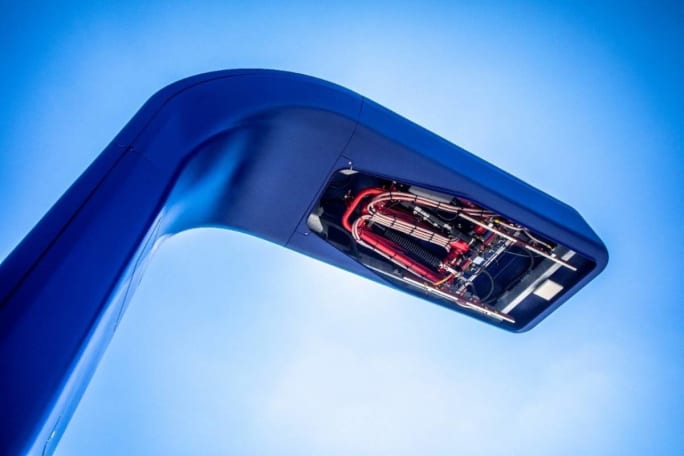
● Overhead structure with pantograph — Charging either happens up from the vehicle or down from the structure. This overhead charging approach offers the most flexibility, with every component above grade and moveable as technology evolves and fleets change, but it requires space consideration for canopy supports. One possibility is creating parking lanes with vehicles parked front to back, then adding an extra-wide walking and storage aisle between some lanes to allow space for the structural supports and electrical charging infrastructure.
Ad Loading...
● Underground induction charging — Charging infrastructure is underground with power induction in the parking surface and on the underside of vehicles. Underground infrastructure offers the least flexibility for future modification. This requires space for charging units placed above ground and near the parking areas, conduit run underground, and plates embedded in the ground for induction charging.
In addition, other elements of the charging systems, such as transformers and capacitors, require a dedicated area.
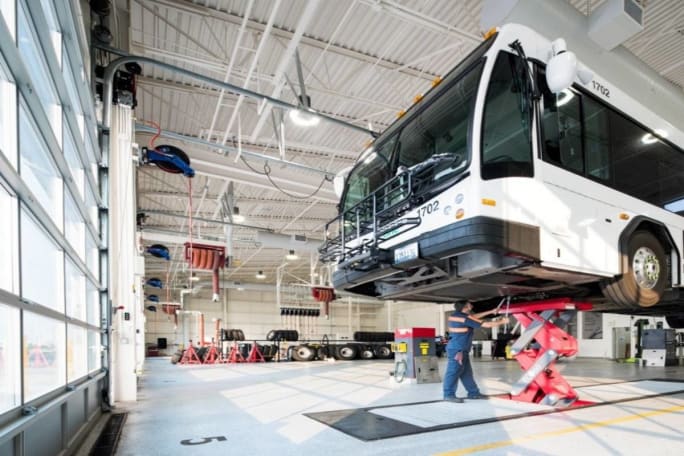
Facilities with lifts will find they’re still adequate if vehicles are added with charging systems and batteries located on the underside.
Photo: HDR
Vehicle Maintenance Facility Modifications
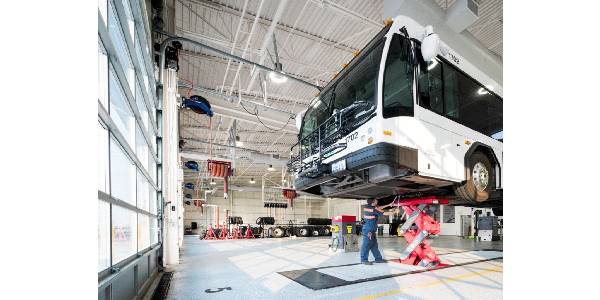
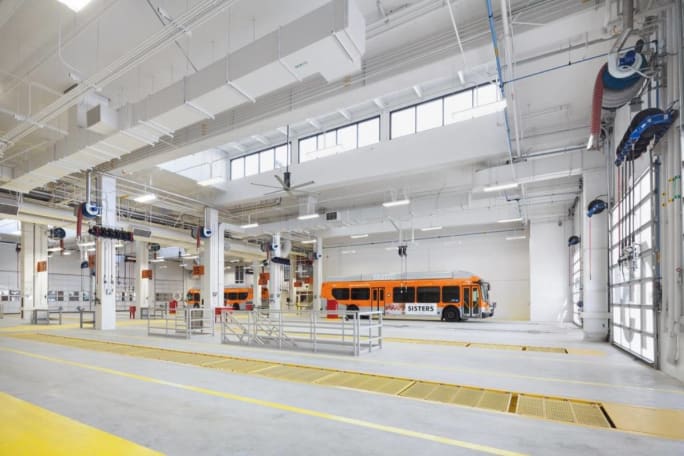
Many maintenance requirements of electric vehicles are similar to a diesel or unleaded fuel vehicle, and the size of the vehicle shop typically will not change. What will change is how that space is used. Depending on the type of electric vehicle, the battery location can require special access for maintenance and removal. This access may be from the underside, interior, or roof of the vehicle.
If the battery system or charging components are located on the roof of the vehicle, maintenance facilities need either fixed or mobile platforms at the correct height. Some vehicles could require overhead crane access for replacing, repairing, and maintaining these systems and components. Existing lifts, lower level work areas, and surface work areas will likely be adequate if batteries or the charging system are beneath the vehicle or in or near the engine compartment, making extensive modifications unnecessary.
Existing lubrication distribution systems will need to be modified to eliminate products specific to conventional engines. Convenience outlets for compressed air and electricity will still be used. Shore power systems (auxiliary power) may be required for some electrical vehicle configurations to supplement onboard power systems. These systems are typically located in the repair bay and will likely require electrical distribution and supply system upgrades in an existing facility, and close design coordination in a new facility.
Ad Loading...
Onboard vehicle energy optimization systems and computers, special electronics, and energy storage (batteries) may all require specialized shops, some with special environments and equipment.
Lower level work areas and preventive maintenance inspection bays will continue to be useful for accessing charging systems and batteries located underneath vehicles.
Photo: HDR
Parts Storage
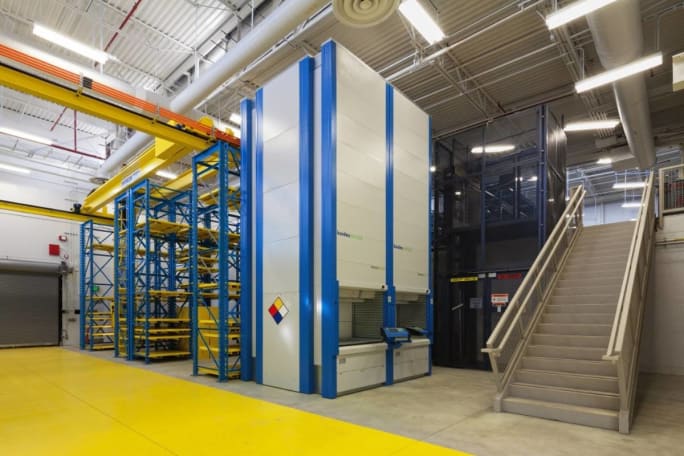
Converting a large fleet of vehicles to electric changes the type and inventory levels of spare parts needed. Initially, spare parts, batteries, and charging system components will likely take more space as the fleet transition is occurring and multiple vehicle types are being supported. However, once a fleet is fully converted to electric power, many experts estimate spare parts storage volumes will be reduced by approximately 20%. As part of upgrades for an all-electric fleet, many modern facilities also add high-density storage systems to reduce parts room space requirements, further reducing space requirements.
Vehicle Charging Operations
Establishing the method and physical operation of electric vehicle charging is imperative to ensure vehicles are ready when needed. This consideration seems basic, but in practice, it is often a hurdle to implement. Establishing the operational “how, when, and who” of charging operations and the responsibility for verifying the vehicles are properly engaged to charging devices is key to ensuring electric vehicles are ready each day.
In transit operations, this task has usually fallen to the vehicle service (washing/cleaning) staff or hostlers (staff that move vehicles into the service areas). Staff make the necessary charging connection and perform a visual inspection of the vehicle and electrical charging components to ensure proper operation. In solid waste, public works, and private fleets, this task often is required of the vehicle operator when he or she parks the vehicle at the end of a workday.
On-site training facilities could become more important as new vehicles are added to a fleet and more training is required for operations and maintenance staff.
Photo: HDR
Training
New vehicles will mean new skills. Electric vehicle operators must be trained on how to drive, troubleshoot, and manage the vehicles while on their routes to maximize their range and meet expectations for performance.
Ad Loading...
Vehicle maintenance staff will require additional training on the inspection and maintenance of electric vehicles and the maintenance and replacement of battery systems in particular. Facility maintenance staff will also require training to assess and maintain the vehicle charging systems components and infrastructure.
Modern parts rooms like this multilevel option with palletized systems and vertical lift modules will be important during transitions, as more parts are needed to maintain multiple types of vehicles.
Photo: HDR
Key Questions
In designing modifications to an existing facility or planning a new facility for electric vehicles, owners and operators need to be prepared to address a number of questions:
● What electrical delivery infrastructure is available, and how do I coordinate improvements with my local electric utility provider?
● What type of vehicle and charging system will maximize the potential of the fleet and value to my operation?
● What modifications or special features must the maintenance facility and parts storage areas include to support the electric vehicle technology?
Ad Loading...
● Who will ensure the vehicles are charged properly and ready for deployment each day?
● What training will my staff require?
The transition to an electric vehicle fleet can be deceptively complex. With proper planning, the pitfalls for the implementation of a conversion and its impact on O&M facilities can be avoided. Understanding potential impacts and setting a realistic implementation timeline that considers those challenges are keys to success.
About the Authors
Sheena Zimmerman is a facility design manager in HDR’s Bellevue, Wash., office. She’s worked on more than 140 maintenance facility projects for transit and municipal clients, including a number of projects helping plan and design facilities with considerations for electric vehicles.
Mark Ellis is HDR’s transportation operations & maintenance facilities director. Based in Houston, Texas, he has more than three decades of experience and a passion for excellent, efficient, and safe functional facility design.
Geofencing is a familiar fleet tool today, but its early adoption marked a major shift in vehicle tracking, route monitoring, and the debate over employee privacy.
Holman is bringing its Mexican fleet management operation fully under its own brand after more than 30 years as a joint venture. The change gives multinational fleet customers a single Holman operation across the U.S., Canada, and Mexico.
Regular tire checks can do more than extend tread life. These five maintenance practices can help work truck fleets catch problems early, reduce costs, and prevent downtime.
Part Two: Commercial auto remains one of the most challenging and costly lines of coverage for fleet operators and insurers alike. Continue learning more about how to effectively address these issues from Onur Aksan, Enterprise Business Development Executive, Geotab
Commercial auto remains one of the most challenging and costly lines of coverage for fleet operators and insurers alike. Learn more about how to effectively address these issues from Onur Aksan, Enterprise Business Development Executive, Geotab.
Fleet leaders are under pressure to reduce costs, adapt to economic uncertainty, and make smarter decisions. See how peers across North America are responding with real data, proven strategies, and forward-looking insights. Download the 2026 Market Pulse Report to benchmark your strategy and uncover where you can gain an edge.