




Debunking Retread Tire Myths
Misconceptions about retreaded tires are keeping many fleets from reaping their benefits.
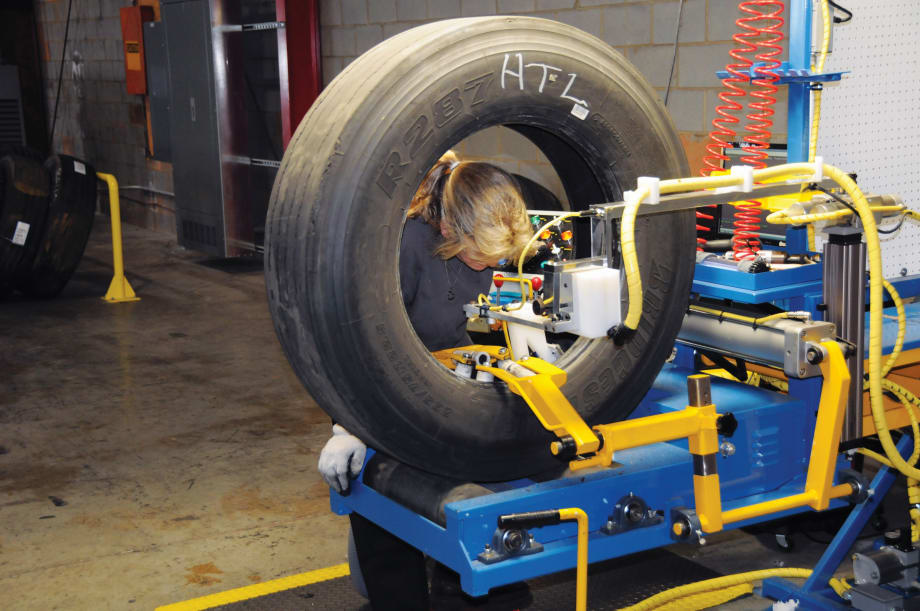
Retreaders inspect casings to determine their suitability for retreading. Well-maintained and properly repaired casings will go on to fight another day.
Photos: Jim Park
If retreaded tires are such a bad idea, why do North American retreaders sell more than 15 million of them every year? More to the point, if they are so unreliable and failure-prone, why do fleets keep buying them?
“Almost 90% of U.S. fleets with 100 or more trucks use retreaded tires,” says David Stevens, the managing director of the Tire Retread & Repair Information Bureau. “They do that because they have tested the tires. They know that retreaded tires deliver the lowest total cost of ownership for their companies.”
If you don’t use retreads because your great uncle Harry had a bad experience with retreaded tires back in 1983, you’re not giving the retread industry or the tires they produce a fair shake.
There are certainly variable qualities between retreaded tires, just like there are in virgin tires. One would hardly expect a $250 drive tire with an unpronounceable brand name to perform like a $600 Tier-1 tire. With retreads, as with virgin tires, you tend to get what you pay for.
Past personal experience factors into future buying decisions, and that can be hard to overcome, but industry statistics show adjustment rates for retreaded tires are comparable to virgin tires.
While researching this story, I reviewed some of the comments left by readers of previous stories about retreaded tires. The comments from the naysayers seem mostly to spring from misconceptions about retreads, or third-party experiences rather than personal experience. We’ll never get everyone on board, but here are a few misconceptions or misunderstandings about retreaded tires that should once and for all be put to rest.
Myth #1
Retreaded tires are all the same
Nothing could be further from the truth. A retread tire has three main components: the casing, the tread, and the process. If there are shortcomings in any of the three, you’ll wind up with a substandard tire.
It all starts with the casing. Retreaders classify casings according to age, previous service life, mileage, the number and quality of previous repairs to the casing, and the condition of the internal belts, rubber plies, etc. A top-quality Tier 1 casing is obviously the most desirable, and fleets heavily invested in a retreading program will take the time and trouble to ensure their casings are maintained in the best condition possible. In the long run, this makes it possible to retread a casing up to four or five times, extending casing life out to 10 years in some cases. Most fleets wouldn’t put a five-time, 10-year-old retread back into long-haul service, but such a tire would serve well in a shunting or local pickup and delivery application.
Retreaders reject casings that don’t meet minimum standards, but some lower-quality casings do make it back into the market and are sold at retail or wholesale for bargain prices. If that’s the sort of retread you had a bad experience with, ask yourself what you expected from a tire sold at well below market prices.
Myth #2
Retreads are not as fuel-efficient
Some retreaded tires are actually more fuel-efficient than their virgin counterparts. It’s well-known that any tire is most fuel-efficient the day it’s pulled from the truck. Tread depth is a significant factor in a tire’s relative rolling resistance; generally speaking, tires with thinner treads are less resistant to rolling. Deeper treads wiggle and squirm and deform as the tire rolls through the contact patch. The energy required for all that movement comes from the fuel tank.
Since tire treads designed for retreading are often thinner than the tread used on the original tire, it’s more fuel-efficient from the day it’s put into service.
It took the Environmental Protection Agency’s SmartWay program nearly 10 years to figure out how to classify retreaded tires. When the EPA first worked to add retreads to its program, it was a challenge to quantify the relative fuel efficiency of a two-part system. How much fuel savings was from the tread itself, and how much from the casing? The agency developed an “interim retread protocol” by which all retreaders tested their treads on the same model casing that they felt represented a typical tire: an American-made Yokohama Super Steel RY-617 in size 295/75R22.5.
Eventually, the EPA began its own testing on retreads applied to different casings and found that fuel-efficient treads applied to almost any casing yielded desirable results.
“We recognized that common industry practice is to apply retreads to any retreadable tire,” said Dennis Johnson, technology assessment center director in EPA’s Transportation and Climate Division. “What we’ve demonstrated is that when you apply different low-rolling-resistance treads to commercially available casings, we’re seeing comparable fuel savings to new low-rolling-resistance tires.”
In other words, if you spec a fuel-efficient tread, you’ll have a SmartWay-compliant retreaded tire.
Myth #3
Anybody can successfully use retreaded tires
Regrettably, that’s probably not true. The cornerstone of a successful retreading program is the casing. Tier 1 and Tier 2 virgin tires are ideal candidates for retreading, but lower-tier tires, including ultra-low-cost imports, often aren’t suitable for retreading. You simply can’t build a retreading program on tires designed to be thrown on the scrap pile after the first use.
A report published in 2018, “Retread Tires in the United States and Canada: An Analysis of the Economic and Environmental Benefits for Fleet Operators and the U.S. Government,” notes, “cash-strapped small fleets and owner-operators may not have the luxury of investing in premium tires and may not have the desire to manage a retreading program, even if doing so provides a lower long-term cost.”
As we noted earlier, it takes resources to manage tires to their maximum potential, including rigorous inspections and pressure checks. If those tasks are not managed successfully, even a premium tire is unlikely to fulfill its potential. Many small-fleet operators believe that retreads are more trouble than they are worth.
“Larger fleets often have sophisticated tire management programs and have carefully measured the benefits that retreaded tires bring to them in terms of overall lower cost per mile,” an attendee of the Mid-America Trucking Show told me a few years ago. “I can’t do all the testing they do on tires. All I can do is try to learn from the testing they’ve done and apply it to my business.”
Tire dealers and retreaders can help small fleets, but the temptation of saving cash in the short term can prove a big deterrent to setting up and monitoring a tire management system and retreading program that will save money in the long term.
Thumping Versus Pumping
Solving tire inflation problems would save the trucking industry millions. Underinflated tires are the single biggest reason for on-road breakdowns. Underinflation causes rapid degradation in tire life expectancy, and it can create a very dangerous sidewall failure called a zipper rupture. And underinflation makes no distinction between virgin tires and retreads - under-inflated tires are time bombs. Period.
Yet drivers continue to thump their tires with sticks or hammers or the toe of their boot to check the tire pressure. Those same drivers, and the fleets they work for, blame retreaded tires for tire failures rather than the true culprit - under-inflation.
Thumping a tire will, at best, only tell you if the tire is totally flat or not. If a tire has even just enough air pressure to keep the beads seated, it will thud when you strike it. The difference between and a thud and a thump is in the ear of the beholder. It’s certainly not a precise way of determining tire pressure. Experts tell us that that even 10 psi difference between two tires in a dual assembly can affect the performance and life of both tires.
If you’re not very good at tire pressure management, don’t blame it on the tire.
This article originally appeared in Heavy Duty Trucking magazine, a sister publication of Automotive Fleet.
More Safety

Fleet Manager’s Ultimate Playbook: Navigating the New Standard in OEM Connectivity
Rising operating costs, driver safety concerns, and unplanned downtime are putting unprecedented pressure on modern fleets. Discover how fleet managers use embedded OEM connectivity and real-time vehicle data to cut TCO, prevent downtime, and protect drivers without aftermarket telematics hardware.
Read More →
From Driver Well-Being to EV Charging | AF News Recap
Mental health belongs in the fleet safety conversation. This week, we’re looking at five ways fleets can support employee well-being before a crisis, plus Holman’s expansion in Mexico, new one-day Fleet Forward passes, and why EV charging demand is outpacing infrastructure growth.
Read More →
Nexar-Nauto Merger Aims to Give Fleets Better Safety Intelligence Through Larger Driving Dataset
Stefan Heck tells Automotive Fleet that combining more than 10 billion miles of driving history with Nexar's AI models will give fleets deeper insights into driver risk and roadway conditions than either company could provide independently.
Read More →
Don't Wait for a Crisis: 5 Ways to Build Mental Health Into Your Fleet Safety Program
For Suicide Prevention Month, fleet and safety leaders have an opportunity to put mental health where it belongs: at the center of workplace safety.
Read More →
How Camera Data Can Strengthen a Fleet’s Insurance Renewal
Insights from a commercial insurance carrier and a broker show how fleets can turn video telematic data, driver coaching, and improved claims results into a stronger case at insurance renewal.
Read More →
The Safest Fleets Aren’t the Ones with the Most Technology
You’ve made the telematics investment. Here’s how to capture the other half of its value and build the safest fleet on the road.
Read More →
Hidden in Plain Sight: Fleet Compliance Risks
Fleet compliance isn't just about having policies — it's about consistently enforcing them. This practical guide reveals six hidden compliance risks common in public sector and shared fleet operations and outlines proven strategies to improve visibility, accountability, and audit readiness
Read More →
NETS Sets 2026 Fleet Safety Benchmark Conference for Indianapolis
The Sept. 15–17 program will feature fleet benchmarking data, case studies, emerging technologies, and implementation strategies while running alongside the NSC Safety Congress & Expo.
Read More →
Off-the-Job Crashes Account for 43% of Employers’ $61.7 Billion Crash Burden
NETS quantifies costs dispersed across fleet, risk, HR, and other departments while providing new per-crash benchmarks for employers.
Read More →
Ram Recalls More Than 1.27 Million 1500 Pickups for Seat Belt Anchor Issue
The recall affects certain 2019-2026 Ram 1500 pickups that may have improperly attached second-row seat belt buckle anchors.
Read More →