




Related: A Modern Collection of Hybrid and Electric Trucks and Vans [2021 Photos]
Could Your Next Work Truck be a Hybrid?
Medium- and heavy-duty hybrid truck tests show promise in stop-and- go situations and those that require auxiliary power generation in urban environments. But will costs come down enough to make them feasible for general use?
by Terry Parkhurst
July 1, 2007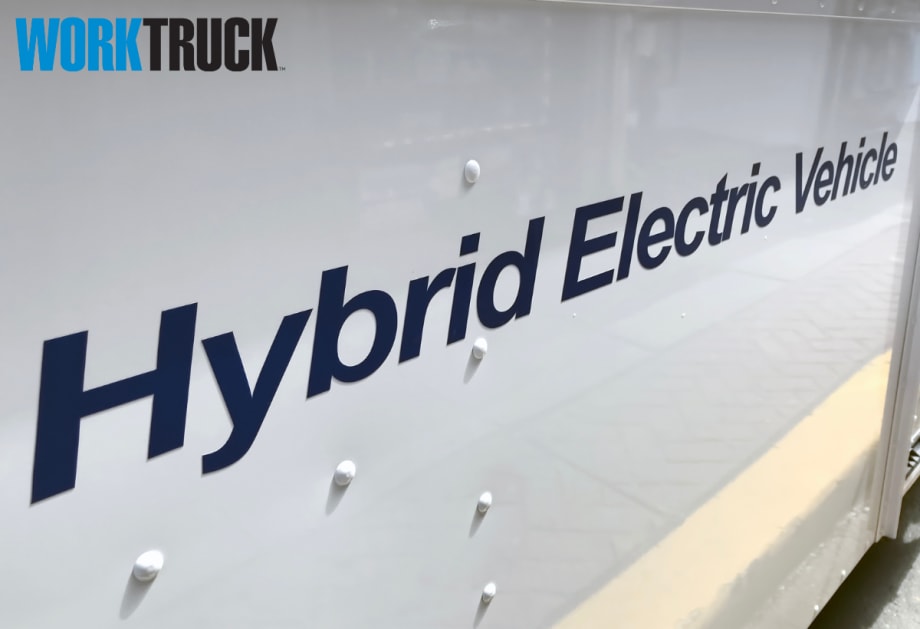
In 2007, there are no major hybrid-electric mass produced work truck options.
Photo: Work Truck
5 min to read
While hybrid passenger vehicles have garnered the lion’s share of media attention and sales, many major truck manufacturers are developing diesel-electric hybrid work trucks for the same reasons as hybrid cars: fuel cost savings and emissions reductions, especially in congested urban environments.
No medium- or heavy-duty hybrids are for sale in the U.S. as of press time. However, national fleets such as the U.S. Postal Service, United Parcel Service, Federal Express, Verizon, and Coca-Cola are testing hybrid trucks and vans, as is the Department of Defense.
Breaking Down the Benefits
There are basically two types of hybrid systems: series hybrids, which use an internal combustion engine to generate electricity for the electric motor that drives the vehicle, and parallel hybrids, which use both internal combustion engines and electric motors for propulsion, and switch back and forth as the situation demands.
One unique feature of a hybrid system is that brake energy can be recuperated with a large-enough energy storage system, impacting fuel economy, especially in city driving.
“The more stop-and-go driving you do, the better the efficiencies,” says Leif Johansson, president and CEO of truck-maker Volvo Group AB. “There’s also higher starting torque than a normal diesel engine.”
“The diesel engine can be 35% smaller with a hybrid drivetrain. You’ll see more savings with complete electrification of the air conditioning, power steering, and power take-off,” explains Sten-Ake Aronsson, senior VP at Volvo Powertrain North America in Hagerstown, Md.
A full-hybrid system can also generate power for auxiliary units such as dump beds, wreckers, and farm equipment.
Since full-hybrid vehicles run solely on electric power up to about 25 mpg, a hybrid truck is much quieter on average than conventional diesel. Diesel engine life may increase, as its load is supplemented by an electric motor. Because charging the batteries retards the truck's motion, brake wear is also reduced.
The Battery Debate
Today’s hybrid systems used in passenger cars employ a nickel-metal hydride battery. Manufacturers such as Isuzu are pioneering a lightweight, energy-dense, high-voltage lithium-ion battery that reportedly lasts three times longer than comparable nickel-metal hydride cells.
In lieu of batteries, some hybrid truck systems store electric energy in ultracapacitors. Ultracapacitors have several advantages over batteries: very high rates of charge and discharge, little degradation over hundreds of thousands of cycles, low toxicity of materials used, and high cycle efficiency (95% or more).
However, the amount of energy stored per unit weight is considerably lower than that of an electrochemical battery, and effectively storing and recovering energy requires sophisticated electronic control and switching equipment.
Thomas Grothous, dean at the College of Technologies, University of Northwestern Ohio, believes “ultracapacitors will work for medium-duty work trucks because of all the city stop-and-go driving, with regenerative braking getting in on the action.
Without regenerative braking, the capacitors only store what has been charged up by a generator — and that takes fuel. The generator sets used to keep a cab warm or cool will be obsolete.”
Now add hydraulic hybrid systems to the mix. This technology stores energy in pressurized tanks rather than batteries. The conventional drivetrain is replaced with a hydraulic one, eliminating the need for a mechanical transmission and driveline.
The hydraulic system offers great advantages for vehicles operating in stop-and-go conditions because, like ultracapacitors, the system can capture large amounts of energy from regenerative braking. Technical challenges with hydraulic hybrids include noise and packaging issues.
Eaton Corporation and the Environmental Protection Agency are testing hydraulic hybrid prototype trucks with UPS. Mileage May Vary Fuel economy improvements in hybrid truck tests vary widely due to application and type of truck.
WestStart-CALSTART, a research and development firm involved with hybrid truck technology, has conducted chassis dynamometer and in-field tests of hybrid utility trucks through its Hybrid Truck Users Forum (HTUF) pilot program. The tests showed a decrease in fuel consumption of 40% to 60% measured against their non-hybrid counterparts in similar conditions.
Grothous estimates a hybrid parcel delivery or refuse collection truck “can get anywhere from a 20% to 30% fuel reduction” relative to a conventional engine.
Trucks making fewer stops don’t fare as well. Grothous says a Class 8 truck, on a cross-country run in high gear, can achieve a 5% reduction in fuel cost if the driver operates the rig in high gear 80% of the time. Individual manufacturers’ real-world tests show substantially fewer fuel savings.
In its hybrid truck test fleet, FedEx reports that independent lab tests showed a 57% reduction in fuel costs over a baseline model.
From Prototype to Production
Though manufacturers such as Isuzu and Hino are producing hybrid models in Japan, medium- and heavy-duty hybrid trucks are still in the test stages in America. Therefore it’s difficult to put a price tag on implementation, manufacturers say.
Some sources speculate the government may eventually offer tax credits on medium- and heavy-duty hybrid trucks, similar to those offered on new hybrid passenger cars, though nothing is imminent.
“We don’t know yet what the cost [per unit] will be,” says Paul Vikner, president and CEO of Mack Trucks. “It’s very volume-dependent. If we had to depend on [government] incentives 20 years from now, we aren’t doing our job.”
Ultimately, it becomes a matter of waiting for the economies of scale to kick in, admits Vikner. “Somewhere in the next decade, we’ll see supply and demand curves crossing for hybrid trucks,” says Johansson.
Aronsson is confident the technology can be harnessed cost-effectively. He compares the cost of diesel-electric hybrid trucks today with catalytic converters that needed platinum in their construction. “Once, catalytic converters were very expensive,” says Aronsson. “And today, they’re a commodity."
Topics:Hybrid TrucksDiesel-Electric HybridsMedium-Duty TrucksBatteriesReducing EmissionsGlobal Fleet
Originally posted on Work Truck Online
Subscribe to Our Newsletter
More Global Fleet

Holman Takes Full Ownership of ARIZA in Mexico
Holman is bringing its Mexican fleet management operation fully under its own brand after more than 30 years as a joint venture. The change gives multinational fleet customers a single Holman operation across the U.S., Canada, and Mexico.
Read More →
Proven Ways to Reduce Work Truck Downtime
The age-old problem of downtime will always be a reality, but with new strategies at hand, fleets have more ways to keep trucks on the road longer.
Read More →
Sponsored•July 23, 2026
The Top 300 Commercial Fleets
The Top 300 Commercial Fleets: See the List
Read More →

Cameras, Safety and Insurance: From Reactive Claims to Real-Time Prevention (Part 2 of 2)
Part Two: Commercial auto remains one of the most challenging and costly lines of coverage for fleet operators and insurers alike. Continue learning more about how to effectively address these issues from Onur Aksan, Enterprise Business Development Executive, Geotab
Read More →
Cameras, Safety and Insurance: From Reactive Claims to Real-time Prevention
Commercial auto remains one of the most challenging and costly lines of coverage for fleet operators and insurers alike. Learn more about how to effectively address these issues from Onur Aksan, Enterprise Business Development Executive, Geotab.
Read More →
Sponsored•May 6, 2026
Fleet Costs Are Rising: Here’s How Leaders Are Responding
Fleet leaders are under pressure to reduce costs, adapt to economic uncertainty, and make smarter decisions. See how peers across North America are responding with real data, proven strategies, and forward-looking insights. Download the 2026 Market Pulse Report to benchmark your strategy and uncover where you can gain an edge.
Read More →
Enterprise Fleet Management Surpasses 900,000 Vehicles in U.S. & Canada
Enterprise Mobility connects with mobility solutions around the globe
Read More →
Sponsored•October 14, 2025
Automotive Fleet's Guide to Fleet Electrification
Unlock the secrets to a successful transition to electric fleets with Automotive Fleet's comprehensive Fleet Electrification Guide!
Read More →
Sumitomo Rubber Industries to Acquire Viaduct
Viaduct will join Sumitomo as an independent subsidiary. Partnership strengthens global reach and accelerates AI-driven innovation for fleets and manufacturing.
Read More →