


At a Glance
Respondents from Fleet Financials tire survey said that a number of issues resulted in their tires going flat, including:
Tires not being inflated properly.
Debris.
Seasonal conditions altering road conditions.
 MENU
MENU SEARCH
Fleet Financials’ inaugural tire survey asked fleet managers how much flat tires deflated the bottom line. The answers provided an in-depth look at a perennial challenge.

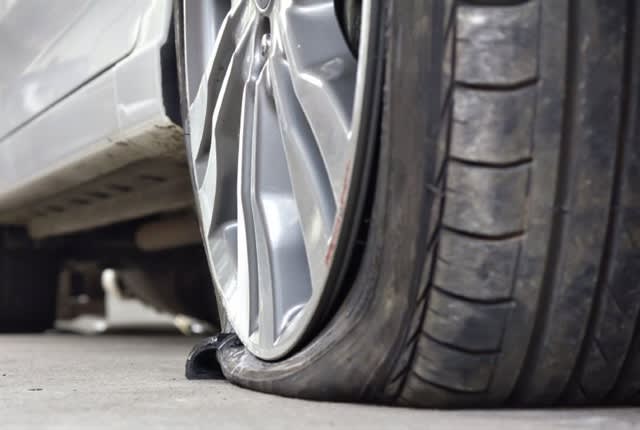
Photo courtesy of iStockphoto.com.
Tires are a fleets No. 1 maintenance cost. So in an effort to get a better idea of what fleets spend on flat tires, Fleet Financials created its inaugural flat tire survey. Among the questions FF asked fleet managers and other fleet stakeholders was the number of vehicles in their fleet, the approximate number of flat tires per year, the average estimated cost of driver downtime and vehicle downtime per flat, and the estimated cost of tire change per flat tire.
Of the survey respondents, the average fleet size was 112 vehicles and the approximate number of flat tires per year were 97. As for estimated costs, the average cost of driver downtime was estimated at $91.32, the estimated amount of vehicle downtime per flat was $117, and the overall cost of a tire change per flat tire $130.10. Taken together the average cost of a flat tire was about $338.42. This result was then multiplied by the average number of flat tires fleets face annually — 97.
Jeb Lopez, owner of Wheelz Up LLC, an auto parts delivery service in metro District of Columbia, was a participant in the survey. His fleet consists of 100 vehicles, with 98 full-size cargo vans and two box trucks.
He said his estimated cost of driver downtime was $50, and $150 for vehicle downtime. He found the estimated numbers by factoring the hourly wage of his fleet drivers, hourly cost of vehicle downtime, and the cost of fuel and other miscellaneous factors.
“If the driver is 30 minutes or more away from our headquarters, our fleet response team takes a minimum of 45 minutes to get dispatched and at the location. Then it may take another 20 minutes minimum to fix the tire or if it’s major, we have to replace/swap the tire and that could total another 30 minutes,” he said.
Raymond Croteau, an assistant director of transportation with GLSS, a social service provider that assists the elderly in the greater Boston area, was another participant in the survey. He echoed Lopez’ methodology when it came to coming up with his answers.
He found his vehicle downtime average based on the average price it costs to tow vehicles, which he said can range from $50 to $150.
“What I basically did is, I kind of used the analogy that when a driver is down, that’s two hours of his time, plus I had to send another driver to do the call, or pick up passenger on the vehicle,” said Croteau.
Lopez attributed his flat tire woes to a multitude of issues.
He said his company delivers within a 60-mile radius, meaning that his vehicles are subject to varying road conditions. Road construction has been a prominent issue for his fleet’s tires, due to the abundance of debris. Weather and seasonal elements also have had a negative impact.
Croteau also mentioned debris as one of the main reasons for flat tires in his fleet, which is the result of construction and weather.
Croteau’s fleet of 300 vehicles, which consists of 220 vans and 80 cars, sometimes sustains tire damage from the debris that comes during spring rain when water pushes debris out of the gutters and into the streets.
Croteau also mentioned that winter was an important season to consider when factoring tire conditions.
“We have winter here. Last year was actually not a bad winter for snow, but it was a bad year in the effect that it went below and above freezing, which caused a lot more potholes, frost heaves and all the stuff we experience,” said Croteau.
He mentioned that preparation for winter begins as early as September, since it’s not uncommon for snow to be on the ground during October.
Conversely, heat also poses an issue for tires, which was noted by Art Meyer, the procurement, fleet equipment manager for NPL Construction, which is based out of Garland, Texas.
Meyer, another participant in the survey, said that his company used to utilize retreaded tires, but it abandoned this because the tires would come apart in the summer heat. Meyer also attributed improper tire pressure and running into construction material, such as rebar or concrete, was common due to his company’s line of work.
Lopez said Wheelz Up drivers are required to check their tires before and after driving a vehicle, as well as regularly checking the air pressure.
He also said that Wheelz Up replaces tires when there is 4/32 inch of remaining tread depth.
Croteau says that he uses proactive methodology when it comes to finding tires that work best for his fleet.
“The big thing is to find a tire that holds up to the area that we live in and the challenges that we face. You’re always trying to analyze your tires and find out what’s the best way to reduce the downtime,” he said. “We research and test by changing tire company brands, we research with types of tread also, since different types of tread work better than others, especially in the winter and rain weather. You’re always looking at it; you’re always trying to analyze what’s going on to find a solution and reanalyze to see if your solution made anything better or worse.”
Croteau mentioned trying to keep within costs and budgets for his fleet while also attempting to find a quality tire for his vehicles as a major difficulty. He suggested that finding a way to compare data with other fleets in regards to handling his budget and tire finances would greatly benefit his fleet.
“I think that’s a struggle that most people see. We’re always doing analysis amongst ourselves, or amongst our own fleet, and don’t have or don’t know of a place to work with others who have already done this or are experiencing these things,” he said.

Where will fleet’s next generation of leaders come from? This week, we’re looking at the industry’s talent pipeline, what certification can add to a fleet career, how to build an award-worthy track record, and the return of Automotive Fleet’s Personal Use Survey.
Read More →
Fleets have more driver data than ever, but identifying risky behavior doesn't necessarily correct it. Smith System's new Driver Risk Management program combines monitoring, training, and follow-up coaching to help fleets connect risk signals with driver intervention.
Read More →
Less than two weeks left! Commercial and corporate fleet managers are invited to share how their organizations handle company vehicle personal-use policies, charges, and driver eligibility.
Read More →
Can better prompts make AI more useful for fleet managers? This week, we’re breaking down smarter fleet analysis, an AI-assisted experiment that turned safety training into music, and what happened to fuel prices in August.
Read More →
Include these six elements in your fleet prompts to generate more relevant analysis and accurate answers.
Read More →
This edition of the Fleet Meets series features one of the industry's best leaders driving multi-market and national operations.
Read More →
Research highlights a growing need for proactive management strategies to address rising costs in fleet operations effectively.
Read More →
Tracking fleet metrics is only useful when the data leads to better decisions. This guide helps fleet leaders assess cost, utilization, and downtime more accurately, identify performance gaps, and prioritize the actions that can improve operational results.
Read More →
Fleet compliance isn't just about having policies — it's about consistently enforcing them. This practical guide reveals six hidden compliance risks common in public sector and shared fleet operations and outlines proven strategies to improve visibility, accountability, and audit readiness
Read More →
Does data alone drive results in operations?
Read More →