




Considering Contactless Rentals? Check Your State Laws First
Car rental operators implementing new customer processes as a result of the coronavirus pandemic must consider state laws regarding remote, electronic, and extended transactions — especially those not yet updated for the digital age.
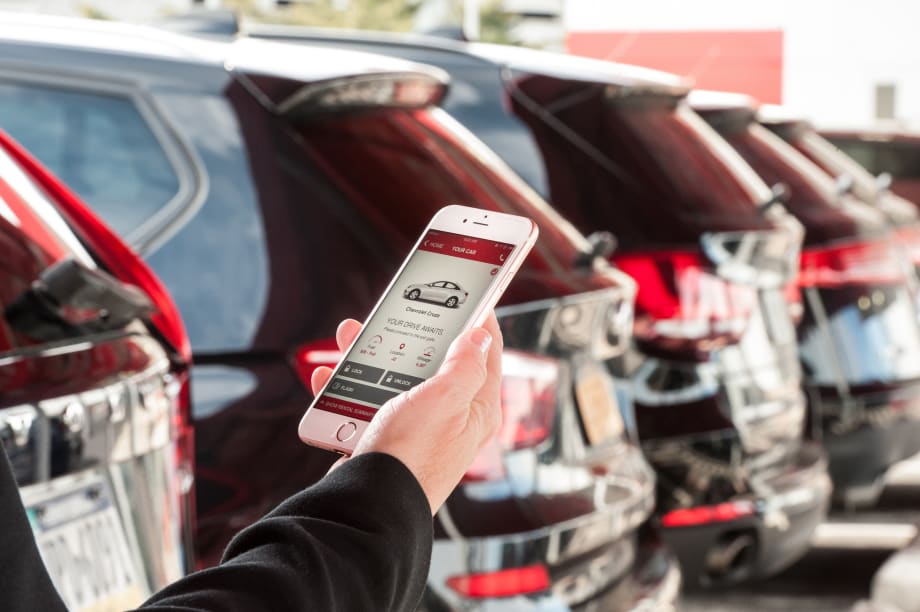
In a completely contactless rental, the customer accesses the vehicle through a pin code, a smartphone, or similar method — all without any face-to-face contact with the car rental operator.
Photo courtesy of Avis.
As long the coronavirus threatens our health, renters are likely to want limited contact with rental agency employees and other customers. Some customers may even prefer “contactless” rentals where the entire rental transaction, including access to and return of vehicles, is conducted remotely or electronically.
The industry was clearly trending in this direction before the pandemic, and contactless processes will likely remain after it subsides. In addition, initial reluctance of consumers to return to public or other shared transportation modes could lead to requests for longer rental periods.
This article will briefly review some of the legal considerations regarding remote rental transactions, electronic rental transactions designed to limit contact, and extended rental terms beyond 30 days. (Cleaning and vehicle sanitizing issues will be addressed in a future article.)
Contactless Rentals
Remote rentals, including membership/loyalty programs, carsharing, and other app-based models, have been part of the industry for many years and typically require the customer to register as a “member” and agree to a master rental agreement or membership agreement through a website or an app. In a completely contactless rental, the customer also accesses and returns the vehicle through a pin code, a smartphone, or another similar method — all without any face-to-face contact with the car rental operator.
As car rental operators develop new policies and procedures to meet customer expectations and comply with local law and public health recommendations amidst the coronavirus pandemic, operators should keep in mind that many state rental laws still contemplate some face-to-face contact while others may impede completely contactless rentals.
For example:
Physical inspections
Many states, including Arizona, California, Colorado, Florida, Illinois, Nevada, and Texas still require a physical inspection of a renter’s driver’s license at the time of rental.
Presently, only a handful of states, including California, Colorado, and Florida exempt remote transactions from the physical inspection requirements if certain conditions are met, such as requiring the renter to verify that he or she holds a valid, unexpired license at the time of entering into a master agreement or before the first rental.
GPS Use
Several states, including California, Connecticut, Montana, and New York prohibit or limit the use of GPS or telematics to track the location of the vehicle and access other information about the vehicle.
California is the most restrictive and prohibits rental companies from using, accessing, or obtaining any information about the vehicle from telematics, including to impose fees, with only limited exceptions, such as to provide roadside assistance to the renter, to locate a vehicle reported stolen by the renter, or to assist with an Amber Alert.
Operators in any state should consult with counsel to understand whether state rental laws or other privacy laws may limit their ability to implement the latest technology to improve customer experience and encourage social distancing, and if so, whether they can restructure their model or planned use of the technology to remain compliant.
Identifying Impairment
During a completely contactless rental, the operator cannot observe the customer to determine whether he or she appears fit to drive, which may lead to claims of negligent entrustment if a renter with an impairment later causes an accident that injures a third party.
As a result, an operator and its insurance company may establish additional rental qualifications (which may be based on a motor vehicle record report) before permitting a customer to participate in a contactless program.
Technology and Privacy
If an operator uses facial recognition technology, fingerprints, or other biometric information to verify the customer’s identity, unlock the vehicle, or both, the operator must ensure that its program, technology, and customer disclosures and policies comply with any applicable privacy laws, such as the California Consumer Privacy Act, the Illinois Biometric Information Privacy Act, or similar state (or federal) privacy laws, which may require a customer to “opt-in” to use of biometric information.
Electronic Transactions
Contactless rentals generally involve a membership agreement entered into via a website or an app or some other digital agreement. Generally, electronic signatures and agreements are permissible and enforceable as long as they meet certain conditions, including:
Consent
The customer must consent to the use of electronic signatures and records. Consent to electronic transaction can generally be inferred from conduct, for example completion of a transaction online or signing an electronic signature pad or tablet.
Proof of Electronic Signature
To be effective, an electronic signature must be “attributable” to the signatory, meaning the method must be capable of linking to that individual and shown as his or her act.
According to the Uniform Electronic Transactions Act (adopted in most states), the act of the person may be shown in any manner, including a showing of the efficacy of any security procedure applied to determine the person to which the electronic record or electronic signature was attributable.
Examples of electronic signatures include a person typing his or her name, initials, or email on a screen; a person initialing or signing a screen using finger or stylus; clicking or tapping on computer or screen that says, “I agree,” “submit” or equivalent.
No alternation of document after signature
Any verbiage on a printed agreement must be identical to the verbiage in the electronic agreement signed. An electronic signature cannot be copied and inserted into multiple sections of an agreement.
Extended Rental Terms
Rental car laws and definitions vary by state. For example, the California Vehicle Rental Law defines a renter as a person obligated under a vehicle contract for a period “less than 30 days.”
Texas defines a vehicle rental as “30 days or less.” And in some states, such as Arizona, the maximum statutory time period varies depending upon whether a statute regulates taxes, collision damage waiver, limited licenses for optional insurance product sales, etc.
Creating a contract term that is longer than the state law definition of rental creates the possibility the transaction will be construed as a lease rather than a rental. Vehicle lease transactions are subject to additional contract and legal requirements.
For example, Regulation M issued by the Bureau of Consumer Financial Protection (which applies to all states) requires certain disclosures for consumer transactions with an initial period of four months or longer.
Regulation M does not consider renewal periods and applies only if the initial period exceeds four months; however, certain state consumer motor vehicle leasing laws (like the Maryland Consumer Motor Vehicle Leasing Law) applies to a transaction if the total term, including the initial term and any renewal terms, exceeds four months.
Compliance with those obligations can be challenging for a rental operator and will be subject to state licensing requirements. Moreover, transactions for a defined term between 30 days and four months may fall into a “grey area” of the law creating compliance challenges
For these and other reasons, many rental car operators require that a new contract be written every 30 days or, at a minimum, that the existing agreement be renewed every 30 days. Even operators in states without a defined rental term should consider similar practices.
Strict compliance with state law drivers’ license inspection laws would require the renter to return to a rental location for a driver’s license inspection and the generation of a new contract. The above discussion regarding contactless and electronic transactions should be considered for the renewal process.
Beware of Outdated Laws
Similar to the driver’s license inspection laws, many states have not updated their rental agreement laws to reflect the move from paper-based to electronic transactions. For example, many states require vehicle rental companies to disclose information, such as collision damage waiver conditions, state conversion/theft laws, and insurance requirements in a specific font style and size.
And some states even mandate that disclosures appear on the “face” of the agreement or on clear and conspicuous signage posted at the rental location. With most digital agreements, font size, style, and even placement are largely irrelevant. Depending upon where the renter will access the vehicle, signage may be impractical.
Although some states are beginning to recognize the evolution from counter-based, face-to-face transactions to all digital, contactless rentals, only New York has amended its law to explicitly exempt digital agreements from the font and placement requirements.
As a result, operators should take into account these requirements and determine the best methods for implementing the state disclosure requirements, which may include use of separate fields in an app or separate state addenda to an agreement to highlight the special state disclosures.
About the Authors
Leslie J. Pujo is an attorney with Plave Koch PLC in Reston, Va., focusing on mobility and vehicle use, as well as franchising. She can be reached at lpujo@plavekoch.com. Wesley D. Hurst is an attorney in the Los Angeles office of Polsinelli and leads the firm’s Mobility & Vehicle Use practice. He can be reached at whurst@polsinelli.com.
Originally posted on Auto Rental News
More Global Fleet
GeoFencing Adds to Your Truck Security Arsenal
Geofencing is a familiar fleet tool today, but its early adoption marked a major shift in vehicle tracking, route monitoring, and the debate over employee privacy.
Read More →
Holman Takes Full Ownership of ARIZA in Mexico
Holman is bringing its Mexican fleet management operation fully under its own brand after more than 30 years as a joint venture. The change gives multinational fleet customers a single Holman operation across the U.S., Canada, and Mexico.
Read More →
5 Tire Maintenance Tips to Help Prevent Work Truck Downtime
Regular tire checks can do more than extend tread life. These five maintenance practices can help work truck fleets catch problems early, reduce costs, and prevent downtime.
Read More →

Proven Ways to Reduce Work Truck Downtime
The age-old problem of downtime will always be a reality, but with new strategies at hand, fleets have more ways to keep trucks on the road longer.
Read More →


Cameras, Safety and Insurance: From Reactive Claims to Real-Time Prevention (Part 2 of 2)
Part Two: Commercial auto remains one of the most challenging and costly lines of coverage for fleet operators and insurers alike. Continue learning more about how to effectively address these issues from Onur Aksan, Enterprise Business Development Executive, Geotab
Read More →
Cameras, Safety and Insurance: From Reactive Claims to Real-time Prevention
Commercial auto remains one of the most challenging and costly lines of coverage for fleet operators and insurers alike. Learn more about how to effectively address these issues from Onur Aksan, Enterprise Business Development Executive, Geotab.
Read More →
Fleet Costs Are Rising: Here’s How Leaders Are Responding
Fleet leaders are under pressure to reduce costs, adapt to economic uncertainty, and make smarter decisions. See how peers across North America are responding with real data, proven strategies, and forward-looking insights. Download the 2026 Market Pulse Report to benchmark your strategy and uncover where you can gain an edge.
Read More →
Enterprise Fleet Management Surpasses 900,000 Vehicles in U.S. & Canada
Enterprise Mobility connects with mobility solutions around the globe
Read More →