




CEI User Group Sees Cutting-Edge Safety and Risk Management Research
CEI’s DriverCare user group meeting in Virginia provided clients the opportunity to discuss safety, policy, as well as share ideas. Attendees also got a glimpse of the company’s ongoing research project with the Virginia Tech Transportation Institute.
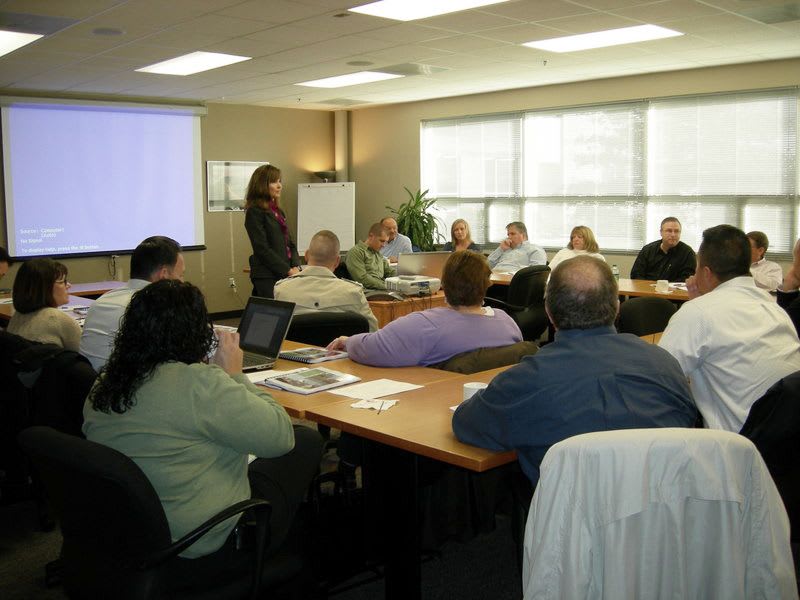
Attendees at The CEI User Group meeting represented 64,000 vehicles from across the country, and took part in two-and-a-half days of interaction.
Attendees at The CEI User Group meeting represented 64,000 vehicles from across the country, and took part in two-and-a-half days of interaction.
The CEI User Group Meeting provides clients:
An introduction to Virginia Tech Transportation Institute.
An opportunity to provide the company with feedback on its products and services.
Details on accident management and safety.
Blacksburg, Va., home of Virginia Tech University, is nestled in the heart of the mountains in the southwestern part of the Old Dominion. From Oct. 19-21, 2011, it was the venue for The CEI Group’s annual meeting for customers of its DriverCare fleet risk and driver safety management solution. Some of the industry’s largest fleets and a team of CEI experts gathered together for presentations and discussions that covered a broad range of risk management and safety-related topics.
Beginning with a welcome dinner and opening remarks from Wayne Smolda, founder and CEO of the company, 14 customers from all over the nation, representing 64,000 vehicles, joined CEI staff at the Inn at Virginia Tech for two days of discussions, presentations, and interactions. Customers came to learn about CEI’s cutting-edge research project and offer feedback for new product development and services.
CEI held the meetings in Blacksburg to introduce the group to the Virginia Tech Transportation Institute (VTTI), the organization contracted to conduct extensive statistical research focused on identifying risk factors that may help fleet managers be more proactive in managing risk associated with the assignment of company vehicles.
Cindy Williamson, VTTI’s operations director, described the CEI/VTTI mission as conducting research in key areas regarding driving safety, which impact policy.
The annual meeting provided attendees with two-and-a-half days of interaction, learning about the cutting-edge predictive analysis research coming out of the VTTI/CEI partnership, and a frank exchange of ideas with their supplier. With a new focus on risk mitigation, via the statistical analysis of mounds of data, CEI will be taking accident management to the next level, one where both predictive as well as remedial models, authoritatively backed, will enable customers to better mitigate risk, rather than simply managing repairs.
Automotive Fleet interviewed CEI President and COO, Vincent Brigidi, after the meeting to get his take on the VTTI research, CEI’s goals for the meeting, and the future of the accident management and safety marketplace.
AF: What is the goal of the annual DriverCare meeting?
BRIGIDI: Over the 27 years CEI has been in existence, we have placed customers, their needs, and their candid feedback at the heart of our servicing models and our product development. Like any good organization in the fleet industry, we feel we are blessed to have a group that willingly travels once a year and gives up their professional and personal time to assist us.
The meeting has four primary goals:
Review the complete catalogue of all recently released DriverCare features and enhancements.
Review any enhancements that are currently in development, show examples (where possible), and provide production dates.
Identify and prioritize the next set of enhancements to DriverCare based on the group’s feedback.
Provide an opportunity for the users to network and share best practices with the rest of the DriverCare community.
AF: Explain the VTTI/CEI research project.
BRIGIDI: CEI depends heavily upon the feedback and suggestions from our diverse customer base in order to decide where our products need to be in both the short- and long-term. The topic of “predictive analytics” has come up repeatedly in the past few years, and we had in-depth discussions with our DriverCare user group on its thoughts and suggestions.
Our research appeared to show us that previous attempts at predictive analytics may have been overly subjective, due to the use of survey responses as the sole source of data.
CEI has one of the largest databases of accidents, motor vehicle reports, driver training events, and driver demographics, and has given us opportunities to:
Produce a statistical model for identifying trends, probabilities, and predictors that are mathematically sound and unbiased, based on actual events and demographics.
Use the model as part of our complete DriverCare Risk Manager solution, so results and findings can be integrated into our customers’ driver safety programs to mitigate risk and reduce accidents.
Create a dynamic model that can make use of new data as it’s captured and incorporate entirely new categories of data that fleets might want to introduce in the future.
AF: is the project completed?
BRIGIDI: The project was initially laid out with a one-year timeline, and it began February 2011. Because of the way we structured the RFP, the culmination of the project in February 2012 will not be the end of the value we’ll derive from it. We will have a working model as one of the deliverables that we should be able to use as new data is collected, so that our predictive analytics can adapt with a changing driving environment.
The overall management of the project is under the leadership of Feng Guo, Ph.D., a brilliant statistician. Dr. Guo has indicated he’s excited to be able to use our real-world data to develop a statistically based predictive model that can help fleet managers reduce the risk and costs of accidents. We can then take these models and build them into our risk management products.
AF: What WILL be the greatest needs in the safety/accident management marketplace?
BRIGIDI: With the increased use of telematics and traffic cameras, combined with more traditional data points like accident reports and motor vehicle records, there is more and more critical data available every day. It is imperative that fleets have a solid process of collecting all of the available data, and then utilizing it to quickly identify areas of need in the fleet.
That said, all efforts to accomplish the aforementioned collection and analysis of data will be ineffective in the long term if the individual drivers are not presented with that data, followed by proper remediation. In almost every aspect of fleet management, driver behavior is the single greatest factor driving unforeseen cost outcomes. Whether it’s gas mileage, vehicle maintenance and repair expense, or accidents, changing driver behavior is one of the fleet manager’s biggest challenges.
Using tools like DriverCare, which enables drivers to see their complete driving history at a glance and clearly understand what they’ll be held accountable for, significantly increases the opportunity for long-term behavioral change.
More Safety

Fleet Manager’s Ultimate Playbook: Navigating the New Standard in OEM Connectivity
Rising operating costs, driver safety concerns, and unplanned downtime are putting unprecedented pressure on modern fleets. Discover how fleet managers use embedded OEM connectivity and real-time vehicle data to cut TCO, prevent downtime, and protect drivers without aftermarket telematics hardware.
Read More →
From Driver Well-Being to EV Charging | AF News Recap
Mental health belongs in the fleet safety conversation. This week, we’re looking at five ways fleets can support employee well-being before a crisis, plus Holman’s expansion in Mexico, new one-day Fleet Forward passes, and why EV charging demand is outpacing infrastructure growth.
Read More →
Nexar-Nauto Merger Aims to Give Fleets Better Safety Intelligence Through Larger Driving Dataset
Stefan Heck tells Automotive Fleet that combining more than 10 billion miles of driving history with Nexar's AI models will give fleets deeper insights into driver risk and roadway conditions than either company could provide independently.
Read More →
Don't Wait for a Crisis: 5 Ways to Build Mental Health Into Your Fleet Safety Program
For Suicide Prevention Month, fleet and safety leaders have an opportunity to put mental health where it belongs: at the center of workplace safety.
Read More →
How Camera Data Can Strengthen a Fleet’s Insurance Renewal
Insights from a commercial insurance carrier and a broker show how fleets can turn video telematic data, driver coaching, and improved claims results into a stronger case at insurance renewal.
Read More →
The Safest Fleets Aren’t the Ones with the Most Technology
You’ve made the telematics investment. Here’s how to capture the other half of its value and build the safest fleet on the road.
Read More →
Hidden in Plain Sight: Fleet Compliance Risks
Fleet compliance isn't just about having policies — it's about consistently enforcing them. This practical guide reveals six hidden compliance risks common in public sector and shared fleet operations and outlines proven strategies to improve visibility, accountability, and audit readiness
Read More →
NETS Sets 2026 Fleet Safety Benchmark Conference for Indianapolis
The Sept. 15–17 program will feature fleet benchmarking data, case studies, emerging technologies, and implementation strategies while running alongside the NSC Safety Congress & Expo.
Read More →
Off-the-Job Crashes Account for 43% of Employers’ $61.7 Billion Crash Burden
NETS quantifies costs dispersed across fleet, risk, HR, and other departments while providing new per-crash benchmarks for employers.
Read More →
Ram Recalls More Than 1.27 Million 1500 Pickups for Seat Belt Anchor Issue
The recall affects certain 2019-2026 Ram 1500 pickups that may have improperly attached second-row seat belt buckle anchors.
Read More →