





Want to make sure you stay up-to-date on all things related to the recent bridge collapse? Sign up for our eNewsletters today!
Baltimore Port Disaster: Francis Scott Key Bridge Transportation Metrics
Data from Geotab shows bridge use for a 12-month period before the disaster by number of trips, vehicle type, trip type, and timeframe.
April 3, 2024
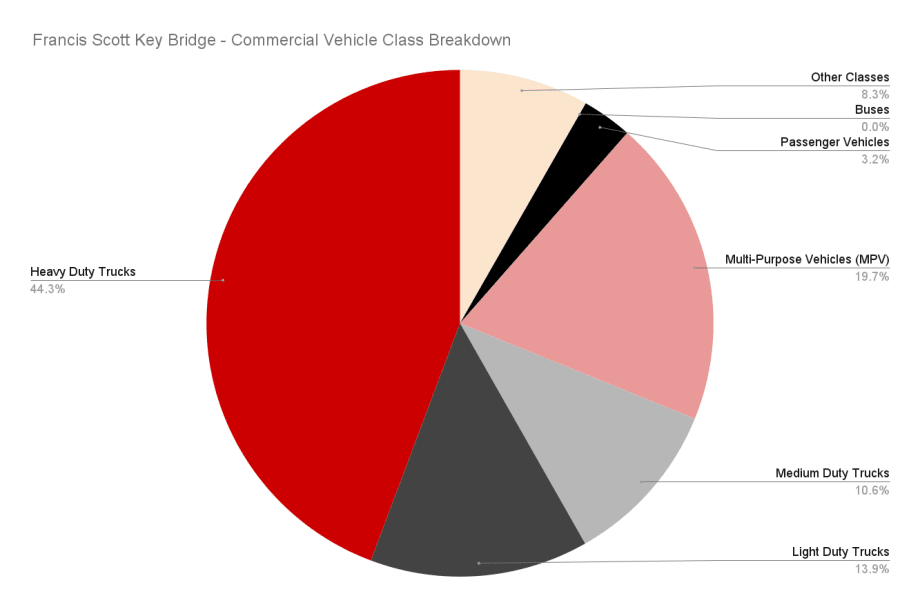
More than 44% of commercial vehicles traveling over the Francis Scott Key Bridge from March 1, 2023 to March 1, 2024 were heavy-duty trucks.
Chart: Geotab ITS
3 min to read
On March 26, the Francis Scott Key Bridge in Baltimore collapsed after being struck by a containership. The collapse has blocked the main access to the port of Baltimore and trapped six bulk carriers and two navy vessels.
The Port of Baltimore is one of the largest in the U.S. by annual tonnage and weight of cargo and is a key hub for shipments of cars and light trucks. Last year, it also handled ships with 847,158 vehicles — making it the busiest port in the U.S. for the sector.
As the port will not be operating at full capacity for some time, shippers must find alternative ports and temporary routes to deliver their goods. However, as the bridge itself handles considerable commercial traffic, commercial fleets and trucking companies will be forced to use alternative routes too.
Geotab, a global telematics provider with over 4 million connected vehicles, launched a new business unit called Geotab ITS which provides agencies and organizations with aggregate insights to improve transportation networks. Geotab ITS provided Automotive Fleet with data from its transportation analytics platform, Altitude, to understand pre-disaster commercial vehicle movements on the bridge by annual trips, vehicle types, time of day, and day of the week.
After the bridge is repaired and the port reopens, Geotab will provide updated data to AF to demonstrate the progression of how commercial traffic was rerouted.
How Was the Bridge Used?
Based on data from vehicles with Geotab-equipped devices crossing the bridge and a calculation for total number of trips, Geotab estimates that the Francis Scott Key Bridge saw more than 4.2 million annual commercial vehicle trips between March 1, 2023, and March 1, 2024.
More than 510,000 distinct vehicles drove on the bridge during those 12 months, with 80% of those trips hitting speeds between 47 mph and 65 mph.
Breaking down the traffic in that time period by vehicle type, heavy-duty trucks made the greatest percentage of journeys by far.
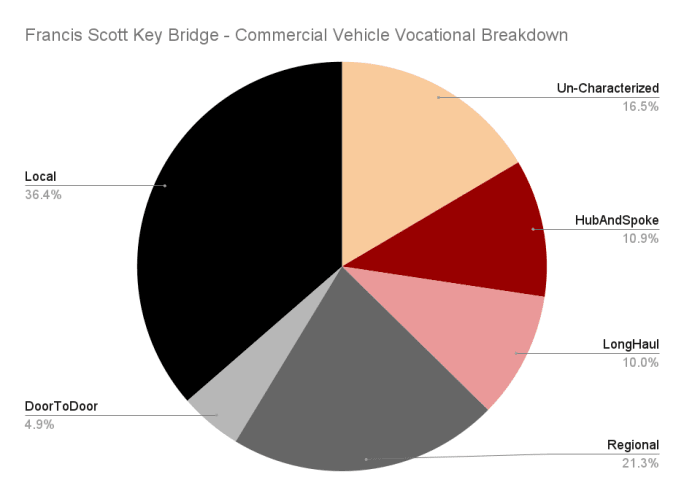
By vocational breakdown, most trips were local, followed by regional.
Chart: Geotab ITS
By trip type, local trips had the greatest percentage, followed by regional and then hub and spoke and long haul.
By day of the week, the bridge saw about four times the volume on weekdays versus weekends.
By direction, travel to the northeast saw peak volumes from 3 pm to 4 pm. Travel in the southwest direction saw peak volumes around 7 am to 8 am.
Geotab also calculated the key destination areas of journeys that travel on the bridge. Northeast-bound hotspots were Baltimore/Tradepoint, Wilmington/Philadelphia, and New York.
Southwest-bound hotspots Washington, D.C., Richmond, and Norfolk, Virginia.
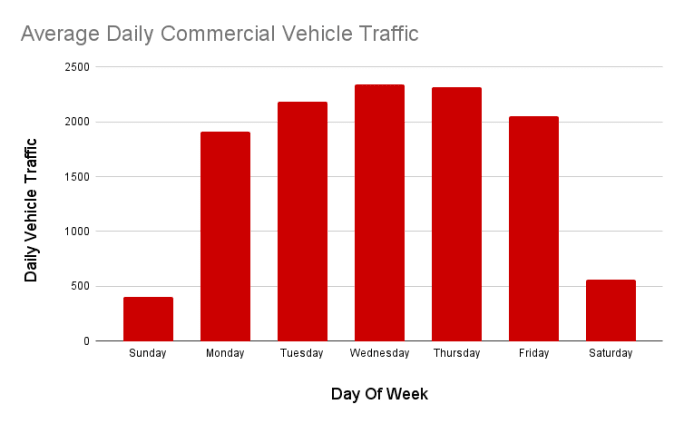
The middle of the week saw the highest daily vehicle traffic.
Chart: Geotab ITS
Key alternate routes include the Baltimore Harbor Tunnel and Fort McHenry Tunnel. These routes are likely to experience increased traffic volumes in the coming weeks and months as they are the most likely alternate routes.
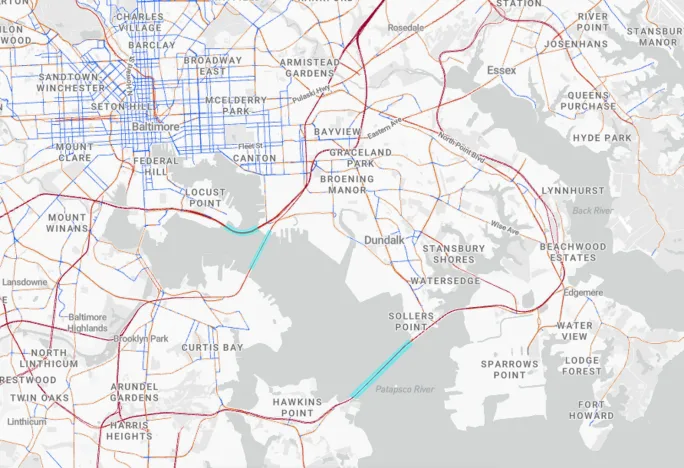
Key alternate routes include the the Baltimore Harbor Tunnel and Fort McHenry Tunnel, which are likely to experience increased traffic volumes in the coming weeks and months.
Image: Geotab ITS
AF will reconnect with Geotab to see how those volumes were realized.
Subscribe to Our Newsletter
More Telematics

GM Launches OnStar Fleet Intelligence Platform With AI Assistant
The new platform brings vehicle data, order tracking, connected services and fleet analytics into one system, with an AI assistant that can answer fleet questions using natural-language prompts.
Read More →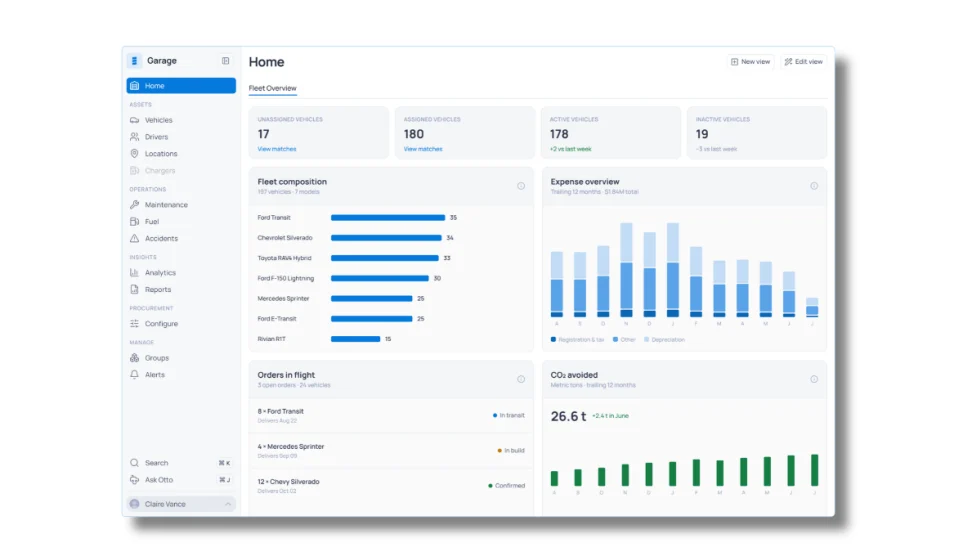
Inspiration Fleet Introduces Garage 2.0 Fleet Intelligence Platform
Fleet managers increasingly have access to data from vehicles, telematics, fuel, charging, and other systems, but those sources don't always communicate with one another. Inspiration Fleet's Garage 2.0 platform brings that information together while letting fleets keep working with different technology and service providers.
Read More →
Inside Inspiration Fleet’s New Platform for Connecting Fleet Data
Inspiration Fleet CTO Chris Getner explains how the new Garage 2.0 platform is designed to connect disparate fleet data and what that could mean for fleet managers in practice.
Read More →
Sponsored•October 1, 2026
Fleet Manager’s Ultimate Playbook: Navigating the New Standard in OEM Connectivity
Rising operating costs, driver safety concerns, and unplanned downtime are putting unprecedented pressure on modern fleets. Discover how fleet managers use embedded OEM connectivity and real-time vehicle data to cut TCO, prevent downtime, and protect drivers without aftermarket telematics hardware.
Read More →
Samsara Driver Perks Adds New Benefit for Corporate Fleet Drivers
The rewards program gives eligible professional drivers access to discounts from more than 50 brands while giving fleets another way to support recruitment, retention, and the driver experience.
Read More →
Inside the Church of Jesus Christ of Latter-day Saints’ Two-Track Telematics Strategy
With 20,000 vehicles and two fundamentally different driver populations, the Church faced a fleet management problem that a single telematics program couldn't solve. How it responded offers a replicable framework for any fleet where one size doesn't fit every driver.
Read More →
How Conversational AI Can Make Fleet Tasks Easier for Drivers
While most generative AI tools help fleet managers interpret data at their desks, Connex2X is applying voice interaction to tasks behind the wheel.
Read More →
Why Fleets Are Creating Dedicated Fleet Analyst Positions
Are fleet analyst positions the new norm? Listen here to find out.
Read More →
Teletrac Navman Begins Next Chapter as Standalone Private Company
What's new with Teletrac Navman and its new owner?
Read More →
Why Fleets Are Creating Dedicated Fleet Analyst Positions
Telematics, AI, EVs, and connected technologies are generating more fleet data than traditional teams can effectively manage. Reed Jackson explains why dedicated fleet analytics roles are emerging to turn that information into better operational decisions.
Read More →