





Get Wrapped: Temporary Vehicle Graphics Fuel Seasonal Promotions
Avoid Getting a 'Bad Wrap'
Making a mistake in the design, material selection, and maintenance of vehicle graphics can project the wrong impression and be costly in the long run.
September 18, 2013
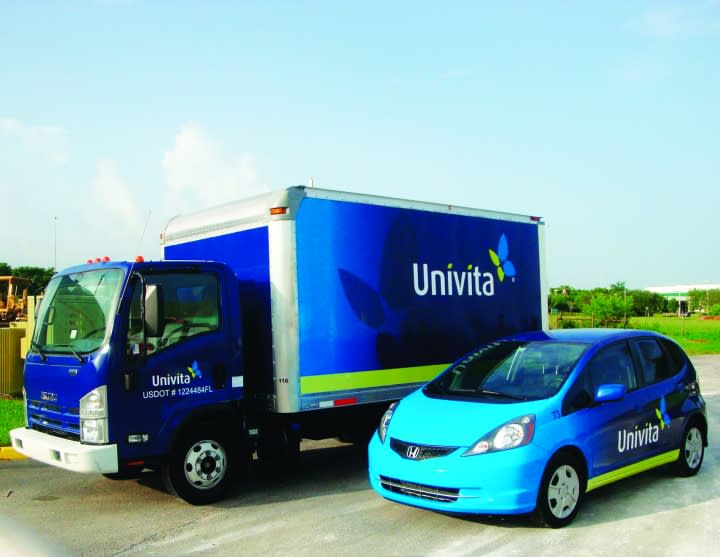
Take vehicle sizes and types into consideration; a graphic design for a truck will not fit the same on a small sedan. (PHOTO: Signature Graphics)
7 min to read
Commercial vehicle graphics, from simple decals to full-on wraps, often create the first impression that customers and the public will have of a company — whether positive, negative, or indifferent. High-quality, compelling, well-maintained vehicle graphics convey the message that the company takes its brand’s reputation (and, by extension, its service to customers) very seriously.
With an investment of several hundred to a few thousand dollars per vehicle for the design and installation of graphics, there’s little room for error. If the logo doesn’t display properly or if the design is ineffective or if the film fades, cracks, or otherwise fails prematurely — these “rolling billboards” will project the kind of impression that could cost a company its reputation and negatively impact the bottom line. A poor or defective wrap could be expensive to fix, repair or replace, cause unnecessary vehicle downtime, and lose revenues.
Avoid these six mistakes to maximize a vehicle’s graphics investment — and make a great first impression:
Poor Design
Problem
A design that wasn’t formatted to the proportions of the vehicle.
“When we get a design from an agency or marketing department, often it is out of scale for that vehicle,” said Kurt Schmidt, vice president, of national accounts at Signature Graphics, a fleet graphics manufacturer based in Porter, Ind. “marketers do a great job gaining corporate buy-in on the design concept, but once its ready for production, we find that many of the vehicle’s basics — such as door handles, hinges, etc. — have been omitted. It’s important to engineer graphics to scale for specific vehicle makes and models with these functionalities built-in to avoid altered designs and production delays.”
Solution
Remember that one size does not fit all. A graphic that works well for a cargo van won’t be the right size and proportion for a 16-foot box truck, and vice versa. Images applied to the rear quarter panel of a ¾-ton single-rear-wheel pickup truck won’t look the same on a 1-ton dually pickup with flared rear fenders. Make sure the designers account for each vehicle make, model, and model-year, adjusting the logo size, copy, and copy type size to ensure a proper fit.
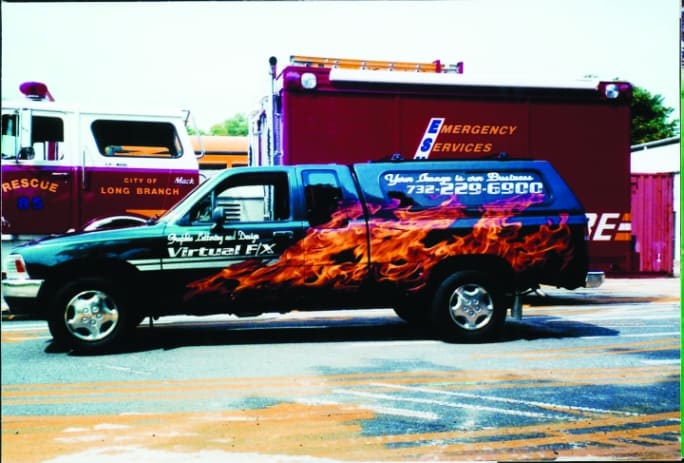
A gloss laminate can give a “wet paint” look and make a brand really pop. But, beware of the potential glare. (PHOTO: 3M Commercial Graphics)
Design Overkill
Problem
Too much text or detail on the vehicle.
Too much information will mean that none of it gets read, squandering prime sales opportunities.
“The tendency is to want to include too much,” Schmidt said. “But, you only have a few seconds to grab attention and get your message across.”
Schmidt referred to the graphics on Best Buy’s Geek Squad vehicles — for both VW Beetles and Ford E-150 full-size vans — as an example of effective simplicity. “The vehicle is black and white and it says ‘Geek Squad.’ The graphics don’t say much else except, perhaps, how to contact the company; yet their vehicles are easily recognizable because of their branding.”
Solution
Design the graphic to be simple, visible, and understandable. Make sure that vital information, e.g., phone numbers, websites, and other contact info, is clear and legible.

Simple graphics with basic contact information are clean looking, without being “too busy.” Keep designs simple, visible, and understandable. (PHOTO: 3M Commercial Graphics)
Too Cheap
Problem
Going for the least expensive product and not taking into consideration the vehicle’s surrounding environment.
“You may be able to take costs out on the front-end with cheaper materials for graphics or wraps, but it may cost you a lot more money in the long run,” Schmidt cautioned.
He noted that with lower quality materials, installation can take longer, which can drive up the cost.
“And, sometimes you’ll have bubbles and wrinkles appear prematurely,” noted Tim Boxeth, business manager for 3M Commercial Graphics. “Removability should also be considered in lifecycle cost. High quality films pull off the vehicle in large panels, making them quicker and easier to remove, while low-quality film tends to tear into small pieces, requiring more work.”
Boxeth estimated that material quality can make a difference of as much as $150 to $200 per vehicle on the back-end.
Surface type is also an important factor with “discount” material, Boxeth noted.
“Some customers have very demanding applications with severe contours or C-channels, such as Sprinter vans, VW Beatles, and dually trucks — these demand the highest level of engineering in materials to ensure they don’t crack or tear prematurely.”
Another option is reflective material, which costs more up front, but offers marketing and safety value to fleets that operate at night or in the early morning.
“If your vehicles are operating at night, why wouldn’t you use reflective graphics?” Schmidt posed. “It helps keep your drivers safer because your vehicles are more visible — and you can continue to sell your message after dark. You lose that opportunity with standard, non-reflective materials.”
Solution
Think in terms of lifecycle vs. initial cost with graphics materials. When evaluating lifecycle costs, be sure to consider such factors as durability, longevity, ease-of-maintenance, reflective properties, and removability.
As Boxeth explained, “You want the right materials for the job so that your brand looks good. If your brand doesn’t look good, then it’s probably not worth doing graphics at all. You risk punishing the brand.”
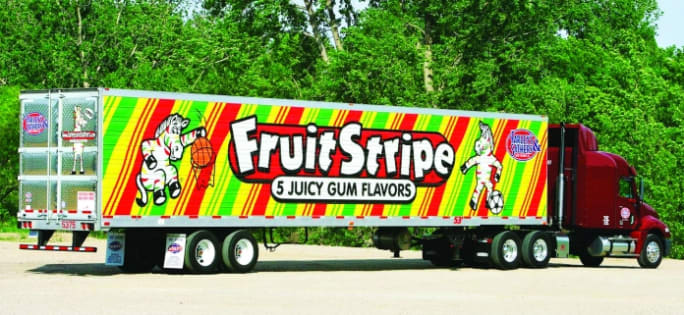
Be sure to consider vehicle location and application relative to the intensity of sun exposure. For example, long-haul vehicles spend a lot of time in direct sunlight. (PHOTO: 3M Commercial Graphics)
Weather Issues
Problem
Neglecting to account for sun exposure.
“The issue here is about durability, or colorfastness, especially in the desert or other high-sun environments. The sun is very tough on colors,” said Schmidt with Signature Graphics.
Peter Salaverry, CEO of SkinzWraps, a full-service vehicle wrap company headquartered in Dallas, with additional locations in Florida, California, New York, North Carolina, and Arizona, agreed. “Different regions and elevations impact vehicle wraps differently. If you have a fleet with 50 vehicles in the high plateaus of the Sierra Nevadas and then five vehicles at sea level, they’re going to have to be wrapped differently. The higher the elevation, the closer the vehicle is to the sun, and the greater the UV protection it needs,” he said.
“You also have to look at how the vehicle is being used,” Salaverry said. “Is it going to be parked long-term as a stationary billboard, exposed to the elements and direct, constant sunlight? If so, it’s going to fade faster than if it is stored in a parking garage or driven throughout the day.”
Boxeth recommended considering the differences between gloss vs. luster laminates in material selection, depending on the intensity of sun exposure and potential glare.
“Gloss laminates give a ‘wet paint’ look, making the brand really ‘pop.’ But, sometimes the brand owner doesn’t want gloss because they don’t want the glare that comes with it, in which case, they should select the luster laminate,” he said.
Solution
Consider vehicle location and application relative to the intensity of sun exposure. Be sure the materials are designed with the appropriate laminate type and sufficient UV protection to handle that exposure and maintain the proper look, even in direct sunlight.
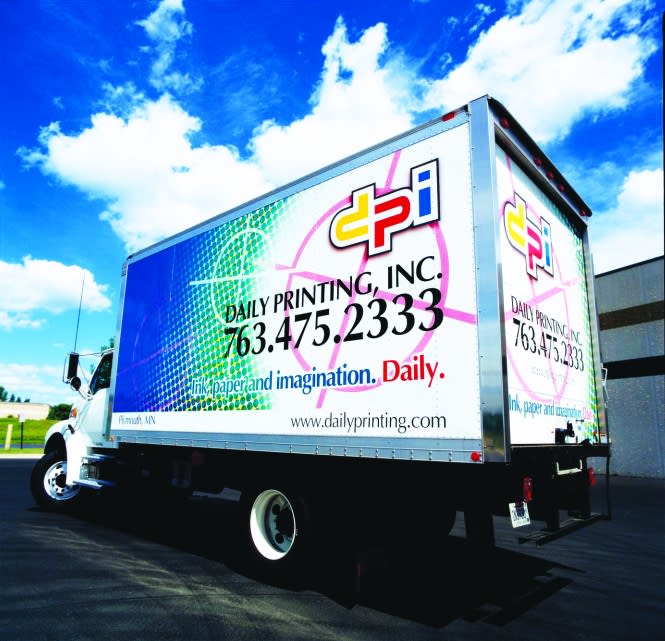
Graphics can be kept simple, but still be eye-catching, through the use of bright colors and larger fonts for vital information. (PHOTO: 3M Commercial Graphics)
Installation Errors
Problem
Choosing inexperienced, unqualified installers.
Much can go wrong when using incompetent vehicle graphics installers.
“The graphics may look good for a few days, or even a few weeks after installation, but then the wrap will start to lift in the C-channels or around the curve areas, bubbling and cracking prematurely,” Boxeth said.
That’s why the major graphics material manufacturers — such as 3M Commercial Graphics and Avery Dennison — have launched “preferred” and “certified” installer programs, to give brand owners peace of mind that the installers have been thoroughly vetted by the manufacturer to provide high standards of competency, proficiency, and service.
Solution
Choose installers carefully. Make sure they have bona-fide experience in the type of vehicle graphics or wraps that are needed and confirm whether the graphics material manufacturer has vetted the vendor.
Maintenance Problems
Problem
Lacking disciplined graphics maintenance programs.
“What kind of program does the fleet have for the interior and exterior cleaning and maintenance of the vehicle, and how well is it being managed?” Salaverry asked. “If they aren’t keeping the vehicles well maintained before they’re wrapped, what are the odds that they will maintain the vehicles properly after they have been wrapped?”
Solution
“If fleets don’t have a consistent program for keeping vehicles clean, they’re not likely to take proper care of their vehicle graphics, leading to premature fading, discoloring, and cracking,” Salaverry said. Include graphics/wrap care as part of an overall vehicle maintenance program. Signature Graphics offers these tips to prolong the life of vehicle graphics:
Avoid ice scrapers; use a snowbrush.
Don’t pressure-wash the vehicle.
Avoid mechanical brush washing.
Keep fuel from prolonged contact.
Clean vehicle from top to bottom; allow dirt and debris to fall downward.
Remove difficult debris by hand with isopropyl alcohol and a microfiber rag.
The Bottom Line
Focus on creating an effective design that’s tailored to the vehicle, selecting high-quality materials and seasoned installers, and implementing a proper maintenance program to maximize the return on the vehicle graphics investment.
Originally posted on Work Truck Online
Subscribe to Our Newsletter
More Operations

How Fleets Can Recruit and Train Veterans for Technician Roles
Here's how the technician shortage has affected uptime for fleets, and what to do about it.
Read More →
Avis Budget Group Deploys Neology Toll Management Technology Across Major Brands
Neology’s neoFleet platform will manage toll transactions and toll-authority operations for vehicles across Avis, Budget, Payless, Budget Truck and Zipcar.
Read More →
Fleet Personal-Use Charges Edge Higher in 2026
Nearly eight in 10 surveyed fleets allow personal use of company vehicles, while just over half of respondents report charging employees for the privilege.
Read More →
The Future of Fleet + What’s Changing Right Now | AF News Recap
Could developments overseas offer a preview of what’s coming for U.S. fleets? This week, we’re looking at the future of AI, autonomy, and electrification, plus Ford Pro’s new certified pre-owned program, smarter vehicle offboarding, and a new way for fleets to manage toll expenses.
Read More →
How to Handle Vehicle Offboarding
What do fleet managers need to do when a driver leaves?
Read More →
Sponsored•October 1, 2026
Fleet Manager’s Ultimate Playbook: Navigating the New Standard in OEM Connectivity
Rising operating costs, driver safety concerns, and unplanned downtime are putting unprecedented pressure on modern fleets. Discover how fleet managers use embedded OEM connectivity and real-time vehicle data to cut TCO, prevent downtime, and protect drivers without aftermarket telematics hardware.
Read More →
U.S. Bank Adds Verra Mobility Toll Management to Voyager Fleet Platform
The integration allows U.S. Bank Voyager fleet customers to manage toll payments and violations alongside fuel, EV charging and maintenance expenses.
Read More →
ADAS Prevents Crashes. But Repairs Cost More | AF News Recap
ADAS-equipped vehicles may crash less often, but they can cost more when they do. This week, we’re breaking down what that tradeoff means for fleets, plus Subaru’s first Forester Wilderness Hybrid, Nissan’s new e-POWER Rogue, and why Calstart has become Catalyst Mobility.
Read More →
Moventum Fleet Management Names Mark Iorillo Head of Sales
Iorillo brings nearly 20 years of fleet management and sales experience to the role, including previous positions at Element Fleet Management, CEI, Donlen and Ryder.
Read More →
Fleet Has a Talent Pipeline Problem. What Comes Next? | AF News Recap
Where will fleet’s next generation of leaders come from? This week, we’re looking at the industry’s talent pipeline, what certification can add to a fleet career, how to build an award-worthy track record, and the return of Automotive Fleet’s Personal Use Survey.
Read More →