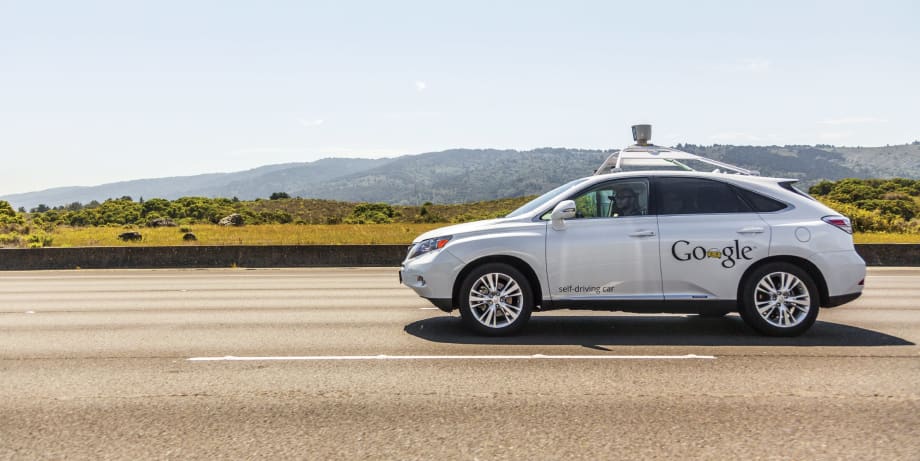
Self-driving vehicles are the next frontier in automobile innovation and companies such as Google, Ford, GM, Tesla, and other OEMs are testing and perfecting their version.
by David Deslauriers
April 4, 2016
Photo courtesy of iStockphoto.com.
4 min to read
Photo courtesy of iStockphoto.com.
A mere decade ago, autonomous vehicles were just a pipe dream confined to the worlds of science fiction and fantasy. Today, companies such as Google, Apple, Tesla, BMW, Ford, GM, and Volvo are all vying to be the first to the market with a fully autonomous vehicle.
Ad Loading...
By the year 2020, there will be as many as 10 million self-driving cars on the road, estimates Business Insider.
Ad Loading...
As the development and testing of autonomous cars — vehicles capable of sensing their environment and navigating without human effort — continues, it has become abundantly clear that the way we view transportation is about to change in a major way.
Before the revolution can commence, there are some key issues that need to be addressed.
At A Glance
Through technology advancements, automobile manufacturers have begun a technological race to see who can get the first fully-autonomous vehicle onto the market. With the introduction of a self-driving car come lingering issues:
● Establishing which type of insurance can
be issued to an autonomous vehicle.
● Formulating the regulations that will
govern autonomous vehicle operations.
● Understanding the ethical complexities
and responsibilities of operating the
vehicle.
● Analyzing the true safety benefits.
Insuring Autonomous Vehicles
Insurance companies are data-driven entities. Their actuaries rely on statistics and averages to calculate the financial consequences of a specific risk or group of risks.
When it comes to insuring autonomous vehicles, numerous questions arise as well. For instance, if an autonomous vehicle gets into an accident (as in the case of Google, which has reported several of its vehicles involved in crashes):
Who is responsible?
How much damage, to both passengers and equipment, should be covered?
What premium should insurers charge owners of autonomous vehicles?
Ad Loading...
With the recent announcement by the National Highway Traffic Safety Administration (NHTSA) that the artificial intelligence system piloting Google’s self-driving car is, for all intents and purposes, considered a “driver,” automakers and drivers may be getting closer to having some answers.
However, this is a subject that’s going to need to be fully fleshed out before the transition into the driver-free era.
Analyzing the Ethical Dilemma
Autonomous vehicles are on the horizon. And as drivers consider buying the vehicle, they should also consider ethical dilemmas that may arise.
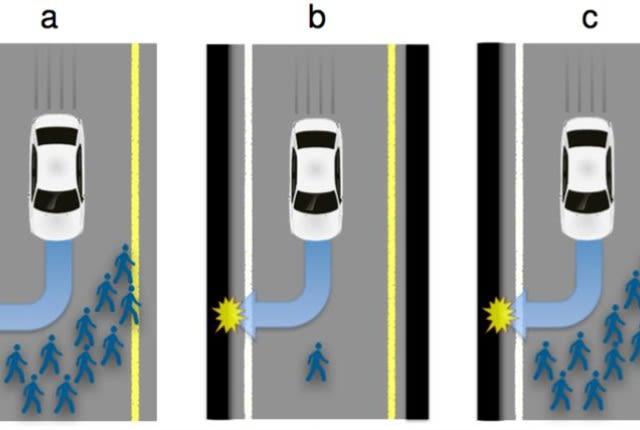
Illustration courtesy of Bonnefon, Shariff, and Rahwan.
Imagine, in the not-too-distant future, being the owner of a self-driving car. And, one day, while out driving, through a series of unfortunate and unavoidable events, the car is headed straight toward a crowd of 10 people who happen to be crossing the road. There is no possibility of stopping in time, but the vehicle can avoid killing those 10 people by veering into a wall.
However, this collision would kill you, the owner and occupant of the vehicle. Consequently, this would lead to a series of questions:
Ad Loading...
What should the vehicle do?
Should the vehicle minimize the loss of life, even if it that means sacrificing the occupants of the vehicle?
Should it protect the occupants at all costs?
Would drivers buy a car that can be programmed to kill them?
Keeping Driver Safety & Regulations in Mind
One of the key selling points in the move toward autonomous vehicles is the notion that these cars will be safer.
Just look at the advancements in safety technology that have become commonplace over the past five years alone; automatic braking, lane monitoring, blind spot assist, rearview cameras, and the list goes on. All of these features have made driving inherently safer.
In fact, a recent study by researchers at the Insurance Institute for Highway Safety (IIHS) found that rear-end collisions have decreased by 40% in vehicles equipped with automatic emergency braking systems, couple that with Volvo’s promise of a “death-proof” car by 2020 and it’s obvious in which direction the automobile industry is heading.
However, there are many safety-related questions yet to be answered by regulators:
Ad Loading...
Will there be any specific training required for operating an autonomous vehicle?
Will these cars be able to break the speed limit or will they be governed?
Will “distracted driving” be allowed?
Will people who were previously precluded from operating a vehicle because of disability or punishment be allowed to operate an autonomous vehicle?
Unfortunately, only the government can provide the rules of the road, and there are many ways the regulatory process could take the industry off track.
Make no mistake about it, autonomous vehicles are the future. The technology is rapidly improving, and, in time, the demand will be there, and the manufacturers certainly see autonomous cars as a large part of their strategy going forward.
But, as with any substantial change, there are bound to be growing pains. It will be interesting to see how this plays out over the coming years. Who knows, in a decade, drivers may be reading articles like this one in Automotive Fleet while their Google cars drive them to work.
Editor's note: David Deslauriers is the business development specialist at Motorlease Corporation.
Rising operating costs, driver safety concerns, and unplanned downtime are putting unprecedented pressure on modern fleets. Discover how fleet managers use embedded OEM connectivity and real-time vehicle data to cut TCO, prevent downtime, and protect drivers without aftermarket telematics hardware.
Mental health belongs in the fleet safety conversation. This week, we’re looking at five ways fleets can support employee well-being before a crisis, plus Holman’s expansion in Mexico, new one-day Fleet Forward passes, and why EV charging demand is outpacing infrastructure growth.
Stefan Heck tells Automotive Fleet that combining more than 10 billion miles of driving history with Nexar's AI models will give fleets deeper insights into driver risk and roadway conditions than either company could provide independently.
Insights from a commercial insurance carrier and a broker show how fleets can turn video telematic data, driver coaching, and improved claims results into a stronger case at insurance renewal.
Fleet compliance isn't just about having policies — it's about consistently enforcing them. This practical guide reveals six hidden compliance risks common in public sector and shared fleet operations and outlines proven strategies to improve visibility, accountability, and audit readiness
The Sept. 15–17 program will feature fleet benchmarking data, case studies, emerging technologies, and implementation strategies while running alongside the NSC Safety Congress & Expo.