




ADT Secures Its Fleet's Future
Increasing its use of smaller vans and splitting the fleet business units up presented challenges and opportunities for the security services fleet.

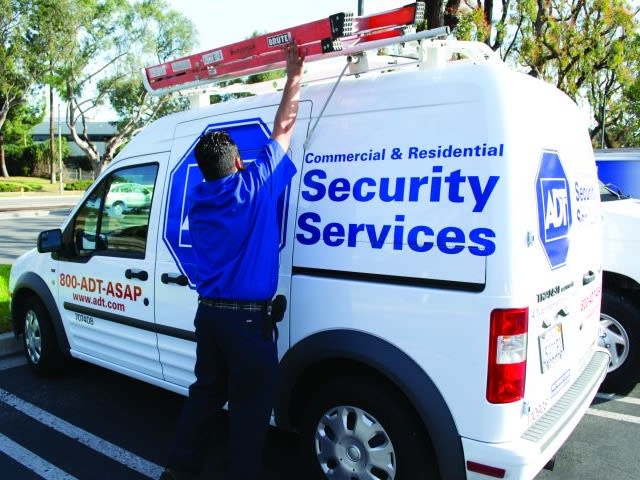
ADT's fleet drivers appreciate the Ford Transit Connects size and upfitted features, which allow technicians to easily access tools and grab ladders off the roof with ease.
Every day, ADT technicians respond to thousands of customer calls and conduct in-person visits to homes and businesses. To help the security services divisions service its customers more efficiently, ADT's parent company, Tyco, is making some big changes later this year, splitting its ADT Residential/Small Business and Commercial Business units into separate companies.
ADT's fleet consists of approximately 7,000 service and installation vehicles throughout the U.S. and Canada. In addition to the upcoming split, the company recently changed its vehicle mix from approximately 95 percent full-size vans to a mix of 85 percent light-duty trucks and 15 percent full-size vans. The company also has about 200 sedans in its patrol fleet.
In the Here and Now
Dave Wade, group director for supply chain for ADT North America, was responsible for both the supply chain and fleet aspect of ADT's business and has been with the company for 17 years. Approximately one year ago, ADT's business presidents and Tyco leadership decided to consolidate the North American fleet across all Tyco entities.
"Fleet is the fourth-largest indirect spend category. Everyone is involved, including the president of our company, operations leadership, field operations, our operational excellence leaders, all the way down to the driver. The hierarchy of who's involved in fleet goes from the top to the bottom of the company," Wade commented.
Faced with volatile fuel prices and aging service vans, the security services provider was looking to replace its fleet. It turned to GE Capital Fleet Services, its fleet management company (FMC) of more than 10 years, to help determine ways to reduce costs and CO2 emissions, and provide technicians with vehicles that would enable them to effectively service the company's 6 million customers.
Re-'Connecting' with Drivers
In 2008, ADT collaborated with its FMC to create a multi-year transformational plan to change the composition of ADT's overall fleet profile to include vehicle mix and size, carbon footprint impact, overall vehicle tracking and management, and an increased focus on driver safety.
Starting in 2009, ADT began transitioning its vehicles from its larger full-size vans to the smaller Ford Transit Connect. The company was looking to not only reduce fuel costs, but reduce its carbon footprint and overall environmental impact as well.
When Wade inherited the fleet, he started reviewing the fleet's current utilization, fleet strategy around optimizing the fleet, and whether it was reducing carbon emissions or reducing fuel expense.
"A lot of our fuel spend is largely determined by vehicle selection. We drive to customer locations, so the average miles driven weren't likely going to change immediately. So, impacting the fuel spend was really in the vehicle selection. We started working with our OEMs - the big three in Detroit - to see what product was currently available or will become available that would get us out of a full-size van culture and into a mid-size van culture," Wade said. "But, the first step in that was really seeing what the appetite of the organization was, again culturally trying to change 7,000 people that have been doing something one way for decades, was a big undertaking."
Before making the switch, ADT assembled a project team that included external strategic partners. "Once we had decided the Transit Connect was the vehicle of choice, we really went deep inside Ford's organization from product development to vehicle marketing. We actually had a kick-off meeting in Detroit in mid-December of 2009. About 50 different people from five different organizations really started to talk about how we'd attack this transformation," Wade explained.
Benefits of the switch include savings of more than $6 million per year in operating costs as a result of the deployment of new, more fuel-efficient vehicles; expected reduction of carbon emissions by 40 percent (or 20,000 metric tons); and a 20-percent reduction in preventable accidents.
Aside from the typical challenges of working with drivers to accept such a change in vehicle size, there were additional challenges as well.
"The vehicle is manufactured in Kocaeli, Turkey, and the upfitter of choice for Ford is in Baltimore," Wade said. "Bringing the product in provided challenges, such as how do we place orders, ensuring we have enough allocation, and organizing with multiple suppliers, including our graphics company." This required pre-planning on ADT's part and setting expectations with drivers, trying to coordinate the change.
According to Wade, "This has been one of the most rewarding projects for the pure fact that not only every day could you save your own company money and help save the environment, but, also help one of the American staple companies, such as Ford, produce a new vehicle that was largely used in European markets. All the way around it was a win-win-win."
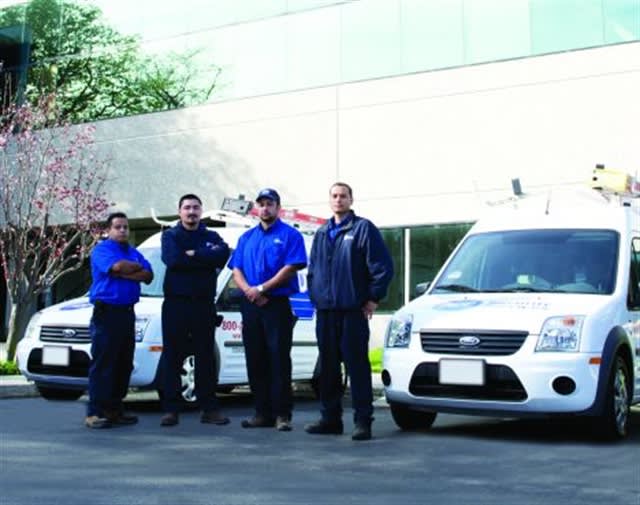
For ADT employees (l-r) Daniel Garcia, installation technician; Robert Robles, service technician; Davon Brazil, installation technician; and Jeffery Mojica, service technician, the Ford Transit Connect has helped them do their jobs better by being easier to handle and providing better access to equipment and supplies.
Splitting Up Isn't Always Hard to Do
Ken Foster is the director of North American Fleet Operations for Tyco. Foster oversees all fleet-related matters for Tyco, as well as its other business units including SimplexGrinnell.
On Sept. 19, 2011, Tyco announced a separation and split that will happen around Oct. 1, 2012. Foster is a Tyco parent company employee who has supervision over the ADT fleet. Once the change happens in October, Foster will be on the Tyco Fire Security side.
The split will separate ADT Residential and ADT Commercial. ADT Residential will become its own company, and ADT Commercial will move under the Tyco Fire Security umbrella, along with SimplexGrinnell. "Our main focus is continuing to consolidate strategic opportunities. We're looking at leveraging our size with each organization, so, as we move into the future, we've already consolidated our overall fleet with one fleet management company," Foster said.
ADT will stay partnered with GE Capital Fleet Services. "It did a portion of our business in the past, now it has it all within the North American sector. We are trying to take opportunities such as this and leverage them," Foster said.
The company is also leveraging its size for the OEMs as well by standardizing its fleet.
Foster doesn't see the upcoming split as a challenge, more a series of opportunities. "The challenges are really opportunities for us, because those businesses operate as one entity today, even though they're separate departments. We'll maintain the same type of structure as we move ADT Commercial going forward into the future. We'll continue to really have the same business model and really continue to leverage the strategic things we've already put in place, such as telematics and working with one FMC," Foster said. "Actually, the way we have the fleet designed today, there aren't too many distinct challenges, which is the good news. We've done a great job managing the fleets, so as we move forward and segment the fleets out, the challenge is more on paper than anything."
One additional change that will need to be made is adjusting fleet vehicle branding. Discussions are still ongoing, as of press time, regarding the naming of the commercial segment. Foster's biggest goal is to minimize disruption and downtime with field technicians.
"We're doing a mass reidentification of the vehicles on the weekends and at night, so that we aren't interrupting our business flow," Foster said.
According to Foster, the biggest opportunity and goal looking at this endeavor was optimizing the fleet. "We're trying to centralize our functions, do a lot of shared services with each respective department that helps support fleet," Foster said. "Standardizing our fleet should also give us some great return on our efforts as well as our dollars spent."
Managing Driver Information
In addition to rightsizing its fleet vehicles, ADT also took on a telematics solution. This portion of the transformational plan has resulted in increased driver productivity and the ability to further limit after-hours or unauthorized vehicle use.
Some of the challenges ADT faced instituting its telematics program were simply justifying the deployment of the new technology on a fleet of 7,000 vehicles, creating an overarching strategy around workforce assimilation and management, and controlling and managing the new information that the technology makes available.
To overcome its challenges, the company "took a collaborative approach with all key stakeholders in the company, and conducted a series of planning meetings on how to best adopt and implement the technology, knowing there was a significant 'change management challenge' facing this deployment," Wade noted. "We had more than 50 leaders across HR, finance, operations, operational excellence, customer experience, fleet, and strategic consulting who were instrumental in laying out the roadmap for this technology."
Tyco's Vince Valentin, vice president of service delivery, agreed about the importance of adding telematics to the ADT fleet. "Telematics not only provides dispatching optimization functionality, it also facilitates significant fuel usage reduction by identifying speeding incidents, aggressive driving, and idling. The associated behavior modifications resulting from leveraging telematics will translate into our broader efforts to be greener companies and into improved driver safety, which, in turn, will result in fewer accidents," he said.
According to Mark Smith, strategic consulting manager for GE Capital Fleet Services, one of the critical elements to the success of these types of partnerships is "the strong working relationship where you become a combined team, with representatives from both companies that have different functions. It can't be the traditional supplier/vendor relationship, because these initiatives take a tremendous amount of involvement."
Drivers Speak Up About Ford Transit Connect
Fleet drivers are the biggest contact point between the fleet manager and the fleet vehicles used. Here is what some of the ADT fleet drivers had to say about using the Ford Transit Connect:
"The Ford Transit Connect runs a lot smoother than our previous vehicles. We frequently drive in cities where we cannot park. We find a lot more parking availability because the [vans] are much smaller. The turning radius is also better than the bigger vans. They save a lot of gas. Every time we went to the gas station before, we saw three-digit [fuel cost] numbers on the bigger vans; now we see two-digit numbers," said Daniel Garcia, installation technician for ADT.
Robert Robles, service technician for ADT, also commented on the vehicle's maneuverability. "We drive around the Los Angeles area most of the day; we have a lot of high traffic volume. So, we have very tight spots we have to squeeze into and these vans are great. They are small in size, easy to maneuver. As far as the ladder racks, they are a lot more convenient for us than on the bigger, taller vans. These are a lot shorter. As far as tools and equipment, the cargo area is easier to store items because of the shelves and it's just a lot more convenient for us all around," Robles said.
Jeffery Mojica, service technician with ADT, agreed with Robles on the vehicles' feel.
"What I like most about the Ford Transit Connect is that it's a van, but it doesn't feel like a van when you are driving around. It feels more like a small car. It has a lot of cab space, and it makes it very easy to grab tools and equipment from the back. I'm very happy with it; I love driving this van," Mojica said.
Davon Brazil, installation technician for ADT, commented on the vehicle's ergonomics.
"The new Ford Transit Connect is so much better use-wise. There are places to put your stuff instead of throwing it everywhere. There are pockets for everything. You don't have to climb into the truck to grab something like before, scraping your knees on the floor - you just open a side door and grab what you need. The truck itself is so much better ergonomically," Brazil said.
View a video of driver reactions below:
More Operations

What Will Shape the Next Era of Fleet Management?
EVs, AI, and autonomous vehicles are reshaping fleet management. Discover what’s ahead—and how fleet leaders can prepare for the next era.
Read More →
How Fleets Can Recruit and Train Veterans for Technician Roles
Here's how the technician shortage has affected uptime for fleets, and what to do about it.
Read More →
Avis Budget Group Deploys Neology Toll Management Technology Across Major Brands
Neology’s neoFleet platform will manage toll transactions and toll-authority operations for vehicles across Avis, Budget, Payless, Budget Truck and Zipcar.
Read More →

Fleet Personal-Use Charges Edge Higher in 2026
Nearly eight in 10 surveyed fleets allow personal use of company vehicles, while just over half of respondents report charging employees for the privilege.
Read More →
The Future of Fleet + What’s Changing Right Now | AF News Recap
Could developments overseas offer a preview of what’s coming for U.S. fleets? This week, we’re looking at the future of AI, autonomy, and electrification, plus Ford Pro’s new certified pre-owned program, smarter vehicle offboarding, and a new way for fleets to manage toll expenses.
Read More →
How to Handle Vehicle Offboarding
What do fleet managers need to do when a driver leaves?
Read More →
Fleet Manager’s Ultimate Playbook: Navigating the New Standard in OEM Connectivity
Rising operating costs, driver safety concerns, and unplanned downtime are putting unprecedented pressure on modern fleets. Discover how fleet managers use embedded OEM connectivity and real-time vehicle data to cut TCO, prevent downtime, and protect drivers without aftermarket telematics hardware.
Read More →
U.S. Bank Adds Verra Mobility Toll Management to Voyager Fleet Platform
The integration allows U.S. Bank Voyager fleet customers to manage toll payments and violations alongside fuel, EV charging and maintenance expenses.
Read More →
ADAS Prevents Crashes. But Repairs Cost More | AF News Recap
ADAS-equipped vehicles may crash less often, but they can cost more when they do. This week, we’re breaking down what that tradeoff means for fleets, plus Subaru’s first Forester Wilderness Hybrid, Nissan’s new e-POWER Rogue, and why Calstart has become Catalyst Mobility.
Read More →
Moventum Fleet Management Names Mark Iorillo Head of Sales
Iorillo brings nearly 20 years of fleet management and sales experience to the role, including previous positions at Element Fleet Management, CEI, Donlen and Ryder.
Read More →