




AALA Talks Shop at 1985 Meeting
"'Business as usual' would be a blessing!" one leasing exec confided over cocktails. In truth, the comment sums up the current mood of the automotive leasing industry.
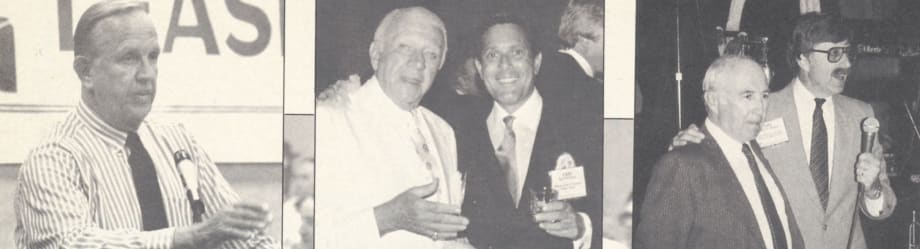
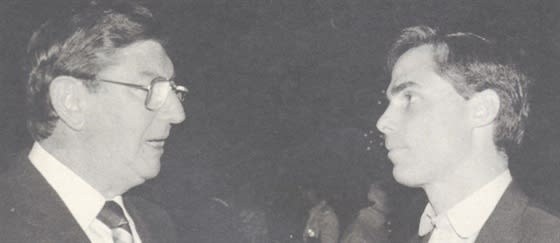
(left) Author Bob Townsend, (center) Zollie Frank of Wheels and AALA accountant Earl Holtzman, (right) retiring Sid Rose and AALA president Art Wolpert.
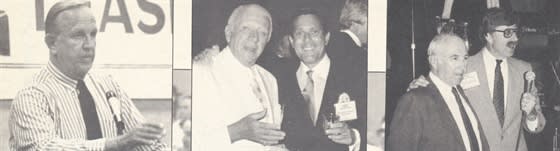
(left) Author Bob Townsend, (center) Zollie Frank of Wheels and AALA accountant Earl Holtzman, (right) retiring Sid Rose and AALA president Art Wolpert.
"'Business as usual' would be a blessing!" one leasing exec confided over cocktails. In truth, the comment sums up the current mood of the automotive leasing industry.
The leasing business is currently beleaguered from many hostile camps, including but not limited to the Internal Revenue Service, the Treasury, and legislatures on both national and state levels. The various attacks focus on how the leasing industry does business. And with so many battle points unresolved, the nation's lessors could be described as somewhat resolute but badgered. At least so it seemed at the recent thirtieth annual convention of the American Automotive Leasing Association, held at the Canyon Hotel in Palm Sprints from March 10 to 13.
Ford's Bill Willis (left) and McCullagh Leasing's Jack McCullagh (right) enjoy a laugh with AF publisher Ed Bobit (center).
Frustrations about the continuing difficulty of doing business, however, were offset with comradeship. When the association's opening business session was held Monday morning, the first item on the agenda was the association's golden handshake to Sid Rose. After serving since '64 as executive secretary for AALA, Rose will be retiring this June. Association President Art Wolpert presented Rose with the keys to a new Chrysler, which Rose humorously reckoned as the first auto he will have owned in 30 years. Also joining Wolpert on the podium congratulating Rose were Zollie Frank and Armund Schoen, both of Wheels, which was one of Rose's first major advertising accounts in the mid-fifties.
Wolpert then gave the over 250 attending members a status update on a number of recent events. Wolpert had just returned from testifying before the House Ways and Means Committee about the IRS' promulgated and revised requirements for contemporaneous recordkeeping. Wolpert had, in fact, advised on behalf of AALA that the requirements are burdensome, confusing, and unreasonable, and that they should be repealed. He told the organization in Palm Springs that the estimated cost of complying with the IRS' requirements would be $4-7 billion, while the revenue generated for the government would total only $150-200 million.
Wolpert also reported that the only proponents of the requirements were Ronald Pearlman, the Treasury's assistant secretary on Tax Policy; Roscoe Egger, IRS commissioner; and Bob Kastengren and Thomas Gearing, executives for Runzheimer International.

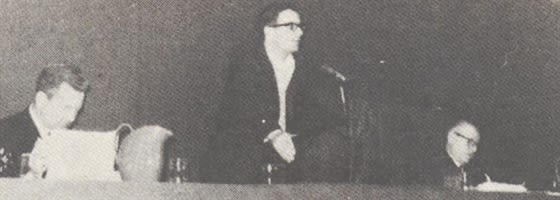
Zollie Frank (far left) joins Sid Rose (center) on the podium while Armund Schoen remembers Rose's early years.
The fact that Runzheimer International came out in favor of the proposed regs was a frequent topic of conversation at the convention, leading one AALA official to say that 'Runzheimer is no friend of fleet business." In truth, the differences of opinion cannot be that simply appraised. Brad Burris, publisher of RunzheimerReportsonTransportation, stressed that Runzheimer International testified at the request of the committee and that the testimony was limited to recordkeeping from the driver's point of view. "We recommended a reduction in the recordkeeping to a single entry per day," Burris stressed, "which is really easier than much of the recordkeeping already required, such as for entertainment expenses. But we also pointed out that corporations can reduce their costs if they realistically recognize personal use. We agree completely with the rest of the fleet industry that the regulations do contain inconsistencies, many areas of confusion, and difficult administrative processes, which we indeed oppose."
PHH's Sam and Beverly Penn enjoy the dinner/dance. Gene Arbaugh is in the background.
Wolpert also told AALA's convention attendees that S. 518 has been introduced into the Senate, calling for the repeal of contemporaneous recordkeeping requirements. But at the time of the Palm Springs convention, the House and Senate had not yet acted to repeal the requirements. Speaking to the odometer-tampering issue, Wolpert informed members that AALA has withdrawn from the Odometer Tampering Elimination Committee because of concern that it might be in violation of anti-trust laws, although AALA is still committed in spirit. Additionally, Wolpert reported that anti-fleet-incentive legislation H.R. 5305 had not yet been introduced, although a similar bill had been introduced and defeated in Oklahoma.
If Wolpert had not pointed to a sufficient number of clouds on the horizon, Doug Fraser certainly did in his keynote address. Recently retired as sixth president of the United Auto Workers and having also served as a workers' representative on the Chyrsler Board of Directors, Fraser focused on the current work environment. Speaking a week after the end of the Voluntary Restraint Agreement with Japan, Fraser called our trade arrangements with the Far East country "one-sided, lopsided, inequitable, and discriminatory." In Fraser's eyes, the consequences of removing VRA will be that Toyota, Honda, and Nissan will move toward larger segment penetration, while Mazda, Mitsubishi, Isuzu, and Suzuki will be "waiting in the wings." Fraser also spoke of Japan's commodity tax system that gives their exports a price advantage," implying that the scope of the problematic trade imbalance is so great that it requires far more dynamic action than heretofore implemented.
Turning to slightly less controversial topics, Fraser detailed changes in the auto manufacturing environment. "You will never go back to the old authoritarian ways of the workplace," Fraser commented, "but you can reduce the areas of conflict." Specifically, Fraser focused on the manufacturers' devotion to the "quality of work-life" concept, with workers being "appreciated as intelligent individuals who can make a contribution." In Fraser's eyes, these changes in the workplace affect not only the overall attitude of workers and management but profitability and product integrity as well.
Following Fraser was Robert Townsend, former Avis Corp. chairman and management expert known for his best-seller, UptheOrganization. Although considered a bit unorthodox by some, Townsend shared with AALA members his philosophies for making the business environment more stimulating, productive, and satisfying for employers and employees alike. Again, the key thoughts were participation and personal investment.
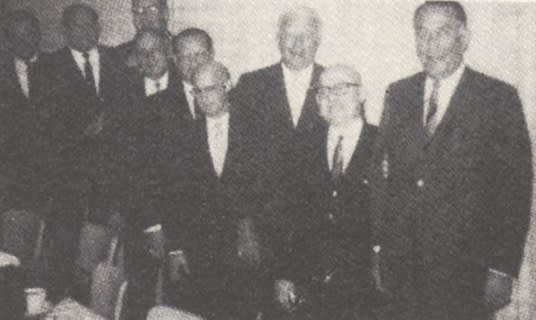
Henk Bosman (left) of US Fleet Leasing shares his astute appraisal of the state of the leasing industry with new AALA executive director John Fitch, who will head transfer of the association's offices to Washington, DC.
Later in the day, Chuck Parker of Leasemark and Elliot Kotzker of Sherwood Leasing chaired a compensation workshop that was aimed at helping leasing company members develop more effective compensation programs. The basic goals of a compensation program were outlined as retaining present management, motivating through profits and objectives, and attracting new talent and ideas. Several trends in leasing-company compensation include: compensation plans being tied to profits and performance, stock being awarded or offered, plans being structured around "management by objectives," employees being given more direct responsibility for profits, and long-term incentives being offered to key employees.
The March compensation survey covered companies with fleets ranging from 141 to 45,000 leased vehicles, and salaries ranging from $24,000 to $85,000 for sales managers and $18,000 to $140,000 for general managers. Incentive plans for sales managers ranged from percentages of profits to 25 percent of base, with seemingly every combination in between. Incentive plans for general managers ranged 10 percent of profit to 6 percent after tax to 20 percent of profit and 25 percent of salary.
On Tuesday morning, the topical issue of residual-value insurance was explored by a panel of experts: Sean Sweeney of Wheelways Insurance and Financial Services; Jim Aiken, publisher of AutomotiveLeaseGuide, and Aaron Stern of Residual Value Management Corp. In Sweeney's words, the most important questions that someone considering residual-value insurance should ask are: First, what is the integrity of the publication that projects residual values? Sweeney recommended looking at a number of year's figures and comparing projections from three years ago with current market values. And second, what is the financial strength of the insuring company? Sweeney recommended investigating a company's BEST rating, that is, the rating of their ability to pay claims down the line.
Following the residual-value panel, AALA General Counsels Ellis Lyons and Ed Groobert provided updates on recent developments on the Washington, D.C, scene, focusing primarily on IRS matters. The most recent activities revolved around the Service's revamping of the regulations covering record keeping requirements, but the current status of anti-fleet-incentive legislation was also bandied about, with the watchword being "caution," in that no news from NADA is not necessarily good news.
On Wednesday morning, Donn Miller of Albert Leasing chaired the ever-popular seminar on used cars and operating leases.
It is difficult to sum up the mood of an entire convention in a few sentences. The recent AALA convention certainly provided a forum in which members could take a look at some '86 new product, project ramifications of tax changes, and share feelings about the state of the leasing industry. But more than that, it gave members a good sense of how challenging the leasing environment currently is. And that knowledge in turn provided members with the chance to prepare themselves to confront the new horizons ahead in a constantly changing industry.
More Operations

How Fleets Can Recruit and Train Veterans for Technician Roles
Here's how the technician shortage has affected uptime for fleets, and what to do about it.
Read More →
Avis Budget Group Deploys Neology Toll Management Technology Across Major Brands
Neology’s neoFleet platform will manage toll transactions and toll-authority operations for vehicles across Avis, Budget, Payless, Budget Truck and Zipcar.
Read More →
Fleet Personal-Use Charges Edge Higher in 2026
Nearly eight in 10 surveyed fleets allow personal use of company vehicles, while just over half of respondents report charging employees for the privilege.
Read More →
The Future of Fleet + What’s Changing Right Now | AF News Recap
Could developments overseas offer a preview of what’s coming for U.S. fleets? This week, we’re looking at the future of AI, autonomy, and electrification, plus Ford Pro’s new certified pre-owned program, smarter vehicle offboarding, and a new way for fleets to manage toll expenses.
Read More →
How to Handle Vehicle Offboarding
What do fleet managers need to do when a driver leaves?
Read More →
Fleet Manager’s Ultimate Playbook: Navigating the New Standard in OEM Connectivity
Rising operating costs, driver safety concerns, and unplanned downtime are putting unprecedented pressure on modern fleets. Discover how fleet managers use embedded OEM connectivity and real-time vehicle data to cut TCO, prevent downtime, and protect drivers without aftermarket telematics hardware.
Read More →
U.S. Bank Adds Verra Mobility Toll Management to Voyager Fleet Platform
The integration allows U.S. Bank Voyager fleet customers to manage toll payments and violations alongside fuel, EV charging and maintenance expenses.
Read More →
ADAS Prevents Crashes. But Repairs Cost More | AF News Recap
ADAS-equipped vehicles may crash less often, but they can cost more when they do. This week, we’re breaking down what that tradeoff means for fleets, plus Subaru’s first Forester Wilderness Hybrid, Nissan’s new e-POWER Rogue, and why Calstart has become Catalyst Mobility.
Read More →
Moventum Fleet Management Names Mark Iorillo Head of Sales
Iorillo brings nearly 20 years of fleet management and sales experience to the role, including previous positions at Element Fleet Management, CEI, Donlen and Ryder.
Read More →
Fleet Has a Talent Pipeline Problem. What Comes Next? | AF News Recap
Where will fleet’s next generation of leaders come from? This week, we’re looking at the industry’s talent pipeline, what certification can add to a fleet career, how to build an award-worthy track record, and the return of Automotive Fleet’s Personal Use Survey.
Read More →