




7 Questions to Ask When Spec'ing a Service Body
Service technicians utilize a variety of tools and equipment that must be kept organized and within reach. With the multitude of available options, these seven questions will help narrow the field.

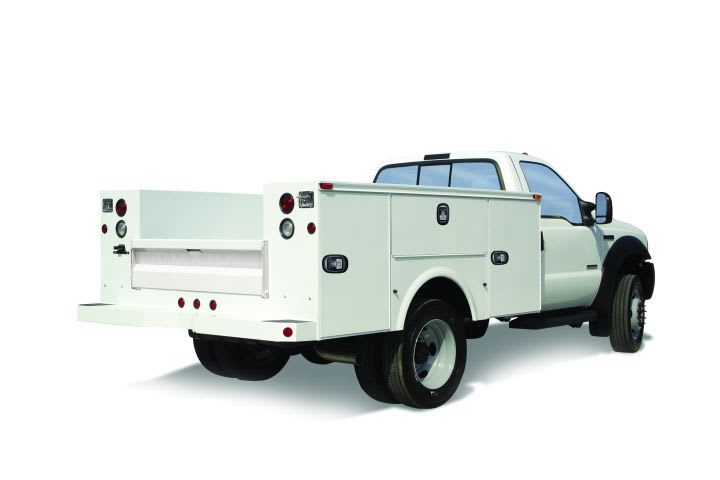
Also consider body material. The standard material used in service bodies is steel; however, some body manufacturers offer lighter weight materials, such as aluminum and fiberglass.
Photo: Omaha Standard Palfinger
Service bodies, also known as utility beds, are essentially heavy-duty toolboxes on wheels. They are available in a full range of configurations, sizes, materials, and other options, enabling service technicians to haul tools, equipment, and parts they need - organized for quick and easy access - to maximize jobsite productivity. Service bodies enable employees to focus time on doing the job, instead of fumbling through cluttered piles of parts to find the right one.
Typical industries that use service bodies include electrical, plumbing, mechanical, heating and air, mobile equipment service, and general construction. However, chances are, whatever the industry, if tools and parts of any kind are hauled in fleet trucks and vans, a company either utilizes service bodies or has at least looked into them.
What steps should be taken to spec a service body that's right for fleet? Use these seven questions as a guide.
1. What equipment will be hauled in the body?
Create a list of what a full load would contain, including estimated quantities and weight per unit. Include equipment, tools, parts, materials - whatever will be placed in the truck.
The list will dictate what compartment configuration will work best. Also ask an upfitter about bins, trays, and other options offered to determine how best to organize equipment for maximum productivity.
2. What will be hauled outside the body?
Will the vehicle haul ladders? Pipes? Conduit? A crane? Compressor? Auxiliary fuel tank? This will impact payload and whether racks and/or reinforcement are needed for the body to support the equipment.
"If you're going to mount a crane, for example, you need a heavier duty body," said Jim Brown, product manager for Omaha Standard Palfinger. "The body moves away from a standard service body and moves into a crane body, where the body can take the abuse of the day-to-day crane operations."
Whether or not equipment is mounted on top of the body also determines if a flip top can be spec'ed, which offers greater accessibility to tools and parts due to the ability to open the side box from the top. If equipment will be installed on top of the side compartments, the flip top won't work, requiring a standard solid top.
3. Will the vehicle's payload require an enclosed body for more space, or protection from the elements and theft?
A standard service body is open in the center with a tailgate, similar to a pickup bed. If materials can be thrown in the back of a truck without concern of corrosion or theft, an enclosure is not necessary. However, if extra hauling capacity with greater security and protection is necessary, consider enclosure options, which typically include a low-profile sliding roof or high roof available in several heights.
4. What will the anticipated maximum load weigh?
This will drive payload requirements and chassis selection. A body supplier will be able to take the anticipated maximum load weight and help determine what gross vehicle weight rating (GVWR) chassis best matches fleet needs.
If the projected total weight of chassis, body, and payload is less than 10,000 lbs., for example, the most likely candidate is a single-rear wheel ¾- to 1-ton chassis. Over that mark, a dual-rear wheel 1-ton or larger chassis is required.
Also consider body material. The standard material used in service bodies is steel; however, some body manufacturers offer lighter weight materials, such as aluminum and fiberglass that may allow the ability to drop to a smaller chassis for improved fuel economy and a lower truck price, without sacrificing payload. The pricing advantage upfront is for steel. Aluminum and fiberglass will range $1,000-$3,000 more for a comparable body.
Chassis selection, whether single-rear or dual-rear wheel, impacts available body width and length. A dual-rear wheel chassis offers a wider body with deeper compartments and more length options, from 56-in. cab-to-axle (CA) for an 8-ft. service body to 60-in. (for 9-ft. body) to 84-in. (11-ft. body) and longer for a medium-duty chassis. Single-rear wheel is only available with a 56-in. CA.
5. Will the truck be operated off road?
This determines whether a four-wheel drive chassis and any modifications to the body to handle off-road conditions are required.
"If you're off road, you might need a spring-mounted body kit," Brown from Omaha Standard Palfinger advised. "This allows the body to basically float on the chassis. There are two springs mounted on the front of the body that attach to the front of the chassis and allow the body to flex going up over curves and down through ditches."
6. Will the truck pull a trailer? If so, what is the total weight of the trailer and its payload?
The answer will help calculate the gross combination weight rating (GCWR) chassis necessary to fit an application. GCWR is the maximum allowable weight (as certified by the truck manufacturer) of the chassis, body, and payload combined with the fully loaded weight of the trailer and its contents.
Overlooking this question is a common mistake fleet managers make, said Brown of Omaha Standard Palfinger. For example, a single-rear wheel ¾-ton chassis may work fine with the current body payload, but if the vehicle will be towing 12,000 lbs. with a full load in the service body, the GCWR will be exceeded. If a trailer is pulled in this instance, a larger chassis will be needed.
Ensure the company's vehicle upfitter knows the unit will be towing a trailer, how much weight it will tow, and whether it will tow with full payload in the service body. This way, the upfitter can help select the right capacity.
7. Will the truck be operated in a region prone to corrosion?
This is especially important if the truck is operated in the northern snowbelt regions that use corrosive road salts or in coastal areas with salty air. Aluminum and fiberglass tend to hold up better in these conditions.
If steel is selected, look at the manufacturing quality. Inspect for crevices in the body that could collect moisture and cause premature corrosion. Most steel service body manufacturers use some form of corrosion-resistant coating (e-coat, etc.) to protect truck bodies.
The Bottom Line
With the answers to these seven questions, a fleet manager can be prepared to collaborate with service body manufacturers or distributors to design and build a service body that's right for fleet.
Originally posted on Work Truck Online
More Vehicle Research

Commercial Fleet Sales Rise 5.8% Through September 2026
September commercial fleet sales were essentially unchanged from a year earlier, slowing year-to-date growth while keeping volume ahead of 2025.
Read More →
Hall of Fame Inductee: John Dmochowsky
The longtime Mondelēz International fleet executive joins the Automotive Fleet Hall of Fame.
Read More →
Hall of Fame Inductee: Lee Miller
After more than four decades at Boehringer Ingelheim, Lee Miller leaves a legacy built on fleet expertise.
Read More →
Hall of Fame Inductee: Mark F. Petersen
From managing fleets of thousands of vehicles to advancing safety and mentoring fellow professionals, Mark F. Petersen made his mark across both the corporate and supplier sides of fleet.
Read More →
When Charger Downtime Becomes a Fleet Availability Problem
As EV deployments move beyond pilot programs, charger reliability can directly affect vehicle readiness, driver productivity and route scheduling.
Read More →
2027 Nissan Rogue Hybrid Adds e-POWER, Standard AWD
The new Rogue Hybrid uses Nissan’s e-POWER system with dual electric motors, offers an estimated 40 mpg and starts at $35,490.
Read More →
2027 Subaru Forester Adds First Wilderness Hybrid
The 2027 Forester lineup starts at $29,995 and adds a Wilderness Hybrid with 194 combined horsepower and 9.3 inches of ground clearance.
Read More →
EV Realty Names Henrik Holland President as Charging Platform Expands
The former Prologis Mobility and Shell executive will help expand EV Realty’s truck charging business and move its power-first infrastructure model into autonomous vehicle depots and other fleet sectors.
Read More →
Mercedes-Benz Introduces Electric GLC With Up to 350 Miles of Range
The GLC 400 4MATIC Electric features an 800-volt architecture, 330-kW DC fast charging and a 94-kWh battery, along with Mercedes-Benz's new MB.OS operating system.
Read More →
Fleet Has a Talent Pipeline Problem, not a Talent Problem
Where will the next generation of fleet leaders come from, and what does the industry need to do differently to find them?
Read More →