




5 Forgotten Driver Distractions to 'Wreck'-ognize
Distracted driving policies should include the less thought about, but still prevalent, distractions that substantially increase crash risks.
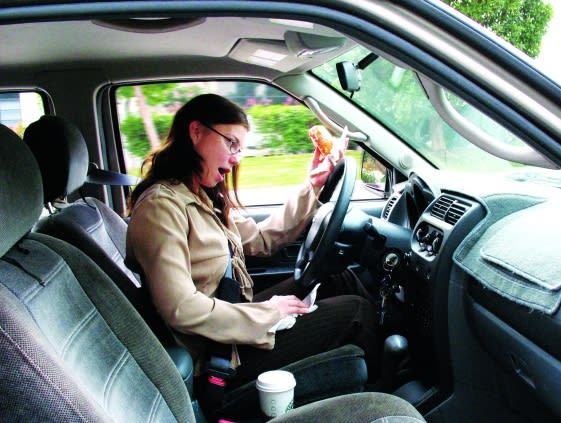
Eating, drinking, using a handheld device, or operating vehicle electronics while driving are distractions that cause drivers to lose focus on vehicle operation and increase crash risk.
While banning the use of handheld devices while driving, especially texting while driving, has been at the forefront of company fleet safety policies, there are other less recognized cognitive and physical distractions that continue to impact the safe operation of fleet vehicles.
In 2008, the National Highway Traffic Safety Administration (NHTSA) reported that all drivers engage in secondary tasks 30 percent of the time while their vehicles are in motion.
NHTSA and the Virginia Tech Transportation Institute showed that driver distractions were behind 65 percent of near-crashes and 80 percent of crashes. Research has shown that most crashes occurred within 3 seconds after the driver was distracted.
Cell-phone use and texting may be today’s biggest scourge in the transportation safety sector, but there are other common driver distractions that also substantially increase crash risks:
1. Eating Causes Driver Mistakes
Eating while driving is riskier than talking/listening to a handheld device, according to NHTSA. After reviewing a 2006 crash-risk analysis, NHTSA found that the extended glance length of eating while driving caused a 1.57:1 crash-risk ratio while talking/listening to a handheld device while driving caused a 1.29:1 crash-risk ratio.
The U.S. Court of Appeals for the District of Columbia Circuit recently ruled the hours-of-service regulations for drivers of property-carrying commercial motor vehicles (CMVs) will no longer be enforced as of July 1, 2013, meaning drivers with the ability to fold the passenger seat down, may be even more tempted to turn that workspace into a countertop for eating while driving.
2. Don’t Resist a Rest
Drowsy driving reduces response time, which increases the crash risk ratio 4.24:1, according to NHTSA. Drowsiness typically has more to do with time-of-day rather than time-on-task.
The Federal Motor Carrier Safety Administration (FMSCA) reported that drowsy driving is two times more likely to occur during the first hour of a work shift, because drivers are not fully refreshed and awake when they begin their day.
According to a 2011 assessment by FMCSA, drowsy driving is also more common among younger or less experienced CMV drivers. Fleet managers should inform their drivers of the statistics on drowsy driving during training.
3. Living in a Dream World
In 2013, Erie Insurance Company released its Fatality Analysis Reporting System, which reviewed nationwide crash data between 2010 and 2011. According to the data, police listed drivers as “lost in thought” 62 percent of the time as the cause of vehicle collisions.
Daydreaming while driving, as with other distracted driving habits, is voluntary, and if caught, drivers should be reprimanded for voluntarily endangering company property, and disregarding their job duties and personal safety, which may result in a lawsuit against the company.
4. Limit In-Car Entertainment
Controls, displays, and driver aids are standard driving tools today. After observing drivers who were instructed to perform radio tuning, NHTSA recorded that crash-risk increased after the driver’s eyes left the road for more than 2 seconds. Furthermore, NHTSA research noted that a task should not take longer than 12 seconds.
5. Put a Lid on Sightseeing
Drivers should constantly scan the road, but should not fixate on objects surrounding the road. According to the FMCSA, drivers who fixate on external objects — e.g., people, billboards, and landmarks — are likely to enter into a blind gaze where they are not paying attention to the road.
More Safety
IIHS Crash Avoidance Tests Reveal Safety Gaps in Cargo Vans and Work Trucks
New crash-avoidance ratings from the Insurance Institute for Highway Safety reveal inconsistent performance among commercial vehicles, with several popular cargo vans and heavy-duty pickups struggling to avoid collisions with other vehicles and pedestrians.
Read More →
What’s Next for Fleet? Safety, AI & Industry Recognition | AF News Recap
Could your company's culture be encouraging distracted driving? This week, we're exploring how workplace expectations affect driver safety, what AI, EVs, and autonomous vehicles could mean for the future of fleet management, and how fleet professionals can strengthen their award nominations.
Read More →
Does Your Fleet's Culture Encourage Distracted Driving?
What happens when the people responsible for enforcing safety rules are the ones setting the wrong example? The answer may reveal why some of the biggest risks to fleet drivers have little to do with what's written in the employee handbook.
Read More →
Fleet Manager’s Ultimate Playbook: Navigating the New Standard in OEM Connectivity
Rising operating costs, driver safety concerns, and unplanned downtime are putting unprecedented pressure on modern fleets. Discover how fleet managers use embedded OEM connectivity and real-time vehicle data to cut TCO, prevent downtime, and protect drivers without aftermarket telematics hardware.
Read More →
From Driver Well-Being to EV Charging | AF News Recap
Mental health belongs in the fleet safety conversation. This week, we’re looking at five ways fleets can support employee well-being before a crisis, plus Holman’s expansion in Mexico, new one-day Fleet Forward passes, and why EV charging demand is outpacing infrastructure growth.
Read More →
Nexar-Nauto Merger Aims to Give Fleets Better Safety Intelligence Through Larger Driving Dataset
Stefan Heck tells Automotive Fleet that combining more than 10 billion miles of driving history with Nexar's AI models will give fleets deeper insights into driver risk and roadway conditions than either company could provide independently.
Read More →
Don't Wait for a Crisis: 5 Ways to Build Mental Health Into Your Fleet Safety Program
For Suicide Prevention Month, fleet and safety leaders have an opportunity to put mental health where it belongs: at the center of workplace safety.
Read More →
How Camera Data Can Strengthen a Fleet’s Insurance Renewal
Insights from a commercial insurance carrier and a broker show how fleets can turn video telematic data, driver coaching, and improved claims results into a stronger case at insurance renewal.
Read More →
The Safest Fleets Aren’t the Ones with the Most Technology
You’ve made the telematics investment. Here’s how to capture the other half of its value and build the safest fleet on the road.
Read More →
Hidden in Plain Sight: Fleet Compliance Risks
Fleet compliance isn't just about having policies — it's about consistently enforcing them. This practical guide reveals six hidden compliance risks common in public sector and shared fleet operations and outlines proven strategies to improve visibility, accountability, and audit readiness
Read More →