





Explore More:Safety Pointers Before You Get Behind the Wheel
12 Truths About a No-Accident Fleet Safety Culture
Daily safe practices are a core business proposition for any fleet operation and should permeate the entire organization.
December 7, 2023
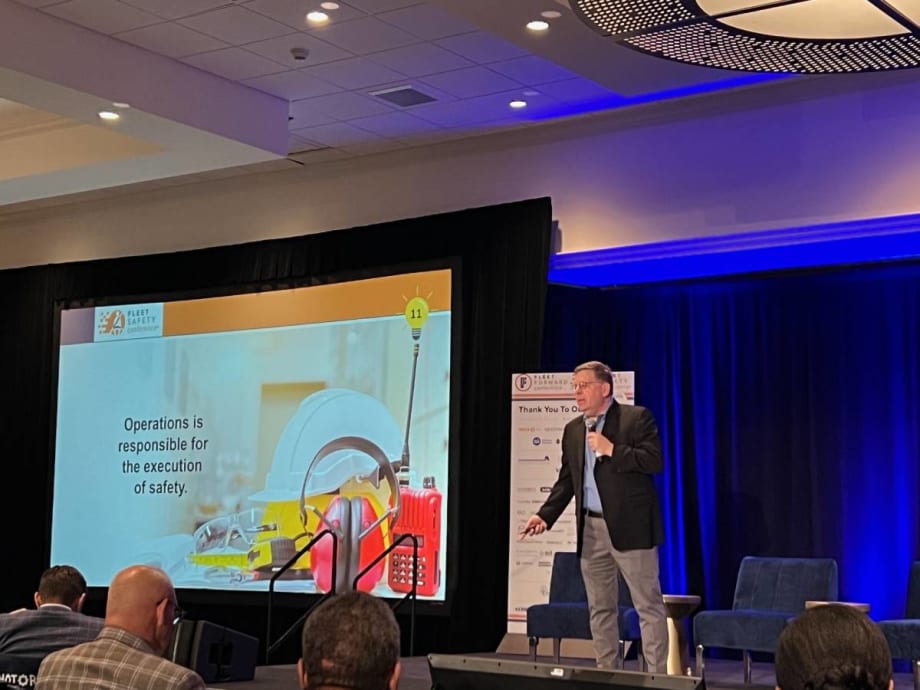
Brian Fielkow, executive vice president of Risk Resources, told an audience Nov. 8 that fleet managers can’t keep doing the same thing on fleet safety time and again and expecting different results.
Photo: Martin Romjue / Bobit
5 min to read
Fleet managers should be ready to answer four key questions when sizing up their safety practices and overall approach: How strong is your safety culture? Is your team living and breathing safety? Are we really living our values? Are we truly providing safety leadership?
The correct answers to those questions can be derived from 12 core principles that Brian Fielkow, executive vice president of Risk Resources, outlined on Nov. 8 during a keynote presentation at the Fleet Safety Conference held in Santa Clara, California.
“Customers don’t want to do business with rogue operators,” Fielkow said. “Safety is a hard-core business proposition. You must think differently about safety; we can’t keep doing the same thing time and again and expecting different results.”
12 Safety Culture Tips
While priorities shift and checklists change, and sometimes compete for each other, safety should stand solid no matter how an organization evolves, Fielkow said before listing the 12 ways fleet managers can develop and instill a strong and consistent fleet safety culture:
NO. 1:Safety at core.
Nothing can compete with a set of immutable, non-negotiable values that should include fleet safety. Productivity and production pressure can never trump safety.
NO. 2: What fleets call an accident is not an accident.
Very few things are accidents. Accidents happen by chance and cannot be prevented. Instead, they should be called crashes or incidents because they are “behavior based and preventable,” he said. “Get accident out of your vocabulary. Call it a crash or an incident.”
NO. 3: 99% is not good enough.
If you are an actuary, you look at crashes and probability. Zero is a mindset. You may not get there but you need to not accept preventable crashes.
NO. 4: If you think safety is expensive, consider the cost of the opposite.
Crashes and incidents can result in deaths, in addition to higher insurance costs and expenses, legal problems, bad morale, loss of customers, retraining and rehiring employees, and a competitive disadvantage. A consistent safety program is priceless compared to the loss of life and permanent disability.
NO. 5: Safety extends beyond compliance.
Just because you’re compliant, does not mean you are safe. If a driver is sick or fatigued, don’t drive. That concept is not found in any regulation, but it’s behavior that a fleet safety program can discourage or prohibit.
NO. 6: Safety is leader driven and will not bubble up organically.
Safety is core to operational excellence.
NO. 7: Safety is employee owned if it’s leader driven.
The most important group is front line opinion leaders, or champions. If you bring in the front-line drivers and employees, an operation can change for the better. Quoting McKinsey & Company, Fielkow said, “A blind spot seems to be the failure to involve frontline employees and their managers in the effort.”
“Let’s get out of the habit of saying good-bye. I’m lukewarm to exit interviews. Figure out how to say hello. Building bridges instead of breaking bridges.”
By building bridges to new employees, a fleet operation can build a stronger safety culture. “Orientations are like fire hoses. People can’t retain that much in a week. Compare that to integration. It takes six months to a year to properly integrate an employee into your environment. What happens on day 45, day 60? It takes that long to decide whether you want them to be there, or they want to be there.”
NO. 8: Move from a blame culture to a just culture.
“When things go wrong, and incidents and mistakes happen, this idea of progressive discipline leads to mistakes. You are human; humans make mistakes: Was it an honest mistake or reckless behavior?”
NO. 9: Cultivate unconditional respect for process.
“We’re drowning in a sea of papers and PDFs. What holds everything together? Professionals follow procedures. They do the right thing when no one is looking. At the core of incidents is a lack of respect for processes. We need better processes, not more.”
If a process is written at a high school or collegiate level, then it’s not readable to most employees. A checklist provides consistency, whether it’s for the “first flight or the 5,000th flight,” Fielkow said, invoking an aviation comparison.
Categorize life critical violations, such as: If an act is likely to kill or maim an employee; using a handheld cell phone while driving; working while drunk or stoned; failing to report accidents; near misses; vehicle damage; reckless driving; pulling unauthorized equipment; improperly securing a load. “Isolate behaviors that are acute in your operation,” he said.
NO. 10: Dismiss severity.
If you run a safe operation, you cannot get caught up on severity. Whether an outcome is severe or not is a function of luck. Focus on behavior and retrain after a so-called minor incident. A fleet operation cannot measure safety success by a lack of crashes.
NO. 11: Tear down the silos.
“If we run large organizations, operations is responsible for safety,” Fielkow said. “You can’t delegate to a department. Safety is not a department, it’s a way of life. Who’s responsible for safety in this organization?”
NO. 12: Overcome the fear of change.
“The ability to drive change is a matter of trust; the more they trust you, the more they will change,” he said. “The champion is no good unless there is clear leadership support. Put people first. The more you capture the power of front-liners to drive change, the more you’ll get it. A top-down memo on Monday won’t work. Employees won’t support it unless they are included. Bring them in.”
Subscribe to Our Newsletter
More Safety

Sponsored•October 1, 2026
Fleet Manager’s Ultimate Playbook: Navigating the New Standard in OEM Connectivity
Rising operating costs, driver safety concerns, and unplanned downtime are putting unprecedented pressure on modern fleets. Discover how fleet managers use embedded OEM connectivity and real-time vehicle data to cut TCO, prevent downtime, and protect drivers without aftermarket telematics hardware.
Read More →
From Driver Well-Being to EV Charging | AF News Recap
Mental health belongs in the fleet safety conversation. This week, we’re looking at five ways fleets can support employee well-being before a crisis, plus Holman’s expansion in Mexico, new one-day Fleet Forward passes, and why EV charging demand is outpacing infrastructure growth.
Read More →
Nexar-Nauto Merger Aims to Give Fleets Better Safety Intelligence Through Larger Driving Dataset
Stefan Heck tells Automotive Fleet that combining more than 10 billion miles of driving history with Nexar's AI models will give fleets deeper insights into driver risk and roadway conditions than either company could provide independently.
Read More →
Don't Wait for a Crisis: 5 Ways to Build Mental Health Into Your Fleet Safety Program
For Suicide Prevention Month, fleet and safety leaders have an opportunity to put mental health where it belongs: at the center of workplace safety.
Read More →
How Camera Data Can Strengthen a Fleet’s Insurance Renewal
Insights from a commercial insurance carrier and a broker show how fleets can turn video telematic data, driver coaching, and improved claims results into a stronger case at insurance renewal.
Read More →
The Safest Fleets Aren’t the Ones with the Most Technology
You’ve made the telematics investment. Here’s how to capture the other half of its value and build the safest fleet on the road.
Read More →
Sponsored•August 7, 2026
Hidden in Plain Sight: Fleet Compliance Risks
Fleet compliance isn't just about having policies — it's about consistently enforcing them. This practical guide reveals six hidden compliance risks common in public sector and shared fleet operations and outlines proven strategies to improve visibility, accountability, and audit readiness
Read More →
NETS Sets 2026 Fleet Safety Benchmark Conference for Indianapolis
The Sept. 15–17 program will feature fleet benchmarking data, case studies, emerging technologies, and implementation strategies while running alongside the NSC Safety Congress & Expo.
Read More →
Off-the-Job Crashes Account for 43% of Employers’ $61.7 Billion Crash Burden
NETS quantifies costs dispersed across fleet, risk, HR, and other departments while providing new per-crash benchmarks for employers.
Read More →
Ram Recalls More Than 1.27 Million 1500 Pickups for Seat Belt Anchor Issue
The recall affects certain 2019-2026 Ram 1500 pickups that may have improperly attached second-row seat belt buckle anchors.
Read More →