




Why Are More Fleets Turning to Cooperative Contracts to Buy Vehicle Lifts?
10 Essential Winter Lift Tips to Boost Shop Safety
Heavy-duty vehicle lift manufacturer Stertil-Koni recommends 10 top tips to improve safety for the busy technicians working on the shop floor.
by Stertil-Koni
October 19, 2018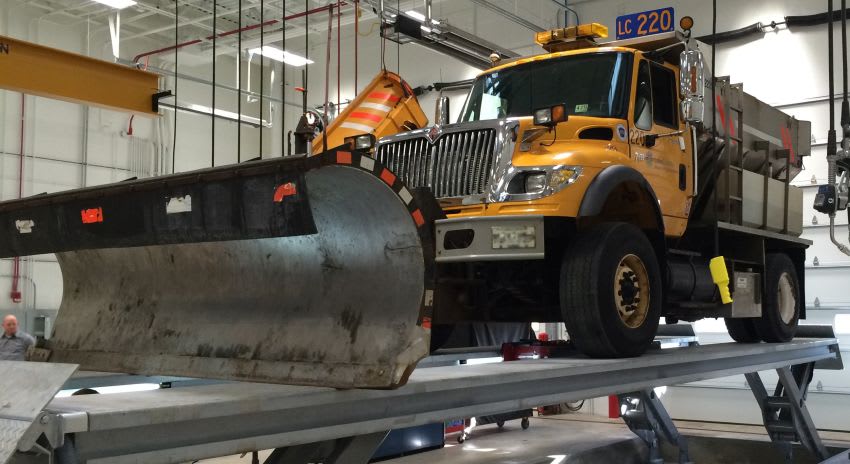
Platform lifts are designed for rapid drive-on, drive-off maintenance. Here, the Stertil-Koni SKYLIFT-Washbay model prepares for a snowplow.
Photo: Stertil-Koni
4 min to read
Following an in-depth review of bus and truck maintenance facilities across North America, combined with heightened service demands due to evolving weather patterns and increasing operational pressures, heavy-duty vehicle lift manufacturer Stertil-Koni recommends 10 top tips to improve safety for the busy technicians working on the shop floor.
As seasons change, fluctuating temperatures and unpredictable conditions can create challenges for work truck fleet maintenance teams. From increased moisture affecting equipment to temperature swings impacting hydraulic systems, staying ahead with a solid preventive maintenance (PM) strategy is key.
“With the fall and winter months bringing shifting conditions, now is the time to plan for and advance your preventive maintenance strategies,” noted Peter Bowers, technical sales support manager at Stertil-Koni. “The advantages are compelling, especially in the form of heightened shop safety, prolonged vehicle life, reduced failures and breakdowns, and sustained maximum vehicle uptime,” added Bowers.
Top 10 Tips for Lift Safety
With so much riding on commercial vehicles and the maintenance personnel that service them, Stertil-Koni has developed 10 top tips for the safe operation of HD vehicle lifts during cold winter months.
Certification is Significant – Consider purchasing lifts certified by the Automotive Lift Institute (ALI). The ANSI/ALI ALCTV (current edition) is the standard for automotive lifts. This lift certification program makes it easy for fleet buyers to choose lifts that meet all safety requirements for construction, testing and validation. The ALI gold label is the only guarantee that a lift has been independently proven to meet stringent industry standards.
Lift Choice and Capacity – Know in advance the weight of the heaviest vehicle to be lifted and make certain that the lift selected is certified to meet or exceed that capacity. Also, confirm the height of the truck is appropriate for your shop’s ceiling height.
Learn the Lift – Well-trained lift operators should know the lift’s use and abilities, prior to powering up. Proper training ensures safe and efficient operation and prepares the user for an emergency situation. Keep a copy of the manufacturer’s lift manual nearby at all times.
Safety First – During lift set up check the perimeter of the lift to confirm that nothing is obstructing its path and there are no hazards in the lifting area. Lift the vehicle no more than 12 inches off the ground, pause, and do another sweep of the area to further check that there are no impediments.
Stability is Key – Always place lifts on a firm foundation and on level ground. This is especially important with Mobile Column Lifts – as they can be easily relocated for operation both inside and outside of the maintenance shop. When outside, check for wind loads. Further, select a lift with an “electronic synchronization” system. As the lift goes into motion and continues through the full-range up to its maximum height, vehicles should rise smoothly, even those with unequal weight distribution, such as fire trucks and pumpers. Assure that the lifted vehicle itself is level.
Adhere to Proper Lifting Points – At all times use designated lifting points on the vehicle. For inground lifts, operators should check that the contact points are properly positioned.
Technician Protection – Lift vehicles to a proper height so technicians can move about freely, safely and comfortably underneath the vehicle. Verify lifts are locked in position before standing under the vehicle.
Maintain a Lift Maintenance Schedule – Make sure lifts receive annual inspections by a certified ALI lift inspector. Also, use factory or manufacturer-authorized technicians to service and repair your lifts.
Create a Culture of Safety – Publicly and prominently post service bulletins, safety messages, and continuously update the skills of all technicians. This is vital to a smooth-running maintenance facility.
Accessorize your Lift – Utilize lift accessories specifically designed to help ensure truck fleet maintenance operator safety and proper ergonomics. One example is a high lift wheel dolly, which allows wheel removal and adequate alignment of dual tire assemblies and brake drums to be completed efficiently and accurately, without back strain.
Dr. Jean DellAmore, Stertil-Koni USA president, added: “Safety is always mission No. 1 in the service bay. That is precisely why we suggest using a well-planned safety-first approach so that shop technicians can perform their duties efficiently, ergonomically and with complete confidence. It also creates a positive workplace atmosphere, helps improve worker retention and contributes to greater longevity of the vehicles being serviced and the maintenance equipment the techs operate.”
Originally posted on Work Truck Online
Subscribe to Our Newsletter
More Global Fleet

GeoFencing Adds to Your Truck Security Arsenal
Geofencing is a familiar fleet tool today, but its early adoption marked a major shift in vehicle tracking, route monitoring, and the debate over employee privacy.
Read More →
Holman Takes Full Ownership of ARIZA in Mexico
Holman is bringing its Mexican fleet management operation fully under its own brand after more than 30 years as a joint venture. The change gives multinational fleet customers a single Holman operation across the U.S., Canada, and Mexico.
Read More →
5 Tire Maintenance Tips to Help Prevent Work Truck Downtime
Regular tire checks can do more than extend tread life. These five maintenance practices can help work truck fleets catch problems early, reduce costs, and prevent downtime.
Read More →

Proven Ways to Reduce Work Truck Downtime
The age-old problem of downtime will always be a reality, but with new strategies at hand, fleets have more ways to keep trucks on the road longer.
Read More →


Cameras, Safety and Insurance: From Reactive Claims to Real-Time Prevention (Part 2 of 2)
Part Two: Commercial auto remains one of the most challenging and costly lines of coverage for fleet operators and insurers alike. Continue learning more about how to effectively address these issues from Onur Aksan, Enterprise Business Development Executive, Geotab
Read More →
Cameras, Safety and Insurance: From Reactive Claims to Real-time Prevention
Commercial auto remains one of the most challenging and costly lines of coverage for fleet operators and insurers alike. Learn more about how to effectively address these issues from Onur Aksan, Enterprise Business Development Executive, Geotab.
Read More →
Fleet Costs Are Rising: Here’s How Leaders Are Responding
Fleet leaders are under pressure to reduce costs, adapt to economic uncertainty, and make smarter decisions. See how peers across North America are responding with real data, proven strategies, and forward-looking insights. Download the 2026 Market Pulse Report to benchmark your strategy and uncover where you can gain an edge.
Read More →
Enterprise Fleet Management Surpasses 900,000 Vehicles in U.S. & Canada
Enterprise Mobility connects with mobility solutions around the globe
Read More →