





RELATED: Benefits of a Service Level Agreement with Upfitters
10 Disadvantages to Using an Upfitter Service Level Agreement
Standardized delivery timelines stipulated in an SLA can create unrealistic expectations. Also, the relationship can become transactional in nature, with a risk of damaging the relationship if there are penalties for missed metrics.
January 20, 2017

An SLA that is overly rigid can have the unintended consequence of driving inefficient production.
Photo courtesy of Reading Truck Body
5 min to read
Although a service level agreement (SLA) with an upfitter can be beneficial, there are potential negative aspects that should also be considered.
Part 1 discussed the pros of an SLA. Here are 10 potential disadvantages to consider when deciding whether to develop an SLA with an upfitter:
1. An SLA can Create Unrealistic Expectations: “Creating standardized timelines can create unrealistic expectations that, in some cases, cannot be met. Issues and delays will happen, so, in the event that an agreed on timeline cannot be met, it’s important to communicate this to the end-user ahead of time,” said Steve Swedberg, truck engineering and ordering specialist for EMKAY.
2. An SLA can be Overly Rigid: “An SLA that is overly rigid can drive inefficient production. When an upfitter has to consistently put overtime in to meet a particular client’s SLA, the costs of the product go up, eventually affecting pricing,” said Joe Brightwell, supply chain, quality and operational excellence manager - service vehicles for Wheels Inc.
3. An SLA can Damage Upfitter Relationships: “There is a risk of relationship damage when an SLA is tied to penalties for missed metrics. Upfitters, or even the FMC, may feel that the client is taking advantage of them. We’ve found that a best practice for our clients is to tie both penalties and rewards to SLAs, so the upfitter feels they can ‘win’ with good performance, not just be punished for non-conforming performance. Penalties or rewards don’t necessarily need to be monetary in nature. Point systems, where points are added for good performance against an SLA and points are deducted for missed metrics, are a way to motivate upfitters without monetary threat,” said Brightwell.
Agreeing with this assessment is Partha Ghosh, director, supply chain management for ARI. “The downside to an SLA is that it formalizes expectations in a contractual context, which can be harmful to the relationship between the partners,” said Ghosh. “Consequently, the service provider may likely be focused on just meeting the client’s minimal expectations, and not necessarily interested in exceeding expectations, as the consequences of failure may be significant enough to deter the provider from doing more than what’s required.”
4. Formulating an SLA Requires Additional Time and Expense: “It takes input from legal and sourcing resources to create an effective set of documents/agreements,” said Scott Bailey, director, strategic alliances and sourcing for Element Fleet Management. “These types of agreements take the time to establish and refine, they don’t lend themselves to transactional (three bids and a buy) relationships.”
One factor not always taken into consideration is that monitoring compliance to an SLA requires additional resources on the part of an upfitter. “An SLA may require an increase in the upfitter’s staffing to meet standards, resulting in additional administrative fees,” said Joe Birren, truck design consultant for Donlen.
5. Difficult to Monitor: “One downside of an SLA is that it can be difficult to monitor. Additional upfitting challenges may arise if expectations aren’t clearly documented and communicated,” said Wayne Reynolds, manager, upfit design and consultation for LeasePlan USA.
6. An SLA May Have Unintended Consequences: “While there should always be a clear discussion about expectations and necessary results, taking the step of formalizing them in an SLA, and likely including financial or other penalties, could have the unintended consequences of producing results that are minimally acceptable and not necessarily what are in the client’s long-term interests,” said Ghosh of ARI.
7. Lack of Knowledge May Create Flawed Agreement: “An SLA requires detailed knowledge of supplier capability and the automotive market, which many clients don’t possess,” said Bailey of Element. “A poorly defined and executed SLA can drive the wrong behaviors, such as trying to take shortcuts.”
8. An SLA Makes the Relationship Transactional: “An SLA changes the dynamics of the relationship to a more transactional nature, and does not encourage a mutually supportive relationship that grows or changes as the business needs change. Depending on how the SLA is worded, aspects of it could be subject to interpretation, and misunderstandings on those interpretations could lead to challenges that benefit no one,” said Ghosh.
9. An SLA Doesn’t Work for All Relationships: “An SLA works for ongoing or large relationships. One-offs or small builds need to be managed differently,” said Bailey.
10. An SLA May Be Counter-Productive: “Reputable, high-quality service providers naturally want to perform well for their clients, and they tend to do what’s needed to be successful. They communicate often and clearly, execute consistently, and deliver results that almost always meet and often exceed the client’s expectations,” said Ghosh. “That said, upfitting mistakes and failures do occur, and most providers do want those issues to be handled appropriately. Service providers will, in most cases, do what’s needed to ‘make it right’ for the client, willingly provide some sort of recompense when something doesn’t go as expected. Therefore, when dealing with a reputable service provider, an SLA is usually not necessary and can be counterproductive to achieving the client’s real objectives.”
Use an SLA as a Last Resort
The key concern about an SLA is that it could potentially be counter-productive and create unintended consequences. The subject-matter experts caution that an SLA should be used only as a last resort.
“The focus for clients should be on identifying great business partners when working with an FMC and their vendor partners such as upfitters and other critical service providers in the supply chain process,” said Ghosh. “Building proper and effective relationships with the ‘best-fit’ FMC and their suppliers/vendors almost always precludes the need for an SLA, which can often lead to a contentious and challenging experience for the client, as well as the upfitter or FMC.”
Ghosh added: “Most business partners want a successful and long-term partnership, and they will usually do whatever is necessary to ensure the client has a positive experience, even when things go wrong, as they almost always will. However, if circumstances or client practices require an SLA, then focusing on the objectives most critical to the client’s needs that address the key aspects of the supply chain process, and negotiating fairly and realistically with the FMC or the upfitter as a partner with a long-term relationship in mind will usually lead to a successful outcome.”
Topics:UpfittingService Level AgreementsUpfittersFleet ManagementpartnershipsVehicle ResearchOperationsGlobal Fleet
Originally posted on Work Truck Online
Subscribe to Our Newsletter
More Vehicle Research

2027 Toyota Camry Offers Hybrid Powertrain Across Five Grades
The 2027 Toyota Camry is a carryover with new pricing.
Read More →
Chevrolet Updates 2027 Trax and Trailblazer with More Standard Safety Features
Chevrolet is updating two of its smallest SUVs with added driver-assistance technology, redesigned interiors, and revised trim options. The changes could add more safety equipment as standard for commercial fleets, while a new Trailblazer configuration adds another all-wheel-drive option.
Read More →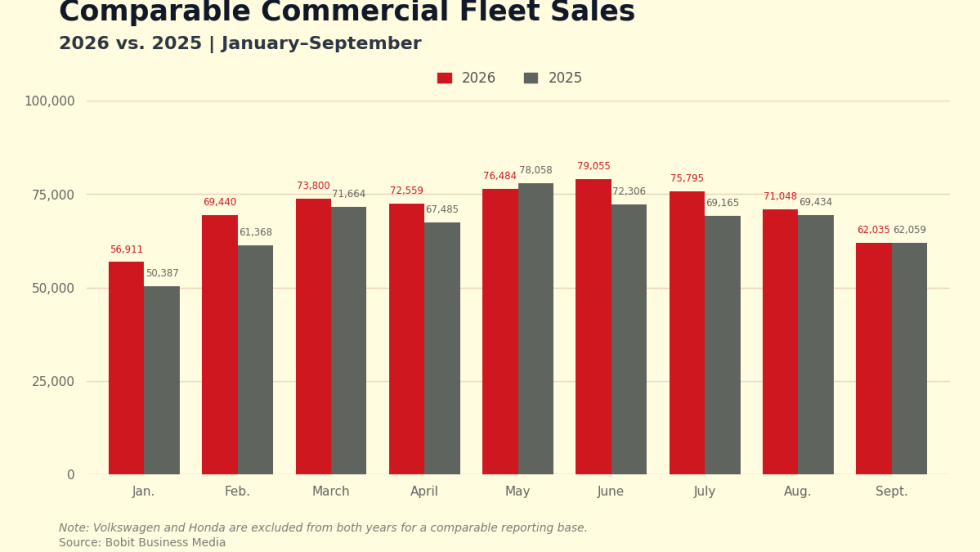
Commercial Fleet Sales Rise 5.8% Through September 2026
September commercial fleet sales were essentially unchanged from a year earlier, slowing year-to-date growth while keeping volume ahead of 2025.
Read More →
Hall of Fame Inductee: John Dmochowsky
The longtime Mondelēz International fleet executive joins the Automotive Fleet Hall of Fame.
Read More →
Hall of Fame Inductee: Lee Miller
After more than four decades at Boehringer Ingelheim, Lee Miller leaves a legacy built on fleet expertise.
Read More →
Hall of Fame Inductee: Mark F. Petersen
From managing fleets of thousands of vehicles to advancing safety and mentoring fellow professionals, Mark F. Petersen made his mark across both the corporate and supplier sides of fleet.
Read More →
When Charger Downtime Becomes a Fleet Availability Problem
As EV deployments move beyond pilot programs, charger reliability can directly affect vehicle readiness, driver productivity and route scheduling.
Read More →
2027 Nissan Rogue Hybrid Adds e-POWER, Standard AWD
The new Rogue Hybrid uses Nissan’s e-POWER system with dual electric motors, offers an estimated 40 mpg and starts at $35,490.
Read More →
2027 Subaru Forester Adds First Wilderness Hybrid
The 2027 Forester lineup starts at $29,995 and adds a Wilderness Hybrid with 194 combined horsepower and 9.3 inches of ground clearance.
Read More →
EV Realty Names Henrik Holland President as Charging Platform Expands
The former Prologis Mobility and Shell executive will help expand EV Realty’s truck charging business and move its power-first infrastructure model into autonomous vehicle depots and other fleet sectors.
Read More →