While fleets are seeing some improvements in their crash and accident statistics, aided by better training and vehicle safety technology, there is still more they can do to not just be a number.
The past several years have seen an increasing priority on fleet safety, and for good reason. Crashes are traumatizing for the driver, they are expensive for the fleet (sometimes costing millions of dollars in liability payments), and damaging to the company’s overall reputation with the public. As the following infographics show, the efforts of fleet managers and their drivers to operate their vehicles more safely have been bearing fruit.
Ad Loading...
This year’s Fleet Accident Management Survey, conducted by CEI and Fleet Response, show that some accident statistics have remained the same. There have been some surprising shifts in how accidents are occurring and the driving group is most to blame.
Ad Loading...
However, while, in general, there is little argument vehicles are becoming safer (as are many fleet drivers), thanks, in part to advanced technology, such as anti-collision braking systems, blind spot detection, rear view cameras, and telematics, the statistics show, alarmingly, that overall driving remains a dangerous activity in the U.S. In fact, motor vehicle fatalities increased 7.7% in 2015 (the latest year for which there is data) to an estimated 35,200 people, according to the National Highway Traffic Safety Administration (NHTSA). In 2014, the U.S. had an estimated 32,675 reported fatalities. Many of these fatalities involved bicyclists and pedestrians.
At A Glance
The results of the 2016 Fleet Accident Survey show a number of changes in the type of crashes and the personnel who are involved, including:
Fleet drivers who are in crashes are getting older
Crashes caused by distracted driving are continuing to slowly increase.
The most common accident type is now rear end collisions.
Demographic Shift
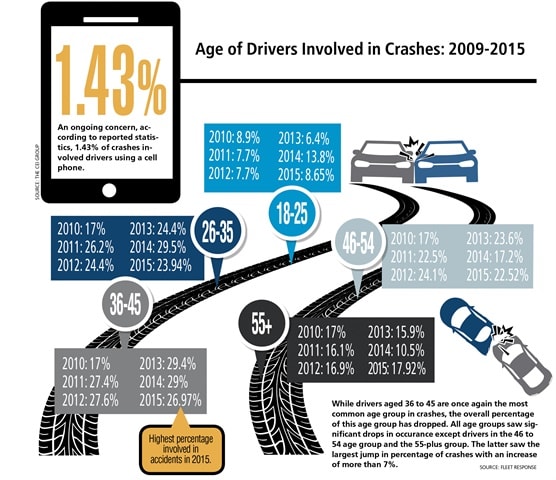
For the first time in at least five years, drivers between the ages of 36 and 45 years old did not report the highest percentage of accidents, coming in at 29% of drivers involved in an accident in 2014 vs. the 29.5% of drivers between the ages of 26 and 35 that were involved in an incident in 2014.
The reason behind this shift may be purely generational, according to to Allison Lanzilotta, executive vice president for Fleet Response.
“These numbers don’t take into account the ratio or percent of each age group that is employed in a driving position, which is important to remember. While the 36-45 age group has the highest percent of accidents, they are also likely the largest population of employees with a driving position. Changes in age demographics of drivers could have an impact on the percent with accidents,” she said. “Many vehicles also contain increased amounts of onboard technology, which can be a benefit but also a distraction, and it is something the younger generations are generally more familiar with, which may aide them in lowering accident ratios verses the older generations.”
Distracted driving is perhaps the biggest scourge facing fleets and the general public alike. Fleet drivers crashing while on a cell phone has continued to inch up from 2014. While the number is low, overall, the fact that it’s increasing at all should be cause for concern.
Ad Loading...
“Distracted driving in general and texting from the behind the wheel are cultural problems, and it is going to take a change in our national culture to rein them, just like the way drunk driving and not using a seat belt were. But it took decades for those changes to occur,” said Brian Kinniry, senior director, Strategic Services for CEI. “But fleets can’t wait for the national culture to change — it’s in their interest to take charge as cultural change agents within their own part of the world. According to studies we’ve seen, the best practice is to make texting cause for dismissal, write that into their safety policies and do their utmost to enforce it. Holding drivers strictly accountable and raising their awareness of the dangers of texting while driving are keys to changing a fleet’s safety culture. We’ve seen fleets strengthen their safety culture in these ways, but the question is how long it will take to minimize texting while driving. Nobody knows, but let’s hope that in fleets it can happen sooner rather than later.”
Defeating ‘Damaged While Parked’
Damaged while parked incidents dropped off as the top cause of reportable accidents replaced by “other party hit rear or driver.” Another one of the surprising changes in this year’s survey. The cause of this change is unsurprising.
“There is a consensus among traffic safety experts that the increase in rear-end collisions, about 60% of which appear to be preventable, is due to more distracted driving, which includes everything from texting and talking on cell phones to adjusting air conditioning and radio controls, reaching for objects, eating and grooming,” said Kinniry of CEI.
Interestingly, Lanzilotta of Fleet Response noted a technological shift that may see this statistic changing in the coming years.
“We’re seeing more cars being ordered or installed with rear and front end sensors. Companies are making these updates and looking to track the impact that it may have over the upcoming years on their accident ratios,” she said.
Ad Loading...
Another shift in the accident statistics was a double digit drop of 17% for accidents occuring on clear days, though this continues to be the most common weather type that involves a crash.
While crashes may have a seeming inevitability, there are things that fleets can do to beat the statistics.
“There are several keys to improving a fleet’s safety culture, and fleets that do the best job at reducing their accident rates use them,” said Kinniry. “They include getting full and visible backing from senior management in making fleet safety a priority; having clear, comprehensive, and up-to-date safety policies that are widely communicated and enforced in a timely and consistent manner; and increasing their safety programs to ‘market’ safe driving to their drivers.”
This video features a reminder from the Connecticut Department of Transportation (DOT) and the Connecticut Police Chiefs Association, urging drivers to prioritize safety this Halloween.
New crash-avoidance ratings from the Insurance Institute for Highway Safety reveal inconsistent performance among commercial vehicles, with several popular cargo vans and heavy-duty pickups struggling to avoid collisions with other vehicles and pedestrians.
Could your company's culture be encouraging distracted driving? This week, we're exploring how workplace expectations affect driver safety, what AI, EVs, and autonomous vehicles could mean for the future of fleet management, and how fleet professionals can strengthen their award nominations.
What happens when the people responsible for enforcing safety rules are the ones setting the wrong example? The answer may reveal why some of the biggest risks to fleet drivers have little to do with what's written in the employee handbook.
Rising operating costs, driver safety concerns, and unplanned downtime are putting unprecedented pressure on modern fleets. Discover how fleet managers use embedded OEM connectivity and real-time vehicle data to cut TCO, prevent downtime, and protect drivers without aftermarket telematics hardware.
Mental health belongs in the fleet safety conversation. This week, we’re looking at five ways fleets can support employee well-being before a crisis, plus Holman’s expansion in Mexico, new one-day Fleet Forward passes, and why EV charging demand is outpacing infrastructure growth.
Stefan Heck tells Automotive Fleet that combining more than 10 billion miles of driving history with Nexar's AI models will give fleets deeper insights into driver risk and roadway conditions than either company could provide independently.
Insights from a commercial insurance carrier and a broker show how fleets can turn video telematic data, driver coaching, and improved claims results into a stronger case at insurance renewal.