




Fleet Operations, Finance Departments Not Seeing Eye to Eye
Corporate finance departments and fleet managers bring different perspectives to priorities such as vehicle acquisition, cost reduction measures, and maintenance and repair that can create obstacles such as "a significant lack of communication," according to a new survey from Fleet Advantage.

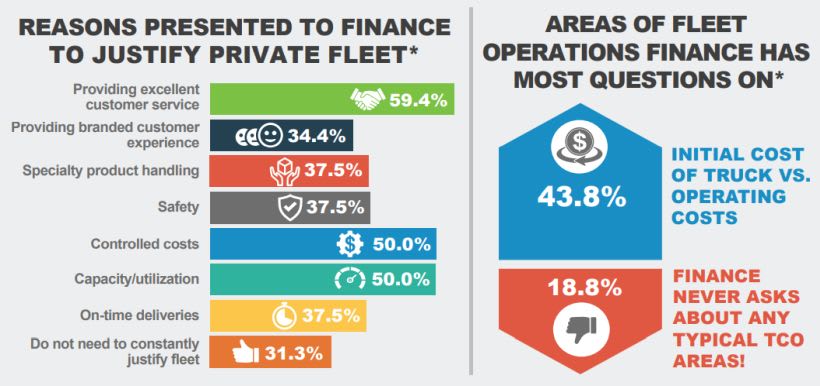
Fleet executives and their finance departments often bring different perspectives to fleet acquisition and cost control initiatives.
Graphic courtesy of Fleet Advantage.
Corporate finance departments and fleet managers bring different perspectives to priorities such as vehicle acquisition, cost reduction measures, and maintenance and repair that can create obstacles such as "a significant lack of communication," according to a new survey from Fleet Advantage.
About a third of fleet executives (37.5%) said their finance departments don't clearly communicate the company's financial metrics and goals to fleet operations personnel. Another third (34.4%) said finance doesn't understand the benefits of investing in new equipment. And 31.3% said finance doesn't understand the various operating costs associated with the fleet.
"It is evident that both the operations and finance departments are focused on different priorities in terms of fleet management and costs, and this poses a challenge to collectively achieve a singular organizational goal," said Brian Holland, Fleet Advantage's president and chief financial officer. "Hopefully, this survey will shed light on these communications challenges so that both departments can work closer on a fleet that operates more smoothly, with lower costs."
Fleet Advantage provides fleet services such as truck fleet analytics, equipment financing, and lifecycle cost management. The company's survey also delved into cost control perspectives and driver turnover.
The fleet executives said the finance department is concerned primarily about cost reduction (53.1%) followed by improving cash flow (40.6%). A quarter of fleet executives also said finance officers are unclear about how proper fleet acquisition strategies and lease-versus-purchase decisions affect the company's bottom line.
A majority of fleet executives (62.5%) said they focus on maintenance and repair costs when calculating a fleet's return on investment and three-fourths said they present this data to finance to gain access to capital expenditure for new equipment. A "stronger focus on TCO metrics" by finance would improve cost reduction initiatives and significantly improve cash flow in truck fleets. ABout 18.8% of finance professionals don't inquire about these metrics, according to Fleet Advantage.
The survey also looked more closely at driver turnover. About a fifth (18.8%) of the fleet executives said finance doesn't understand how newer trucks can reduce driver turnover and improve retention. Among heavy-duty truck fleets, this can be a critical issue due to a shortage of qualified drivers. The annual turnover rate at large truckload carriers with more than $30 million in annual revenue increased six points to 94%, according to the ATA's Trucking Activity Report. The turnover rate for smaller carriers fell to 73%, which was still seven points higher than the prior year.
Fleet Advantage has created an infographic to show the survey's results.
Related: Traditional Procurement Incentive Plans Are Counter-Productive to Good Fleet Management
More Operations

90% Use Telematics. Are Fleets Getting Safer? | AF News Recap
This week, we're breaking down which industries have the highest rates, how Jamie McKay manages 2,400 vehicles, what's happening with the 2027 fleet awards, and why software-defined vehicles could introduce new costs.
Read More →
What's Best Handled by an FMC, and What's Better Done Directly?
Fleet managers continue to rely on FMCs for essential services but are taking a closer look at where working directly with suppliers can improve efficiency and responsiveness.
Read More →
Fleet Meets: Erin Gilchrist
Meet Erin Gilchrist, the inaugural Mike Antich Spirit of Fleet Award winner, as she shares insights on leadership, mentorship, the power of industry connections, and why people remain at the heart of fleet's future.
Read More →

How 2026 Fleet Visionary Jamie McKay Manages 2,400 Vehicles Across 37 States
How do you keep 2,400 vehicles running across 37 states? Fleet Visionary Award winner Jamie McKay shares how collaboration, flexibility, and a few simple strategies help her tackle fleet management challenges at Aptive Pest Control.
Read More →
Managing Fleet Costs in an Era of Permanent Volatility
Fleet operating costs have risen more than 20% since 2020, raising a key question: When does extending a vehicle's service life stop making financial sense?
Read More →
The Next Evolution of Fleet Management: Autonomous Operations
This opening keynote session at the Fleet Forward Conference highlights the future of autonomous driving for fleets.
Read More →
How to Reduce the Total Cost of Risk From Catalytic Converter Theft
A stolen catalytic converter can cost fleets far more in downtime and lost productivity than in repairs. A total-cost-of-risk approach can help fleet managers quantify their exposure and prioritize theft prevention.
Read More →
Personal-Use Charges Rise as Vehicle Values Fall | AF News Recap
Personal-use charges are climbing, wholesale used-vehicle values are declining, and commercial fleet sales growth is slowing. This week, we're breaking down the latest fleet data, plus how Element Fleet Management is helping Waymo prepare for its first Canadian robotaxi market.
Read More →
Here's When You Should Make an Exception to Fleet Policy
Fleet policies are designed to create consistency, but not every driver or situation fits neatly within standard rules.
Read More →
AI-Native or AI-Acquired: What Should Fleet Managers Look for in an AI Platform?
Six questions can help fleet managers look beyond AI marketing claims to evaluate integration, data access, and real-world operational performance.
Read More →