




Operating Costs Flat for Fourth Consecutive Year
With fuel representing 60% of a fleet’s total operating costs, lower fuel prices are keeping overall fleet costs flat. Also, vehicle build quality is high, curbing maintenance costs, and lower commodity prices have stabilized tire prices.

Graphic courtesy of iStockphoto.com.

Graphic courtesy of iStockphoto.com.
Editors Note: This article is part of a five-part package dealing with operating costs in 2016. Read related articles that offer and in depth look at Fuel Spend, Tire Prices, Fleet Maintenance, and Preventative Maintenance.
Calendar-year 2016 marks the fourth consecutive year that fleet operating costs have remained stable compared to the past four years, primarily due to the continuation of lower gasoline and diesel prices.
This, along with other findings, are revealed in Automotive Fleet’s 25th annual operating cost survey, and are based on data provided by six survey partners:
ARI
Element Fleet Management
EMKAY
LeasePlan USA
Merchants Fleet Management
Wheels Inc.
This year’s survey is based on the analysis of actual operating costs incurred by 634,515 vehicles operated by commercial fleets, which are managed by these six fleet management companies.
Fuel Prices Continue to be Stable
Fuel represents 60% of a fleet’s total operating costs, so the lower price per gallon of fuel has had a dramatic impact on overall fleet costs. However, it has had a dramatic impact on fleets operated by energy companies, which are operating on austerity budgets to offset the decline in retail fuel prices.
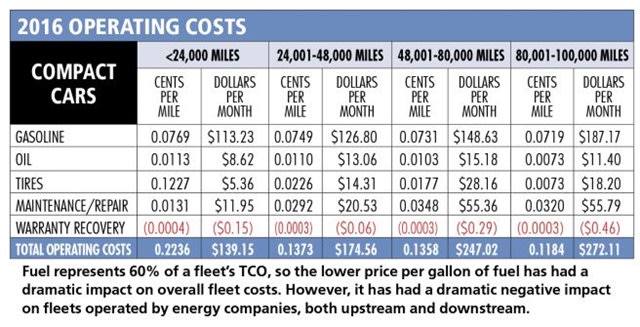
Chart courtesy of Automotive Fleet.
In addition to lower prices at the pump, these cost reductions have been amplified by the ongoing trend by fleets to spec smaller displacement engines, when applicable, along with increased driver training to encourage more fuel-efficient driving behaviors.
Although there may be less pressure for alternative-fuel vehicles, the focus continues to be to acquire the most fuel-efficient models that can fulfill the fleet requirement. In addition, new-model vehicles tend to have higher MPG ratings than predecessor models, due to light weighting, the proliferation of higher-speed transmissions, and more efficient powertrains. The increased implementation of telematics systems has also resulted in improved route optimization and easier identification of drivers who are engaging in driving behaviors that are decreasing MPG.
What is the forecast for per gallon fuel prices in calendar-year 2017?
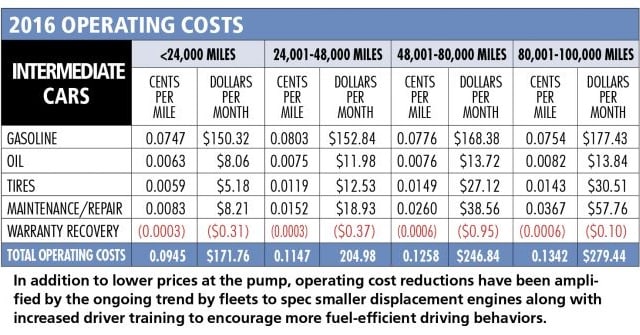
Chart courtesy of Automotive Fleet.
As many have learned through experience, fuel prices are impossible to forecast with certainty, and are influenced by a number of external variables, such as macroeconomic activity, geopolitical situations, and domestic supply and demand.
Most fleet management companies use the U.S. Energy Information Administration (EIA) of the U.S. Department of Energy forecasts for internal planning and external fuel price forecast dissemination. The EIA projects fuel costs to rise modestly over the next 12 months.
The EIA Short-Term Energy Outlook forecast is for an annual average of $2.26 per gallon of gasoline for CY-2017 from the current $2.08 per gallon in 2016. The forecast of continued flat fuel prices will be an important factor influencing 2017 and 2018 model-year acquisition decisions.
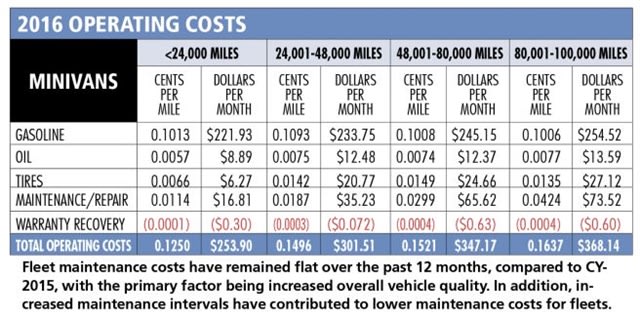
Chart courtesy of Automotive Fleet.
In addition, the prediction for CY-2017 is that global supply and demand for oil will remain at today’s levels, which will keep downward pressure on fuel prices. Another ongoing variable is that the percentage of imported oil has continued to drop with the increase in domestically sourced oil. This has lowered the impact of price volatility in oil-producing regions mired in political instability.
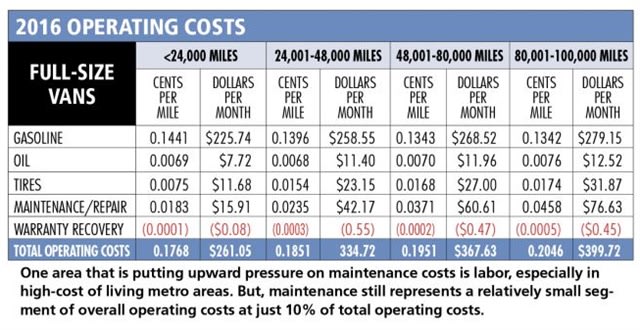
Chart courtesy of Automotive Fleet.
Tire Prices to Remain Stable
The second highest operating cost is replacement tires, whose pricing has been stable in 2016. A key reason for the stabilization in replacement tire prices is less volatility for the commodities used to manufacture tires, namely oil, rubber, and steel. These lower materials prices have contributed to keeping replacement tire costs flat.
Maintenance Costs to Remain Flat
Fleet maintenance costs have remained flat over the past 12 months, compared to CY-2015, with the primary factor being increased overall vehicle quality. In addition, increased maintenance intervals have contributed to lower maintenance costs for fleets.
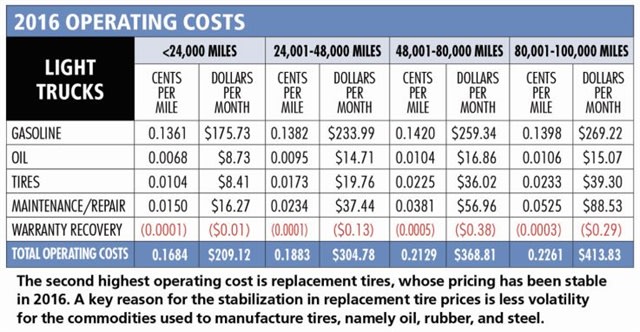
Chart courtesy of Automotive Fleet.
An ongoing issue is parts availability, where the manufacturer supply chains are not able to keep up with demands for certain components — primarily related to warranty or recall covered work.
The widespread use of just-in-time manufacturing has created situations where demand exceeded production capacity and created unforeseen downtime waiting for parts deliveries.
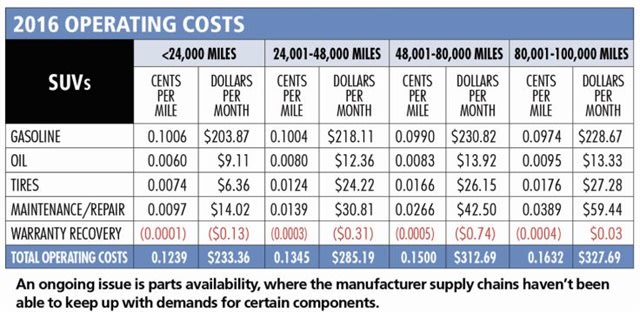
Chart courtesy of Automotive Fleet.
In addition, there has been a general uptick in parts pricing. However, vehicle quality continues to remain high, helping to offset these expenses.
Another area that is putting upward pressure on maintenance costs is labor. But, maintenance still represents a relatively small segment of overall operating costs at just 10% of total operating costs. In order for maintenance to have a dramatic impact on total operating costs, it would require far more significant increases than what is anticipated in the future.
The following four articles provide an in-depth examination of 2016 operating cost trends and a forecast of expenses for the 2017 calendar-year.
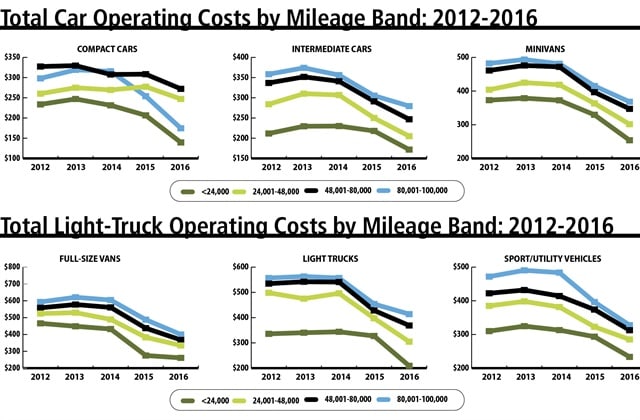
Chart courtesy of Automotive Fleet.
More Operations

How Fleets Can Recruit and Train Veterans for Technician Roles
Here's how the technician shortage has affected uptime for fleets, and what to do about it.
Read More →
Avis Budget Group Deploys Neology Toll Management Technology Across Major Brands
Neology’s neoFleet platform will manage toll transactions and toll-authority operations for vehicles across Avis, Budget, Payless, Budget Truck and Zipcar.
Read More →
Fleet Personal-Use Charges Edge Higher in 2026
Nearly eight in 10 surveyed fleets allow personal use of company vehicles, while just over half of respondents report charging employees for the privilege.
Read More →
The Future of Fleet + What’s Changing Right Now | AF News Recap
Could developments overseas offer a preview of what’s coming for U.S. fleets? This week, we’re looking at the future of AI, autonomy, and electrification, plus Ford Pro’s new certified pre-owned program, smarter vehicle offboarding, and a new way for fleets to manage toll expenses.
Read More →
How to Handle Vehicle Offboarding
What do fleet managers need to do when a driver leaves?
Read More →
Fleet Manager’s Ultimate Playbook: Navigating the New Standard in OEM Connectivity
Rising operating costs, driver safety concerns, and unplanned downtime are putting unprecedented pressure on modern fleets. Discover how fleet managers use embedded OEM connectivity and real-time vehicle data to cut TCO, prevent downtime, and protect drivers without aftermarket telematics hardware.
Read More →
U.S. Bank Adds Verra Mobility Toll Management to Voyager Fleet Platform
The integration allows U.S. Bank Voyager fleet customers to manage toll payments and violations alongside fuel, EV charging and maintenance expenses.
Read More →
ADAS Prevents Crashes. But Repairs Cost More | AF News Recap
ADAS-equipped vehicles may crash less often, but they can cost more when they do. This week, we’re breaking down what that tradeoff means for fleets, plus Subaru’s first Forester Wilderness Hybrid, Nissan’s new e-POWER Rogue, and why Calstart has become Catalyst Mobility.
Read More →
Moventum Fleet Management Names Mark Iorillo Head of Sales
Iorillo brings nearly 20 years of fleet management and sales experience to the role, including previous positions at Element Fleet Management, CEI, Donlen and Ryder.
Read More →
Fleet Has a Talent Pipeline Problem. What Comes Next? | AF News Recap
Where will fleet’s next generation of leaders come from? This week, we’re looking at the industry’s talent pipeline, what certification can add to a fleet career, how to build an award-worthy track record, and the return of Automotive Fleet’s Personal Use Survey.
Read More →