




ARI Celebrates 25th Anniversary
Leasing over 30,000 vehicles, ARI briefly pauses to remember their first quarter-of-a-century.
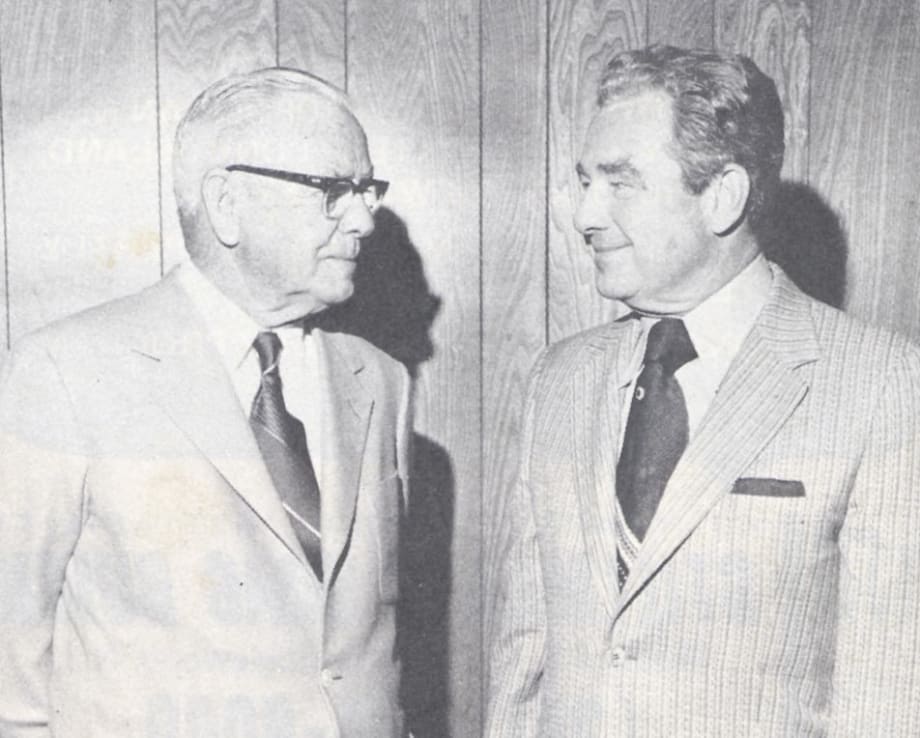
(left) ARI founder, Steward C. Holman, with president Arno Neuber
Source: Bobit File Photo
Automotive Rentals, Inc. of Pennsauken, New Jersey is celebrating its 25th Anniversary. Founded in October, 1948 as an extension of a Rice & Holman Ford dealership, ARI has the first franchise given by the Ford Authorized Leasing System (FALS). And it has been said that the ARI system became the original model for all future FALS members.
(left) ARI founder, Steward C. Homan, with president Arno Neuber
The basic idea of leasing as a new concept for the Rice and Holman dealership was planted by the late Charles Beecham of Ford Motor Company, who approached ARI's founder, Steward C. Holman, and encouraged his dealership to enter the automobile leasing field. With the total expansion of the leasing business, ARI was at the front of this growing industry.
ARI acquired its first national account in 1948, an electronics firm. Shortly thereafter, ARI secured a major steel producer as its second national account. From these early beginnings, ARI has grown to a present fleet size in excess of 30,000 units (20,000 cars/10,000 trucks). Doing business in all fifty states - as well as in Puerto Rico and Canada- ARI's fleet breakdown follows the concentration of population.
Annual vehicle purchases are in excess of 10,000 units, with approximately the same number of used vehicles being sold throughout the country. (The Holman Group of Companies are said to be one of Ford Motor Company's largest customers, with orders totaling over $300,000 a day.)
Located in a suburb of Philadelphia, ARI began in the showroom of the Rice and Holman dealership, and in 1951 moved to a separate facility across the street. Over the years, additional wings and sections have been added, so that today, ARI's home office handles the total paper work for the company and houses about 85-percent of the staff.
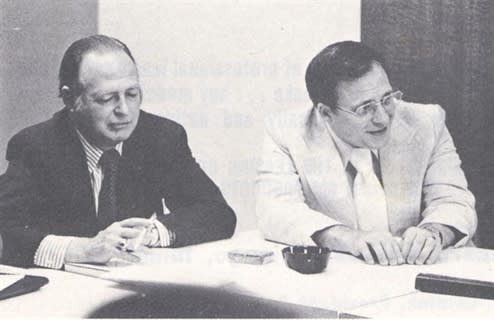
(left) Norman Kasschau, VP/marekting, and John W. Kolb, VP/finance
In the early 50's, ARI opened its first branch office in Detroit. This was followed by a New York office and one in Dallas. ARI's Los Angeles office was opened in 1962. The Chicago office opened in 1963.
"ARI is currently studying the feasibility of opening several additional regional locations," according to ARI president, Arno Neuber. "Our home office facilities, on the other hand, should satisfy our requirements for the next five years."
Today, ARI enjoys its own computer facilities using a combination of tape and disk processing techniques, together with automated key tapes for input processing. This system was installed in 1968 after converting from 402 tabequipment. Before 1960, previous systems had been maintained.
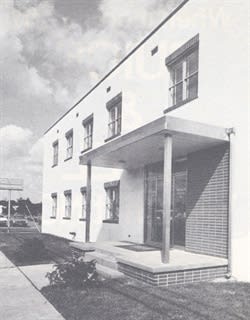
ARI headquarters, Pennsauken, New Jersey (1973)
Computer systems in 1973 are completely automated from the receipt of the customer's order to the final disposition report of the used vehicle, with customer flexibility designed as the primary consideration. A complete fleet management system is offered to all customers as an adjunct of leasing. Current programming includes the ability for an individual customer to select the various cost control parameters resulting in exception type reports and systems.
Future Forecast
"ARI expects to grow at a 15-percent yearly rate, primarily in open end leasing - either through new business or acquisition," says ARI President Arno Neuber. "However, ARI will continue to offer all types of leasing - including closed end leasing, both net and maintenance.
"ARI's growth is greatest as it attempts to individualize its marketing concepts to meet specific customer needs," Neuber continues. "We know we can't be all things to all people, but ARI continues to experiment and assist individual companies in satisfying their specific needs. This is what is needed to keep ARI in the front position of leasing leadership."
When asked about proposed accounting regulation changes, Neuber replied, "We firmly believe that leasing transportation service and not a bookkeeping gimmick. Therefore, we have no fear that any change in the accounting regulations will seriously affect the really important reasons for buying transportation and service expertise."
He also said, "We have always said that leasing is meant to be, and is, a long term association between lessor and lessee." This philosophy appears valid when looking at ARI's major accounts, who in some cases have had associations as long as 24 years.
Executive Officers
President of ARI is Arno R. Neuber, who joined Automotive Rentals, Inc. in 1949, after serving with Goodyear Tire and Rubber Company in a sales capacity and as a private business man. Neuber was sales manager and executive vice president of ARI before becoming president and chief executive officer in 1970 upon the retirement of P. James Deasy. Neuber is past president and one of the founders of the American Automotive Leasing Association, as well as Director of the Highway Users Association.
Vice President of Marketing is Norman Kasschau. Kasschau joined ARI in 1958 after 12 years of fleet and leasing experience with the Ford Motor Company in their Northeast Region. He is an affiliate member of the National Association of Fleet Administrators and has been a member of the Society of Automotive Engineers.
Vice president of finance is John W. Kolb, who joined ARI in 1966 from Drexel University where he was controller, academic financial advisor and professor.
William J. McFeeters is secretary and treasurer, and has been with ARI since 1949 in administrative and accounting posts. McFeeters has been active in various trade associations and assists in the administrative control of ARI's regional offices and depots.
ARI's employees total over 125, with ARI managers holding collectively over 275 years of automotive experience, 90-percent in the national fleet leasing market.
Used Vehicle Disposition
In discussing liquidation of used vehicles, it was learned that current automated statistics of ARI's performance are reviewed and compared to various market research publications on resale values.
Reconditioning is done on a "selective basis," of course, which means that each unit is analyzed on its individual merits - taking into consideration the vehicle's condition and resale value both before and after reconditioning, and in relationship to the current market. Reconditioning will only be authorized when the dollar return on resale exceeds the dollar invested for reconditioning.
ARI merchandises its used vehicles through independent used vehicle outlets as well as selected auctions where performance is measured weekly. This is an addition to disposal through ARI's own widespread locations. In an unbiased study, one of ARI's large customers, who maintains independent records, has shown that the ARI disposal method over the years has exceeded the results of other suppliers.
Financial
ARI is one of only two major national lessors owned by one private sector as opposed to public ownership. The last two fiscal years have been the best in ARI's history, and ARI has sufficient profit capital together with adequate lines of credit to take care of future expansion. As Neuber said, "The company was built over the years through a conservative accounting approach coupled with a steady growth. Dividends were allowed to accumulate and this together with profits have been the basis of capital accumulation."
In projecting the future, Mr. Neuber says,"We see continuing growth in leasing, with probably larger automated and financially able lessors taking over the bulk of corporate fleet leasing. Individual leasing will grow by leaps and bounds and will show the greatest percent of increased growth in the automotive industry."
If Mr. Neuber's prediction about the future is correct, it seems certain that ARI will continue in its growth and leadership.
More Operations
Company Vehicle or Reimbursement? How Fleets Are Rethinking Assignments
As fleet costs and insurance pressures rise, fleet managers are taking a closer look at which employees need company-provided vehicles and when a reimbursement program may make more sense.
Read More →
Fleetio, ASE Launch Scholarship Program for Automotive Technicians
The second annual program will award 15 scholarships totaling $35,000 to support ASE certification, testing fees, and equipment costs.
Read More →
Reading the Global Signals: What AI and the Energy Transition Mean for Fleets Now
In this opening keynote of the 2026 Fleet Forward Conference, John Rossant, founder of CoMotion, How can fleet managers navigate a never-ending, changing industry landscape?
Read More →
90% Use Telematics. Are Fleets Getting Safer? | AF News Recap
This week, we're breaking down which industries have the highest rates, how Jamie McKay manages 2,400 vehicles, what's happening with the 2027 fleet awards, and why software-defined vehicles could introduce new costs.
Read More →
What's Best Handled by an FMC, and What's Better Done Directly?
Fleet managers continue to rely on FMCs for essential services but are taking a closer look at where working directly with suppliers can improve efficiency and responsiveness.
Read More →
Fleet Meets: Erin Gilchrist
Meet Erin Gilchrist, the inaugural Mike Antich Spirit of Fleet Award winner, as she shares insights on leadership, mentorship, the power of industry connections, and why people remain at the heart of fleet's future.
Read More →
How 2026 Fleet Visionary Jamie McKay Manages 2,400 Vehicles Across 37 States
How do you keep 2,400 vehicles running across 37 states? Fleet Visionary Award winner Jamie McKay shares how collaboration, flexibility, and a few simple strategies help her tackle fleet management challenges at Aptive Pest Control.
Read More →
Managing Fleet Costs in an Era of Permanent Volatility
Fleet operating costs have risen more than 20% since 2020, raising a key question: When does extending a vehicle's service life stop making financial sense?
Read More →
The Next Evolution of Fleet Management: Autonomous Operations
This opening keynote session at the Fleet Forward Conference highlights the future of autonomous driving for fleets.
Read More →
How to Reduce the Total Cost of Risk From Catalytic Converter Theft
A stolen catalytic converter can cost fleets far more in downtime and lost productivity than in repairs. A total-cost-of-risk approach can help fleet managers quantify their exposure and prioritize theft prevention.
Read More →