




Compact SUV Headlights Draw Poor Safety Ratings
IIHS tests the headlights on 21 small SUVs, and only four of the models are available with “acceptable”-rated headlights.

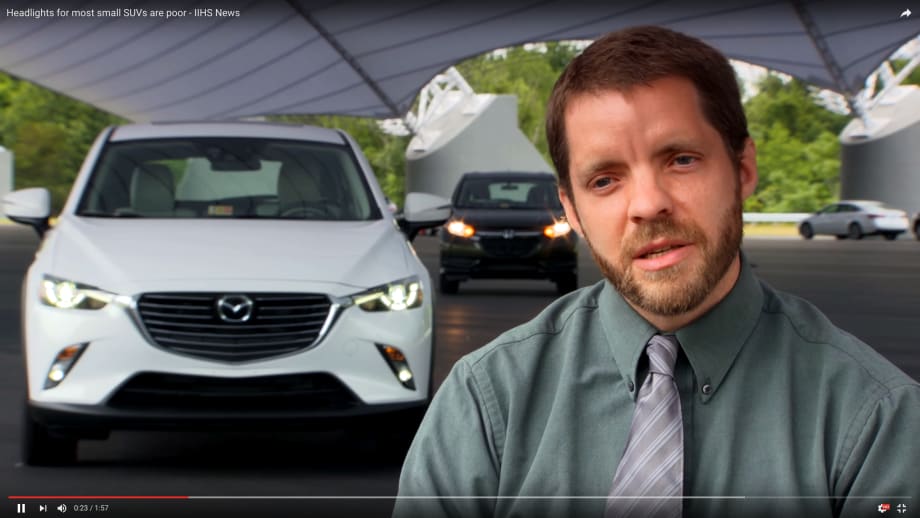
Photo: IIHS
The Insurance Institute for Highway Safety evaluated the available headlights for 21 compact SUVs, but none of them drew the highest rating of “good” and only four models are available with headlights rated as “acceptable.”
Among the 21 vehicles tested, there are 47 different headlight combinations available, IIHS noted. More than two-thirds of them drew a “poor” rating, making this group of vehicles even more deficient in lighting quality than the mid-size cars that IIHS rated earlier this year.
Headlight performance in today’s vehicles varies widely, IIHS stressed.
“Government standards are based on laboratory tests, which don’t accurately gauge performance in real-world driving,” the organization said in a released statement about the test results. “The issue merits attention because about half of traffic deaths occur either in the dark or around dawn or dusk.”
As with mid-size cars, the IIHS evaluations of small SUVs showed that a vehicle’s price tag doesn’t correspond to the quality of headlights. More modern lighting types, including high-intensity discharge (HID) and light-emitting diode (LED) lamps — along with curve-adaptive systems, which swivel in the direction of steering — also are no guarantee of good performance, according to IIHS.
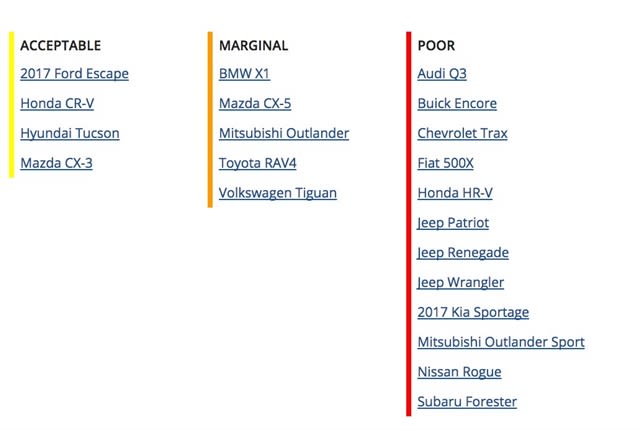
IIHS headlight ratings for small SUVs. (Best available system for each model, 2016 models unless specified.) Chart courtesy of IIHS.
The best-performing headlights in the small SUV group belong to a new model, the Mazda CX-3, and are available on its Grand Touring trim. These lamps are curve-adaptive LED lights with optional high-beam assist. The low beams perform well on both right curves and fairly well on the straightaway and sharp left curve, IIHS said. However, they provide inadequate light on the gradual left curve. The high beams perform well on most approaches.
The other vehicles available with “acceptable” headlights, IIHS said, are the Ford Escape, the Honda CR-V, and the Hyundai Tucson. None of the three are curve-adaptive, and only the Escape has high-beam assist. Still, all of them provide fair or good illumination in most scenarios, according to IIHS.
The model that fared the worst in the headlights testing was the 2016 Honda HR-V.
“The illumination provided by the HR-V’s halogen low beams and high beams is inadequate on all four curves and on the straightaway,” IIHS said. The HR-V is one of 12 small SUVs that can’t be purchased with anything other than “poor”-rated headlights.
“Manufacturers aren’t paying enough attention to the actual on-road performance of this basic equipment,” said IIHS Senior Research Engineer Matthew Brumbelow. “We’re optimistic that improvements will come quickly now that we’ve given automakers something to strive for.”
For 2017, vehicles will need “good” or “acceptable” headlights in order to qualify for the institute's highest award, Top Safety Pick+.
While studies have pointed to advantages for advanced lighting systems, the IIHS rating system doesn’t favor one type of technology over the other. Instead, evaluations measure the amount of usable light provided by low beams and high beams as vehicles travel on straightaways and curves.
IIHS engineers evaluate headlights on the Vehicle Research Center's track after dark. A special device measures how far the light is projected as the vehicle is driven on five approaches: traveling straight, a sharp left curve, a sharp right curve, a gradual left curve, and a gradual right curve.
Glare from low beams for oncoming drivers is also measured in each scenario. A vehicle with excessive glare on any of the approaches can’t earn a rating higher than “marginal.”
The only type of technology given an explicit nod in the ratings is high-beam assist, which automatically switches between high and low beams based on the presence of other vehicles. Vehicles can earn extra credit for this feature because of its potential to increase low rates of high-beam use, IIHS said.
Seventeen of the rated SUV headlight combinations have unacceptable glare, IIHS concluded. They include all types of lights — halogen, HID, and LED — and none of the headlight types is more likely than the others to have excessive glare. Three of the 17 fell short of an “acceptable” rating on the basis of glare alone.
“Glare issues are usually a result of poorly aimed headlights,” Brumbelow said. “SUV headlights are mounted higher than car headlights, so they generally should be aimed lower. Instead, many of them are aimed higher than the car headlights we’ve tested so far.”
IIHS plans to conduct headlight tests on pickups next.
More Safety

What’s Next for Fleet? Safety, AI & Industry Recognition | AF News Recap
Could your company's culture be encouraging distracted driving? This week, we're exploring how workplace expectations affect driver safety, what AI, EVs, and autonomous vehicles could mean for the future of fleet management, and how fleet professionals can strengthen their award nominations.
Read More →
Does Your Fleet's Culture Encourage Distracted Driving?
What happens when the people responsible for enforcing safety rules are the ones setting the wrong example? The answer may reveal why some of the biggest risks to fleet drivers have little to do with what's written in the employee handbook.
Read More →
Fleet Manager’s Ultimate Playbook: Navigating the New Standard in OEM Connectivity
Rising operating costs, driver safety concerns, and unplanned downtime are putting unprecedented pressure on modern fleets. Discover how fleet managers use embedded OEM connectivity and real-time vehicle data to cut TCO, prevent downtime, and protect drivers without aftermarket telematics hardware.
Read More →
From Driver Well-Being to EV Charging | AF News Recap
Mental health belongs in the fleet safety conversation. This week, we’re looking at five ways fleets can support employee well-being before a crisis, plus Holman’s expansion in Mexico, new one-day Fleet Forward passes, and why EV charging demand is outpacing infrastructure growth.
Read More →
Nexar-Nauto Merger Aims to Give Fleets Better Safety Intelligence Through Larger Driving Dataset
Stefan Heck tells Automotive Fleet that combining more than 10 billion miles of driving history with Nexar's AI models will give fleets deeper insights into driver risk and roadway conditions than either company could provide independently.
Read More →
Don't Wait for a Crisis: 5 Ways to Build Mental Health Into Your Fleet Safety Program
For Suicide Prevention Month, fleet and safety leaders have an opportunity to put mental health where it belongs: at the center of workplace safety.
Read More →
How Camera Data Can Strengthen a Fleet’s Insurance Renewal
Insights from a commercial insurance carrier and a broker show how fleets can turn video telematic data, driver coaching, and improved claims results into a stronger case at insurance renewal.
Read More →
The Safest Fleets Aren’t the Ones with the Most Technology
You’ve made the telematics investment. Here’s how to capture the other half of its value and build the safest fleet on the road.
Read More →
Hidden in Plain Sight: Fleet Compliance Risks
Fleet compliance isn't just about having policies — it's about consistently enforcing them. This practical guide reveals six hidden compliance risks common in public sector and shared fleet operations and outlines proven strategies to improve visibility, accountability, and audit readiness
Read More →
NETS Sets 2026 Fleet Safety Benchmark Conference for Indianapolis
The Sept. 15–17 program will feature fleet benchmarking data, case studies, emerging technologies, and implementation strategies while running alongside the NSC Safety Congress & Expo.
Read More →