




Hail Damage Claims for Vehicles Spiking
Insurers made increasingly higher payouts for hail damage to vehicles in three of the four years ending with 2014 than in the earlier three years of a seven-year study completed by the Highway Loss Data Institute.
Photo courtesy of HLDI.
Photo courtesy of HLDI.
Insurers made increasingly higher payouts for hail damage to vehicles in three of the four years ending with 2014 than in the earlier three years of a seven-year study completed by the Highway Loss Data Institute.
Members of the institute's database paid $5.37 billion for hail-related claims between 2008 and 2014, the insurance industry organization announced.
The biggest payouts were in 2014 ($968.9 million) and 2011 ($948.3 million), HLDI reported. But the actual payout by all insurers is likely higher and estimated to be $7.26 billion, including $1.33 billion in 2014 and $1.28 billion in 2011. This estimated total takes into account that not all companies are represented in HLDI's database, and not all data suppliers submit weather information, HLDI said.
The hail claims data are from the 31 companies that specify weather as a cause of loss when supplying information to HLDI. These companies’ exposure represents 87% of the comprehensive coverage exposure in HLDI’s database. Results for the latest analysis were based on more than 491 million insured vehicle years and more than 1.5 million claims. Losses were concentrated in the country’s midsection.
HLDI has been studying the frequency, severity, and cost of these claims for several years. Using information from insurers about weather-related losses under comprehensive coverage, HLDI analysts matched the dates of those claims to hail events recorded by the National Oceanic and Atmospheric Administration to determine which vehicle claims were for hail damage.
The analysis excluded any hailstorms that accompanied tornadoes since it isn't possible using HLDI’s data to determine which weather event caused the damage that led to the claim. Motorcycle claims also were excluded.
Source: HLDI
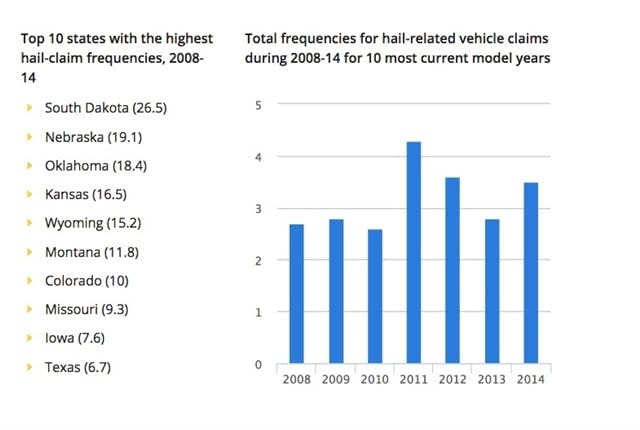
The results showed a frequency of 3.2 claims per 1,000 insured vehicle years during 2008-2014, a claim severity of $3,428, and overall losses of $11 per insured vehicle year. Across the study period, 2011 had the highest claim frequency of 4.3, while 2014 had the highest claim severity at $4,169 and overall loss at $15 per insured vehicle year.
The states with the highest claim frequencies during 2008-2014 were South Dakota (26.5), Nebraska (19.1), Oklahoma (18.4) and Kansas (16.5). Other states in the top 10, by order, were Wyoming (15.2), Montana (11.8), Colorado (10), Missouri (9.3), Iowa (7.6), and Texas (6.7).
“HLDI periodically does studies to document the effects of weather on insurance losses,” said Matt Moore, HLDI vice president. “Hail storms can be devastating events for vehicle owners. Given the recent news from Texas, as soon as the final numbers are available, we will be updating this study.”
So far in 2016, severe thunderstorms have pummeled Texas, Kansas, Missouri, and Oklahoma with large hailstones. Vehicle damage estimates for three springtime Texas storms alone top $1 billion, according to the Insurance Council of Texas. Some of these losses may be due to other weather factors, such as high winds.
“2011 and 2014 were bad years for hail storms, but it looks like 2016 may be worse,” Moore said.
Although Great Plains and Midwestern states predominate HLDI’s hail claims’ list, the most extreme hail events often occur in other regions. This was the case in five of the seven years examined. While it’s true that spring is prime time for destructive hail events, HLDI analysts uncovered another outlier.
During the study period, the worst hail storm measured by vehicle insurance losses occurred in the fall in the Southwest. Vehicle damage from the Oct. 5, 2010, Arizona storm was concentrated in three counties: Gila, Maricopa, and Yavapai. Of the three counties, Maricopa had the highest hail-loss tally for the day, with nearly 39,000 claims and more than $157 million in payments, according to HLDI.
More Safety

Fleet Manager’s Ultimate Playbook: Navigating the New Standard in OEM Connectivity
Rising operating costs, driver safety concerns, and unplanned downtime are putting unprecedented pressure on modern fleets. Discover how fleet managers use embedded OEM connectivity and real-time vehicle data to cut TCO, prevent downtime, and protect drivers without aftermarket telematics hardware.
Read More →
From Driver Well-Being to EV Charging | AF News Recap
Mental health belongs in the fleet safety conversation. This week, we’re looking at five ways fleets can support employee well-being before a crisis, plus Holman’s expansion in Mexico, new one-day Fleet Forward passes, and why EV charging demand is outpacing infrastructure growth.
Read More →
Nexar-Nauto Merger Aims to Give Fleets Better Safety Intelligence Through Larger Driving Dataset
Stefan Heck tells Automotive Fleet that combining more than 10 billion miles of driving history with Nexar's AI models will give fleets deeper insights into driver risk and roadway conditions than either company could provide independently.
Read More →
Don't Wait for a Crisis: 5 Ways to Build Mental Health Into Your Fleet Safety Program
For Suicide Prevention Month, fleet and safety leaders have an opportunity to put mental health where it belongs: at the center of workplace safety.
Read More →
How Camera Data Can Strengthen a Fleet’s Insurance Renewal
Insights from a commercial insurance carrier and a broker show how fleets can turn video telematic data, driver coaching, and improved claims results into a stronger case at insurance renewal.
Read More →
The Safest Fleets Aren’t the Ones with the Most Technology
You’ve made the telematics investment. Here’s how to capture the other half of its value and build the safest fleet on the road.
Read More →
Hidden in Plain Sight: Fleet Compliance Risks
Fleet compliance isn't just about having policies — it's about consistently enforcing them. This practical guide reveals six hidden compliance risks common in public sector and shared fleet operations and outlines proven strategies to improve visibility, accountability, and audit readiness
Read More →
NETS Sets 2026 Fleet Safety Benchmark Conference for Indianapolis
The Sept. 15–17 program will feature fleet benchmarking data, case studies, emerging technologies, and implementation strategies while running alongside the NSC Safety Congress & Expo.
Read More →
Off-the-Job Crashes Account for 43% of Employers’ $61.7 Billion Crash Burden
NETS quantifies costs dispersed across fleet, risk, HR, and other departments while providing new per-crash benchmarks for employers.
Read More →
Ram Recalls More Than 1.27 Million 1500 Pickups for Seat Belt Anchor Issue
The recall affects certain 2019-2026 Ram 1500 pickups that may have improperly attached second-row seat belt buckle anchors.
Read More →