




Ford’s Autonomous Cars Navigate Snow-Covered Roads
The self-driving Fusion Hybrids rely on LiDAR-Enabled 3D digital mapping to identify their precise position.
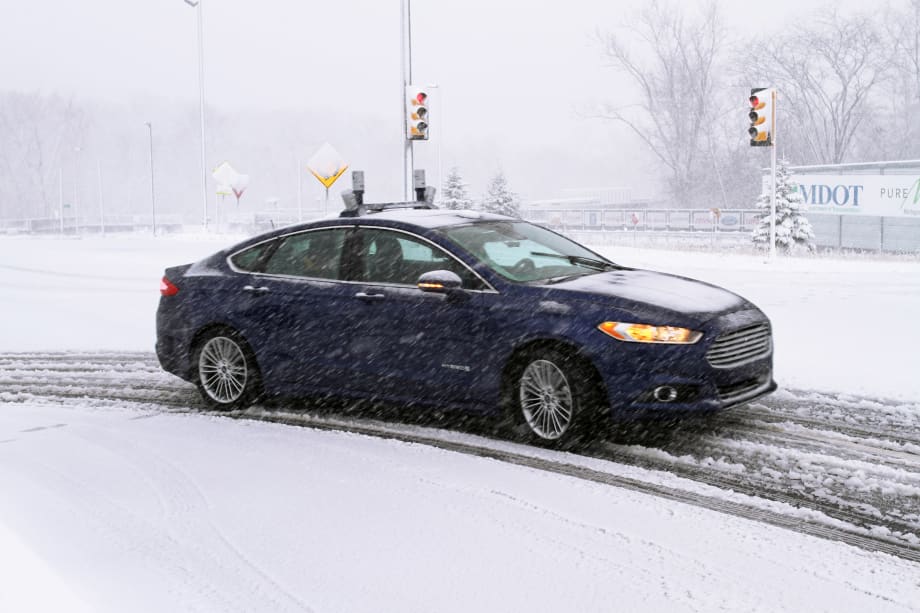
To navigate snowy roads, Ford autonomous vehicles are equipped with high-resolution 3D maps – complete with information about the road and what’s above it, including road markings, signs, geography, landmarks and topography. Photo courtesy of Ford.
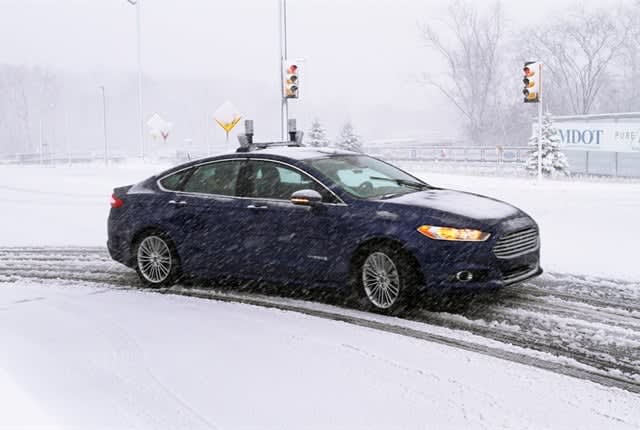
To navigate snowy roads, Ford autonomous vehicles are equipped with high-resolution 3D maps – complete with information about the road and what’s above it, including road markings, signs, geography, landmarks and topography. Photo courtesy of Ford.
Snow-covered roads in Michigan have provided a rigorous testing ground for Ford Fusion Hybrid autonomous research vehicles this past winter, and the challenging road conditions have also helped Ford demonstrate the versatility of the 3D digital mapping capabilities made possible by recent advances in LiDAR (light detection and ranging) systems.
To operate in snow, Ford Fusion Hybrid autonomous vehicles first need to scan the environment to create high-resolution 3D digital maps. By driving the test route in ideal weather, an autonomous vehicle creates highly accurate digital models of the road and surrounding infrastructure using four LiDAR scanners. These scanners generate a total of 2.8 million laser points a second, according to Ford.
The resulting map then serves as a baseline that’s used to identify the car’s position when driving in autonomous mode. Using the LiDAR sensors to scan the environment in real time, the car can locate itself within the mapped area later, when the road is covered in snow.
While mapping their environment, Ford autonomous vehicles collect and process a diverse set of data about the road and surrounding landmarks — signs, buildings, trees and other features. The car collects up to 600 gigabytes per hour, which it uses to create a high-resolution 3D map of the landscape, Ford said.
Ford’s autonomous vehicles generate so many laser points from the LiDAR sensors that some can even bounce off falling snowflakes or raindrops, returning the false impression that there’s an object in the way. Of course, there’s no need to steer around precipitation, so Ford — working with University of Michigan researchers — created an algorithm that recognizes snow and rain, filtering them out of the car’s vision so the vehicle can continue along its path.
When the subject of vehicle navigation comes up, most people think of GPS. But where current GPS is accurate to just more than 10 yards, autonomous operation requires precise vehicle location. By scanning their environment for landmarks, then comparing that information to the 3D digital maps stored in their databanks, Ford’s autonomous vehicles can precisely locate themselves to within a centimeter, Ford said.
In addition to LiDAR sensors, Ford uses cameras and radar to monitor the environment around the vehicle, with the data generated from all of those sensors fused together in a process known as sensor fusion. This process results in 360-degree situational awareness, according to Ford.
Sensor fusion means that one inactive sensor — perhaps caused by ice, snow, grime or debris buildup on a sensor lens — doesn’t necessarily hinder autonomous driving. Still, Ford autonomous vehicles monitor all LiDAR, camera and radar systems to identify the deterioration of sensor performance. This helps keep sensors in ideal working order, Ford said. Eventually, the cars might be able to handle ice and grime buildup themselves through self-cleaning or defogging measures.
The company's winter weather road testing takes place in Michigan, including at Mcity — a 32-acre, real-world driving environment at the University of Michigan. Ford’s testing on this full-scale simulated urban campus is aimed at supporting the company’s mission to advance autonomous driving.
More Safety
IIHS Crash Avoidance Tests Reveal Safety Gaps in Cargo Vans and Work Trucks
New crash-avoidance ratings from the Insurance Institute for Highway Safety reveal inconsistent performance among commercial vehicles, with several popular cargo vans and heavy-duty pickups struggling to avoid collisions with other vehicles and pedestrians.
Read More →
What’s Next for Fleet? Safety, AI & Industry Recognition | AF News Recap
Could your company's culture be encouraging distracted driving? This week, we're exploring how workplace expectations affect driver safety, what AI, EVs, and autonomous vehicles could mean for the future of fleet management, and how fleet professionals can strengthen their award nominations.
Read More →
Does Your Fleet's Culture Encourage Distracted Driving?
What happens when the people responsible for enforcing safety rules are the ones setting the wrong example? The answer may reveal why some of the biggest risks to fleet drivers have little to do with what's written in the employee handbook.
Read More →
Fleet Manager’s Ultimate Playbook: Navigating the New Standard in OEM Connectivity
Rising operating costs, driver safety concerns, and unplanned downtime are putting unprecedented pressure on modern fleets. Discover how fleet managers use embedded OEM connectivity and real-time vehicle data to cut TCO, prevent downtime, and protect drivers without aftermarket telematics hardware.
Read More →
From Driver Well-Being to EV Charging | AF News Recap
Mental health belongs in the fleet safety conversation. This week, we’re looking at five ways fleets can support employee well-being before a crisis, plus Holman’s expansion in Mexico, new one-day Fleet Forward passes, and why EV charging demand is outpacing infrastructure growth.
Read More →
Nexar-Nauto Merger Aims to Give Fleets Better Safety Intelligence Through Larger Driving Dataset
Stefan Heck tells Automotive Fleet that combining more than 10 billion miles of driving history with Nexar's AI models will give fleets deeper insights into driver risk and roadway conditions than either company could provide independently.
Read More →
Don't Wait for a Crisis: 5 Ways to Build Mental Health Into Your Fleet Safety Program
For Suicide Prevention Month, fleet and safety leaders have an opportunity to put mental health where it belongs: at the center of workplace safety.
Read More →
How Camera Data Can Strengthen a Fleet’s Insurance Renewal
Insights from a commercial insurance carrier and a broker show how fleets can turn video telematic data, driver coaching, and improved claims results into a stronger case at insurance renewal.
Read More →
The Safest Fleets Aren’t the Ones with the Most Technology
You’ve made the telematics investment. Here’s how to capture the other half of its value and build the safest fleet on the road.
Read More →
Hidden in Plain Sight: Fleet Compliance Risks
Fleet compliance isn't just about having policies — it's about consistently enforcing them. This practical guide reveals six hidden compliance risks common in public sector and shared fleet operations and outlines proven strategies to improve visibility, accountability, and audit readiness
Read More →