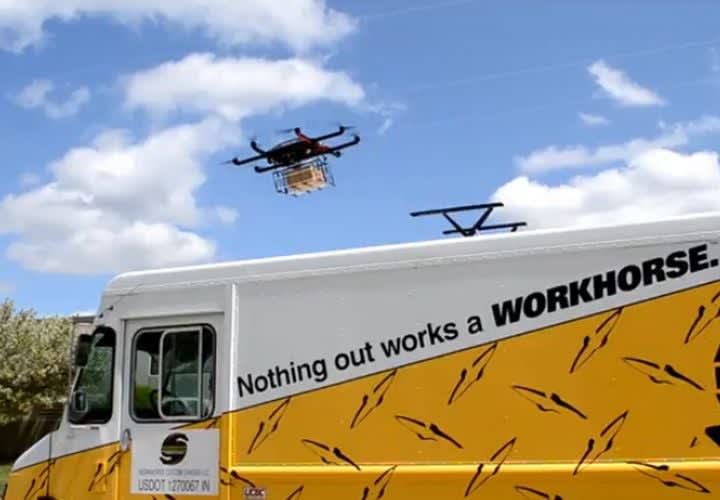
The Workhorse Group — with its electric truck and a drone delivery system — is among the 15 companies qualified by the U.S. Postal Service as potential suppliers of its next-generation delivery vehicle.
Paul Clinton・Former Senior Web Editor
May 13, 2015
Screenshot via Workhorse.
2 min to read
Screenshot via Workhorse.
The Workhorse Group — with its electric truck and a drone delivery system — is among the 15 companies qualified by the U.S. Postal Service as potential suppliers of its next-generation delivery vehicle.
Whether the USPS will embrace innovative technology that's poised to disrupt the "last mile" of traditional package delivery remains an open question, but Workhorse CEO Steve Burns believes an order for 180,000 vehicles that could reach $6.3 billion could play into his favor. The USPS has said it's seeking a vehicle that will serve for two decades.
Ad Loading...
"When you’ve got a deal that big, it’s a chance to leapfrog" other delivery methods, Burns said. "That’s a big enough bounty where innovation can happen. It's going to cause a quantum leap."
Burns faces tough competition on a list of potential suppliers that includes Fiat Chrysler Automobiles, Ford, Nissan, and Freightliner. The list also includes AM General, Emerald Automotive, Karsan, Mahindra, Morgan Olson, OEM Systems, Oshkosh, Utilimaster, VT Hackney, and ZAP Jonway.
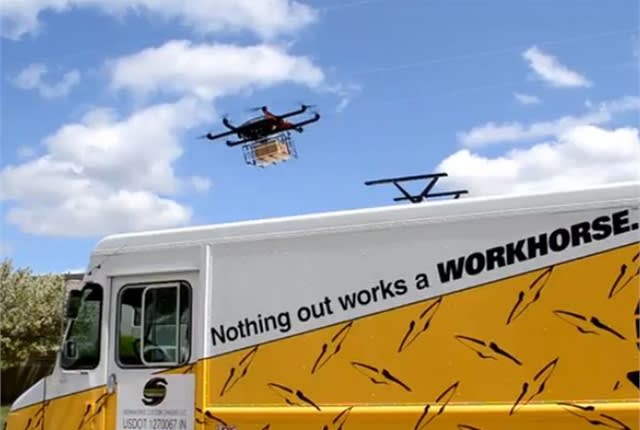
Workhorse, which officially changed its name from Amp in April, would submit its E-Gen range-extended truck chassis and HorseFly package delivery drone. The company is partnering with a body builder to develop a custom service body that would include a drone deployment port in the roof that allows the drone to exit and return from delivery jobs.
The drone would use the vehicle's battery to charge its pair of Panasonic 18650 (18-by-65 mm size) lithium ion batteries. The drone uses a 3G cellular signal and point-to-point signal from the truck to reach its target. The driver uses a tablet mounted inside the truck to pinpoint the final delivery location at the address, and the landing is managed by certified pilots in a Workhorse command center.
The latest E-Gen chassis features a 200-kilowatt Sumo motor from Canada's TM4, a Panasonic 18650 battery pack, and 2.4-liter engine from Power Solutions International in the hybrid model. The engine can be set up to run on gasoline, CNG or propane autogas.
Ad Loading...
Burns is waiting for the USPS to issue its RFP this month so he can submit a detailed proposal. The USPS would then select several suppliers to build prototypes for testing. Drone operation would still need federal regulatory approval before moving forward.
For fleet managers, fuel is one of the biggest line items in the budget — and it's one hybrids can shrink without changing how your people work. Download the eBook to see the numbers, understand the technology, and get a step-by-step guide to making the switch.
James Victory of NOV discusses how the company manages fleet safety, maintenance, and telematics across more than 150 locations supporting oilfield operations throughout the U.S.
Departmentally assigned vehicles often create hidden costs through underutilization, poor visibility, and increased administrative burden. This white paper explores how shared motor pool strategies help fleets reduce costs, improve accountability, and optimize vehicle utilization.
BBL Fleet expanded its footprint in the fleet management industry with the acquisition of Velcor Leasing Corporation of Madison through a stock purchase agreement finalized Feb. 27, 2026.
Fleet leaders are under pressure to reduce costs, adapt to economic uncertainty, and make smarter decisions. See how peers across North America are responding with real data, proven strategies, and forward-looking insights. Download the 2026 Market Pulse Report to benchmark your strategy and uncover where you can gain an edge.
AI is no longer a future concept for fleets—it’s already embedded in the tools, data, and decisions that operators rely on every day. In this episode of the Fleet Forward Podcast, recorded live at Fleet Forward, industry leaders take the conversation beyond hype to examine what responsible AI adoption really looks like in fleet operations.