




Ford Claims Best-in-Class Towing for 2015 F-450
Ford has increased the towing capability of its largest pickup, the F-450, for the 2015 model-year to a best-in-class 31,200 pounds, Ford announced at a media event in West Virginia.
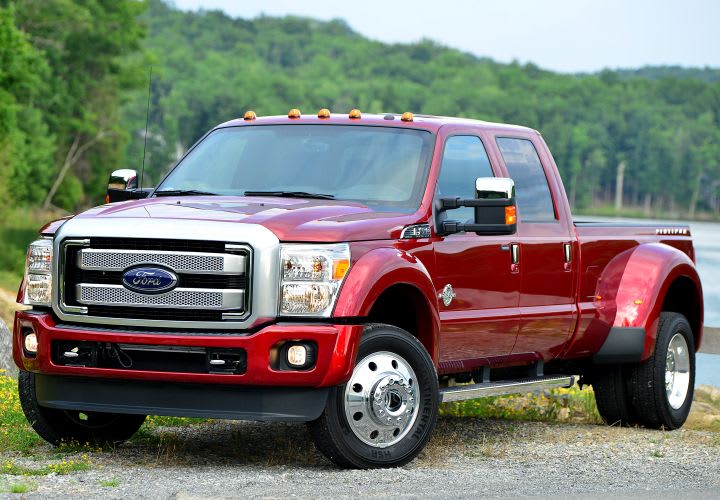
Photo of 2015 F-450 Super Duty courtesy of Ford.

Photo of 2015 F-450 Super Duty courtesy of Ford.
Ford has increased the towing capability of its largest pickup, the F-450, for the 2015 model-year to a best-in-class 31,200 pounds, Ford announced at a media event in West Virginia.
The 2015 F-450 increases payload capability 6,500 pounds over the 2014 model, which would give it greater towing capacity than the Ram 3500 HD or the Chevrolet Silverado 3500 HD, said Doug Scott, Ford Truck Group marketing manager.
Ford brought automotive journalists to New River Gorge National River for a demonstration that included side-by-side comparisons with its competitors' vehicles.
Ford has made several other improvements to its Super Duty pickups including the F-250 and F-350 such as improved power output from the 6.7L Power Stroke V-8 engine, upgrades to the chassis, and a revamped King Ranch model.
The 2015 F-450 is going on sale this week, while the 2015 F-250 and F-350 became available earlier this month.
While improving towing capability, Ford won't align the trucks to the SAE J2807 towing standard developed by the Society of Automotive Engineers. Meeting the standard would require Ford to retest the vehicles, which won't happen during this midcycle refresh. Ford has said it will conform to the towing standard with all new vehicles, including the 2015 F-150, which will be available later this year. Ford representives declined to say whether they would shift to aluminum for the heavier pickups.
The automotive industry agreed on the SAE J2807 towing standard in 2009 for the 2013 model year, but only Toyota adopted it. Ford and Chrysler said in February they would adopt the standard for 2015. In June, General Motors revised its ratings for its Chevrolet Silverado 1500 and GMC Sierra 1500 2015-MY pickups.
More Operations
Company Vehicle or Reimbursement? How Fleets Are Rethinking Assignments
As fleet costs and insurance pressures rise, fleet managers are taking a closer look at which employees need company-provided vehicles and when a reimbursement program may make more sense.

Fleetio, ASE Launch Scholarship Program for Automotive Technicians
The second annual program will award 15 scholarships totaling $35,000 to support ASE certification, testing fees, and equipment costs.

Reading the Global Signals: What AI and the Energy Transition Mean for Fleets Now
In this opening keynote of the 2026 Fleet Forward Conference, John Rossant, founder of CoMotion, How can fleet managers navigate a never-ending, changing industry landscape?

90% Use Telematics. Are Fleets Getting Safer? | AF News Recap
This week, we're breaking down which industries have the highest rates, how Jamie McKay manages 2,400 vehicles, what's happening with the 2027 fleet awards, and why software-defined vehicles could introduce new costs.

What's Best Handled by an FMC, and What's Better Done Directly?
Fleet managers continue to rely on FMCs for essential services but are taking a closer look at where working directly with suppliers can improve efficiency and responsiveness.

Fleet Meets: Erin Gilchrist
Meet Erin Gilchrist, the inaugural Mike Antich Spirit of Fleet Award winner, as she shares insights on leadership, mentorship, the power of industry connections, and why people remain at the heart of fleet's future.

How 2026 Fleet Visionary Jamie McKay Manages 2,400 Vehicles Across 37 States
How do you keep 2,400 vehicles running across 37 states? Fleet Visionary Award winner Jamie McKay shares how collaboration, flexibility, and a few simple strategies help her tackle fleet management challenges at Aptive Pest Control.

Managing Fleet Costs in an Era of Permanent Volatility
Fleet operating costs have risen more than 20% since 2020, raising a key question: When does extending a vehicle's service life stop making financial sense?

The Next Evolution of Fleet Management: Autonomous Operations
This opening keynote session at the Fleet Forward Conference highlights the future of autonomous driving for fleets.

How to Reduce the Total Cost of Risk From Catalytic Converter Theft
A stolen catalytic converter can cost fleets far more in downtime and lost productivity than in repairs. A total-cost-of-risk approach can help fleet managers quantify their exposure and prioritize theft prevention.