




Auditing the Gray Fleet: How to Reduce Risk in Reimbursed Driver Programs
When employees drive for work, liability follows, no matter who owns the vehicle. A “carrot-flavored stick” approach shows fleets what to do about it.
February 13, 2026


Reimbursed drivers introduce risk that is harder to see, monitor, and document without a formal gray fleet audit.
Credit: Automotive Fleet
6 min to read
The term "gray (grey) fleet" has traditionally carried much more significance in the U.K. than in the U.S. One might think a "gray fleet" refers to older fleet vehicles. The definition is actually “employees' personal (privately owned) vehicles used for business purposes.”
In the U.S., we’ve generally used “reimbursement of employees’ vehicles” or even more esoteric — “non-owned auto” — but those phrases frankly aren’t as catchy. Gray fleet captures that gray area between things you have less control over but still must manage.
Gray fleets will always be a part of fleet management, as there are always use cases (generally around mileage thresholds) in which it makes sense to reimburse.
Yet when an employee is driving for work, liability exposure remains firmly with the organization — regardless of who owns the vehicle. This is underappreciated in many organizations, said Mark Iorillo, senior director of client experience and revenue enablement at Element Fleet Management.
“Many companies think they transfer the risk from the company to the individual driver in a gray fleet environment,” he said. “This is incorrect. The company still carries liability for an employee operating any vehicle for business purposes, regardless of ownership.”
That reality means organizations must apply the same discipline to reimbursed drivers as to the company fleet, but through different enforcement mechanisms.
Note: This discussion focuses on non-CDL drivers, who have a different duty of care than CDL holders.
Establishing Non-Negotiable Safety Standards
The starting point for any gray fleet audit is defining what is non-negotiable. From a risk standpoint, the exposure does not change simply because the vehicle is personally owned.
“At a minimum, gray fleet drivers should be held to the same foundational safety expectations as company-provided fleet drivers,” said Austin Walters, senior specialist, strategic initiatives at Element. “From a risk standpoint, the exposure is identical — the vehicle is being used to conduct company business.”
The non-negotiables:
A valid driver’s license in good standing
Ongoing MVR monitoring
Defined insurance minimums
Vehicle maintenance standards
A signed company driving policy
The challenge is enforcement. Ryon Packer, chief product officer at Motus, calls an effective mechanism the “carrot-flavored stick,” which leverages employees’ desire for reimbursement to strict safety and policy compliance.
Here’s how to approach the non-negotiables:
Auditing Driver Risk Through MVRs
“The most critical requirement is a comprehensive MVR (motor vehicle record) monitoring program,” Iorillo said. “Making sure the folks who are performing company business while operating a vehicle have a license in good standing and are not habitual offenders for breaking traffic laws is a bare minimum requirement.”
The carrot-flavored stick approach lets the fleet manager enforce the same MVR standards for gray fleet drivers as for company vehicles, Packer said. Reimbursement is withheld until signatures are obtained and compliance is verified.
Verifying Insurance Coverage
“(Insurance) is one of the most overlooked gray fleet risks,” Walters said. “Many employees assume their personal policy automatically covers business use, which often isn’t the case.”
Audits should verify not just state minimums, but whether policies explicitly allow business use and meet company-defined liability limits. Just as important is verification frequency.
“Verification — not just at enrollment, but throughout the year — is critical,” Walters added. “Annual or semi-annual proof of insurance submission is a good starting point.”
Vehicle Eligibility and Maintenance Oversight
Unlike a company fleet, gray fleet vehicles vary widely in age, configuration, and condition. That variability makes vehicle standards harder to enforce, yet they remain critical.
“We treat gray fleet exactly the same as we would a company car,” said Applied Driving CEO Andy Phillips. “From our point of view, the risk is actually slightly greater because you don’t have the same direct control over maintenance or vehicle suitability.”
That includes defining acceptable vehicle age, condition, and equipment, and ensuring business-appropriate insurance and breakdown coverage.
“If you provide someone with a company vehicle, they’ll have breakdown cover (roadside assistance),” Phillips said. “If you don’t stipulate that in your gray fleet policy, then not all drivers will have it, and that creates both safety risk and lost productivity.”
Training for Non-Professional Drivers
Training is another area where gray fleet programs often struggle. Reimbursed drivers are not professional drivers; they are business professionals whose primary job is not behind the wheel.
As such, they often resist traditional long-form or classroom-style training, Packer said, because it is seen as taking away from their primary responsibilities.
A more effective approach for these drivers is to deliver bite-sized content, such as two-minute videos focused on a single topic. This style mirrors familiar social media consumption, making it quick and easy to fit into busy schedules, Packer said.
This method ensures key safety principles are communicated and acknowledged effectively while respecting the realities of non-professional driving roles, Packer said.
Audits should confirm not only that training exists, but that completion is tracked and reinforced over time.
Monitoring Behavior Without Traditional Telematics
Installing a telematics device in a personally owned vehicle is a non-starter. But driver behaviors can still be tracked in those vehicles using smartphone-based tools and reimbursement data.
Installing a smartphone-based monitoring app can be tied to a condition of participation in the reimbursement program. The app uses the phone's built-in GPS and sensors to capture driving data only during business-related trips.
The app can track safety metrics such as average speed, exceeding company limits, hours driven (to monitor fatigue), phone handling, harsh acceleration, braking, and cornering, as well as automatic crash detection for emergency response.
“All of that information exists without having a single piece of hardware in the car because it is working off of the GPS data that's required to create a mileage log,” Packer said.
When introducing the app to drivers, both Packer and Phillips emphasize it as a supportive safety tool.
“We don’t track location,” Phillips said. “The only time location is shared is in an emergency situation triggered by a crash or if the driver presses an SOS button and that’s shared with emergency services, not us.”
Instead, audits can focus on indicators such as speeding trends, journey length, and fatigue risk, without crossing into surveillance.
Hidden Costs That Audits Often Reveal
While gray fleet programs are often justified as a cost-saving measure, audits frequently uncover indirect costs that offset expected savings.
“There are a lot of hidden costs with gray fleet. The ‘bent metal’ cost isn’t borne by the organization, but the hidden costs, which can be four to eight times the bent metal cost, are still absorbed by the company,” Phillips said.
Those costs include lost productivity from downtime, administrative effort, and delays caused by unmanaged incidents.
You Own the Risk, So Audit it
Gray fleet is not a loophole. It is simply another way employees drive on company business—and it carries the same obligation to manage risk.
“The best company driving policies spell out requirements clearly and require validation of adherence periodically,” Iorillo said. “Without that structure, compliance becomes inconsistent and risk increases.”
Auditing reimbursed drivers is not about over-controlling personal vehicles. It is about confirming that the organization’s standards are met, documented, and enforced.
If an employee drives for work, the company already owns the risk. A disciplined gray fleet audit ensures it also owns the oversight.
Subscribe to Our Newsletter
More Safety

Sponsored•October 1, 2026
Fleet Manager’s Ultimate Playbook: Navigating the New Standard in OEM Connectivity
Rising operating costs, driver safety concerns, and unplanned downtime are putting unprecedented pressure on modern fleets. Discover how fleet managers use embedded OEM connectivity and real-time vehicle data to cut TCO, prevent downtime, and protect drivers without aftermarket telematics hardware.
Read More →
From Driver Well-Being to EV Charging | AF News Recap
Mental health belongs in the fleet safety conversation. This week, we’re looking at five ways fleets can support employee well-being before a crisis, plus Holman’s expansion in Mexico, new one-day Fleet Forward passes, and why EV charging demand is outpacing infrastructure growth.
Read More →
Nexar-Nauto Merger Aims to Give Fleets Better Safety Intelligence Through Larger Driving Dataset
Stefan Heck tells Automotive Fleet that combining more than 10 billion miles of driving history with Nexar's AI models will give fleets deeper insights into driver risk and roadway conditions than either company could provide independently.
Read More →
Don't Wait for a Crisis: 5 Ways to Build Mental Health Into Your Fleet Safety Program
For Suicide Prevention Month, fleet and safety leaders have an opportunity to put mental health where it belongs: at the center of workplace safety.
Read More →
How Camera Data Can Strengthen a Fleet’s Insurance Renewal
Insights from a commercial insurance carrier and a broker show how fleets can turn video telematic data, driver coaching, and improved claims results into a stronger case at insurance renewal.
Read More →
The Safest Fleets Aren’t the Ones with the Most Technology
You’ve made the telematics investment. Here’s how to capture the other half of its value and build the safest fleet on the road.
Read More →
Sponsored•August 7, 2026
Hidden in Plain Sight: Fleet Compliance Risks
Fleet compliance isn't just about having policies — it's about consistently enforcing them. This practical guide reveals six hidden compliance risks common in public sector and shared fleet operations and outlines proven strategies to improve visibility, accountability, and audit readiness
Read More →
NETS Sets 2026 Fleet Safety Benchmark Conference for Indianapolis
The Sept. 15–17 program will feature fleet benchmarking data, case studies, emerging technologies, and implementation strategies while running alongside the NSC Safety Congress & Expo.
Read More →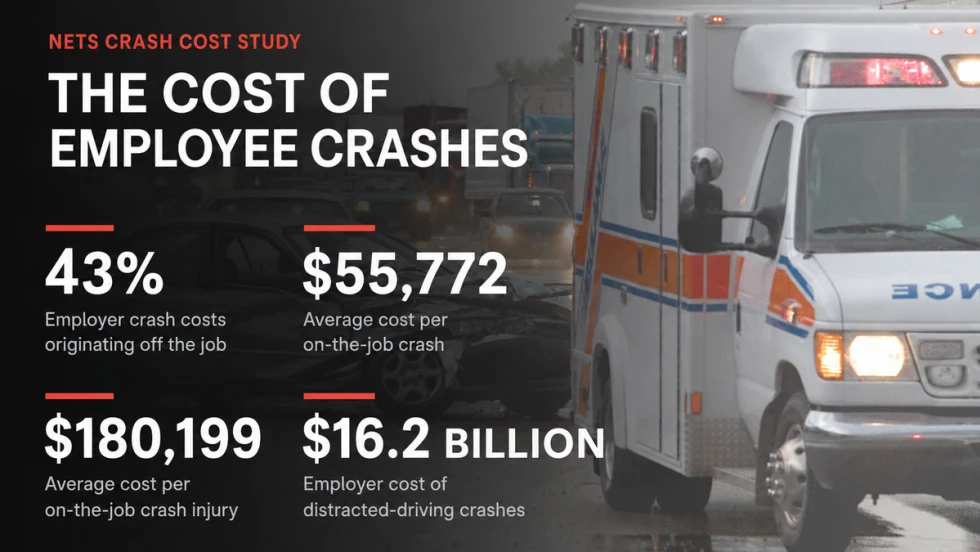
Off-the-Job Crashes Account for 43% of Employers’ $61.7 Billion Crash Burden
NETS quantifies costs dispersed across fleet, risk, HR, and other departments while providing new per-crash benchmarks for employers.
Read More →
Ram Recalls More Than 1.27 Million 1500 Pickups for Seat Belt Anchor Issue
The recall affects certain 2019-2026 Ram 1500 pickups that may have improperly attached second-row seat belt buckle anchors.
Read More →