




Dropping: New Vehicle Prices, EV Sales, Incentives
The decline in the average transaction price was mostly expected, as sales of expensive EVs fell sharply as government incentives expired Sept. 30.

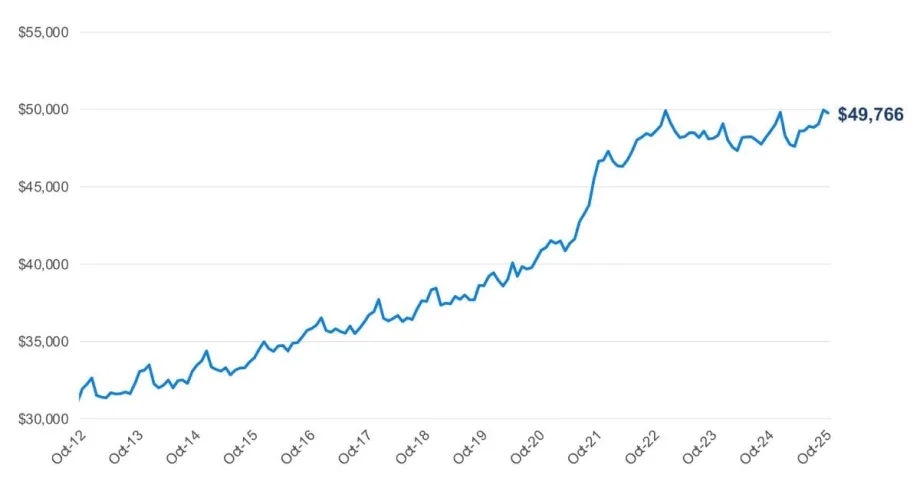
The ATP last month was lower by 0.4% compared to September but higher year over year by 2.1%, slightly below the long-term average ATP increase.
Graphic: Cox Automotive
The average transaction price (ATP) of a new vehicle in the U.S. declined marginally in October, according to estimates released Nov. 12 by Kelley Blue Book, falling from a record high set in September. New-vehicle ATPs last month were higher compared to year-ago levels.
The ATP decline was mostly expected, as sales of expensive electric vehicles (EVs) fell sharply month over month, as government-backed sales incentives expired at the end of September.
In October, the new-vehicle ATP was $49,766, falling as expected from the all-time high in September. The ATP last month was lower by 0.4% compared to September but higher year over year by 2.1%, slightly below the long-term average ATP increase.
The average new-vehicle manufacturer’s suggested retail price (MSRP) – commonly called “the asking price” – also declined in October, as fewer higher-priced EVs were sold last month. The new-vehicle MSRP was $51,841, down from the record set in September, but up by 2.6% year over year.
Incentive spending declined in October. The average incentive package last month was equal to 6.5% of ATP, a decrease of 11.4% compared to September, when incentive spending equaled 7.3% of ATP. A year ago, the average incentive package was equal to 7.6% of ATP.
Full-size pickup trucks, a volume-leading segment in the U.S. market, behind only the compact and mid-size SUV segments, saw average transaction prices hit a record high in October, at $66,462. Incentives, at 8.4% of ATP, were higher month over month but lower than the peaks for 2025 seen in June and July. The average MSRP for a full-size pickup sold last month was $70,351.
Among major volume brands, Cadillac and Porsche have seen some of the biggest price gains in the past year. Cadillac, a brand focused on a robust EV strategy and selling a strong mix of high-end Escalades, has seen ATPs jump more than 22% year over year. At Porsche, a heavy importer facing steep tariff costs, ATPs in October were up more than 13%. Lincoln and Chevrolet also saw annual prices increase well above the industry average, while Acura, Jeep and Tesla saw ATPs notably lower versus year-ago levels.
“October’s dip in average transaction prices was anticipated and reflects a natural market adjustment after September’s record highs," said Erin Keating, executive analyst with Cox Automotive, in a Nov. 12 news release. "Even with the pullback, prices remain elevated year over year. Fortunately for automakers, there is continued strength in consumer demand, especially from well-heeled households. Consumers remain engaged, and while affordability challenges persist, the industry is adapting with incentives and product mix shifts. We’ve been anticipating a slowdown in the market. This is a story of moderation, not retreat.”
Electric Vehicle Sales Plunge in October as Prices Edge Higher
Electric vehicle sales fell sharply in October, as expected, dropping to 74,835, a decline of 48.9% month over month, according to initial estimates from Cox Automotive. EV sales in October were lower year over year by 30.3%.
In October, the ATP for a new EV was 1.6% higher month over month, climbing to $59,125. New EV prices in October were higher year over year by 2.3%.
Market leader Tesla’s ATPs declined month over month in October, falling 1.1% to $53,526. Compared to October 2024, Tesla prices were 5.5% lower. ATPs for the core Tesla models – the popular Model 3 and Model Y – both declined month-over-month in October. Sales also declined, as the entire EV segment contracted. Tesla sales in October fell 35.3% from September and 23.6% from the year-ago level, declines smaller than those of the overall EV segment.
Said Cox Automotive senior analyst Stephanie Valdez Streaty: “We expected this shift in the electric vehicle market. With the IRA-backed sales incentives gone, lower-cost EV volume was hit hard, pushing the mix toward more luxury and driving October’s EV ATP to a 2025 high of $59,125 — now $9,359 above the industry average. Affordability has always been the core challenge with EV sales, and this reset only underscores how critical it is to bring more attainable EV options to market.”
More Operations

How Fleets Can Recruit and Train Veterans for Technician Roles
Here's how the technician shortage has affected uptime for fleets, and what to do about it.
Read More →
Avis Budget Group Deploys Neology Toll Management Technology Across Major Brands
Neology’s neoFleet platform will manage toll transactions and toll-authority operations for vehicles across Avis, Budget, Payless, Budget Truck and Zipcar.
Read More →
Fleet Personal-Use Charges Edge Higher in 2026
Nearly eight in 10 surveyed fleets allow personal use of company vehicles, while just over half of respondents report charging employees for the privilege.
Read More →
The Future of Fleet + What’s Changing Right Now | AF News Recap
Could developments overseas offer a preview of what’s coming for U.S. fleets? This week, we’re looking at the future of AI, autonomy, and electrification, plus Ford Pro’s new certified pre-owned program, smarter vehicle offboarding, and a new way for fleets to manage toll expenses.
Read More →
How to Handle Vehicle Offboarding
What do fleet managers need to do when a driver leaves?
Read More →
Fleet Manager’s Ultimate Playbook: Navigating the New Standard in OEM Connectivity
Rising operating costs, driver safety concerns, and unplanned downtime are putting unprecedented pressure on modern fleets. Discover how fleet managers use embedded OEM connectivity and real-time vehicle data to cut TCO, prevent downtime, and protect drivers without aftermarket telematics hardware.
Read More →
U.S. Bank Adds Verra Mobility Toll Management to Voyager Fleet Platform
The integration allows U.S. Bank Voyager fleet customers to manage toll payments and violations alongside fuel, EV charging and maintenance expenses.
Read More →
ADAS Prevents Crashes. But Repairs Cost More | AF News Recap
ADAS-equipped vehicles may crash less often, but they can cost more when they do. This week, we’re breaking down what that tradeoff means for fleets, plus Subaru’s first Forester Wilderness Hybrid, Nissan’s new e-POWER Rogue, and why Calstart has become Catalyst Mobility.
Read More →
Moventum Fleet Management Names Mark Iorillo Head of Sales
Iorillo brings nearly 20 years of fleet management and sales experience to the role, including previous positions at Element Fleet Management, CEI, Donlen and Ryder.
Read More →
Fleet Has a Talent Pipeline Problem. What Comes Next? | AF News Recap
Where will fleet’s next generation of leaders come from? This week, we’re looking at the industry’s talent pipeline, what certification can add to a fleet career, how to build an award-worthy track record, and the return of Automotive Fleet’s Personal Use Survey.
Read More →