





Recent News: State of Used Vehicles at End of 2024
Wholesale Used-Vehicle Prices Fell in December 2024
Wholesale values declined slightly more than usual at year-end, but it was still the most normal year for depreciation trends since 2020.
January 8, 2025
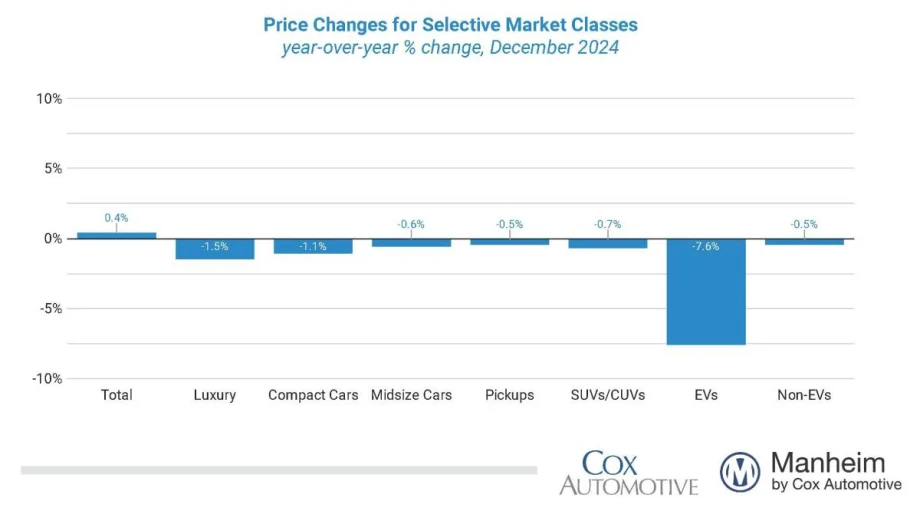
All major market segments experienced seasonally adjusted prices that were down year over year in December, though the declines have been mitigated in recent months.
Graphic: Cox Automotive
6 min to read
Wholesale used-vehicle prices (on a mix, mileage, and seasonally adjusted basis) were lower in December compared to November, according to the Manheim Used Vehicle Value Index (MUVVI) released Jan. 8.
The index fell to 204.8, an increase of 0.4% from a year ago. The seasonal adjustment reduced the change for the month, as non-seasonally adjusted values declined at a higher rate. The non-adjusted price in December decreased by 0.8% compared to November, increasing the unadjusted average price to 0.3% year over year.
“On the margin, wholesale values declined just a bit more than usual right at year-end, but when all was said and done, it was our most normal year for depreciation trends in the last five years,” said Jeremy Robb, senior director of economic and industry insights at Cox Automotive, in a Jan. 8 news release. “The Manheim Index ended the year up 0.4% from last year, below the long-term average increase of 2.3%. Market participants experienced a bit of a roller coaster ride, with values depreciating more than normal in the first half but less in the second half, and we ended the year much closer to longer-term trends. With the tightness of current retail supply, lower lease maturities expected throughout the coming year, and the question of tariffs on new vehicles still up in the air, we expect to continue to see more normal depreciation patterns in 2025.”
In December, Manheim Market Report (MMR) values saw weekly decreases in every week of the month, with larger declines seen in the back half of the month, consistent with seasonal trends. During the last four weeks, the Three-Year-Old Index decreased an aggregate of 1.3%, including a decline of 0.5% each of December’s last two weeks. Those four weeks delivered an average accumulated decrease of 0.5% between 2014 and 2019, indicating that depreciation trends were a bit higher than usual at year-end.
Over the month, daily MMR Retention, the average difference in price relative to the current MMR, averaged 99.1%, meaning market prices moved away from MMR values this month and were lower against November levels. Compared to last year, valuation models were higher by 1.3 percentage points for MMR retention but six-tenths of a point higher than 2019 levels for the same period.
The average daily sales conversion rate fell to 53.8%, a decline of 1.1 percentage points from last month yet higher than normally seen at this time of year. For comparison, the daily sales conversion rate averaged 51.9% in December over the last three years. Given the holiday period and its effect on sales and offerings, it is normal to see a seasonal decline in conversion in December.
Vehicle Segment Prices See Small Decreases
All major market segments experienced seasonally adjusted prices that were down year over year in December, though the declines have been mitigated in recent months.
Compared to December 2023, trucks were down the least, falling by 0.5%, with mid-size sedans falling 0.6% and SUVs down 0.7%. Compact cars fell by 1.1% over the period, and luxury performed the worst, falling 1.5% against last year.
Compared to the previous month, the truck segment outperformed the industry overall, rising by 1% over the month, while compact cars fell by 0.3%, which aligns with the industry average. The luxury segment fell 0.5% against November 2024, SUVs declined 0.7%, and mid-size sedans showed the highest decline, falling by 0.9%.
Looking at the market by powertrain, electric vehicles (EVs) were higher in November and stronger than the industry average overall, increasing by 3.4%, while non-EVs fell 0.5% over the same time. Seasonally adjusted EV values for December 2024 continued to show stronger depreciation trends, although the year-over-year declines have slowed in the last few months, with values falling by 7.6%. Non-EVs were down only 0.5% year over year, a bit higher than the overall industry average.
Retail Used-Vehicle Sales Were Flat in December
Assessing retail vehicle sales based on observed changes in units tracked by vAuto, Cox estimates retail used-vehicle sales in December were flat compared to November and higher year over year by 13%. A used vehicle's average retail listing price increased 0.3% over the last four weeks.
Using estimates of retail used days’ supply based on vAuto data, a first assessment indicates December ended at 48 days’ supply, up one day from 47 days at the end of November and down 10 days from December 2023 at 58 days.
New vehicle sales in December were up 2% from last year, and volume increased 8.4% from November. The December sales pace, or seasonally adjusted annual rate (SAAR), came in at 16.8 million, up 0.9 million from last year’s pace and higher than November’s upwardly revised 16.6 million level.
Combined sales into large rental, commercial, and government fleets decreased 11.6% year over year in December. Including an estimate for fleet deliveries into dealer and manufacturer channels, the remaining new retail sales were estimated to be up 2.1% from last year, leading to an estimated retail SAAR of 14 million, up 6.3% from last year’s pace and up from November’s estimated 13.7 million level. Fleet share was estimated to be 13.3%, down from last year’s 14.1% share.
Rental Risk Price and Mileage Results Were Mixed Against Last December
The average price for rental risk units sold at auction in December decreased 0.1% year over year. Rental risk prices also fell by 2.6% compared to November. Average mileage for rental risk units in December (at 51,700 miles) rose 12.3% against last year’s monthly level. For December, the average mileage of the rental unit was also higher, by 6.1% from November 2024.
Measures of Consumer Confidence Were Mixed in December
The Conference Board Consumer Confidence Index declined 7.2% in December, far worse than the small gain expected; but November’s index was revised higher. Consumers’ views of both the present and the future declined, with the view of the future plunging 13.4% to its lowest level since July. Consumer confidence was down 3.1% year over year. Plans to purchase a vehicle in the next six months also dropped to the lowest level since June from the highest level since May 2019, leaving plans down year over year for the first time in four months.
The sentiment index from the University of Michigan increased 3% in December, which was lower than expected as it saw no improvement from the earlier reading at the start of the month. With the final monthly increase, the index was up 6.2% year over year. The underlying views of current conditions and future expectations moved in different directions, with current conditions jumping but consumer expectations falling. Expectations for inflation in one year increased to 2.8% from 2.6%, but expectations for inflation in five years declined to 3% from 3.2%. Consumers’ views of buying conditions for vehicles increased to the best level since April as views of interest rates were less negative, but the views of prices deteriorated.
Morning Consult's daily consumer sentiment index saw a slight increase in December after increases in each of the prior five months. The index was up 0.1% for the month, which left the index up 10.4% year over year.
According to AAA, the national average price for unleaded gas was $3.06 per gallon, up 0.4% in December from the end of November but down 1% year over year.
More Remarketing
Wholesale Used-Vehicle Values Fall as Cox Automotive Cuts 2026 Forecast
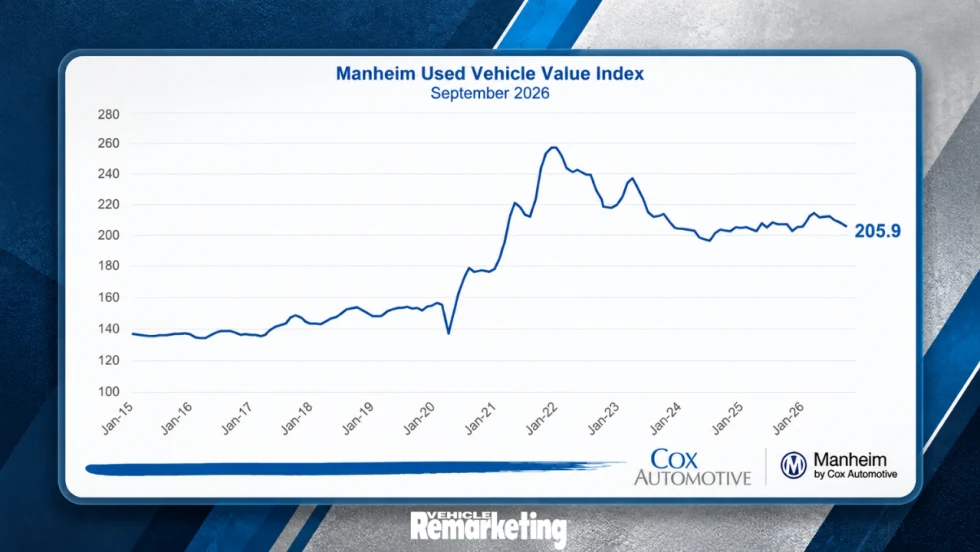
Wholesale used-vehicle prices declined in September as depreciation accelerated, prompting Cox Automotive to lower its year-end forecast.
Read More →
FLD Promotes Three Executives in Leadership Changes
FLD has promoted three longtime executives, naming Gary Mott CEO, Richard Mallek president, and Ron Sanders managing partner.
Read More →
Ford Pro Launches Certified Pre-Owned Program for Commercial Vehicles
Ford Pro Advantage will offer certified pre-owned Class 1-7 commercial vehicles through more than 700 Ford Pro Commercial Vehicle Centers.
Read More →
Copart to Acquire ACV in $1.9 Billion Deal
The acquisition would expand Copart beyond its traditional salvage business into dealer-to-dealer wholesale remarketing while adding ACV’s vehicle data, inspection, and valuation technology.
Read More →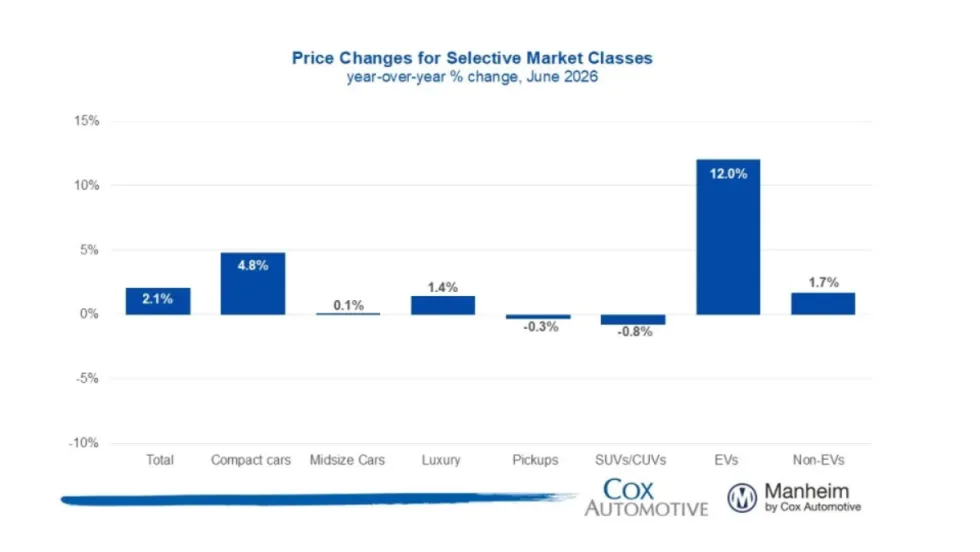
Manheim Index Shows Used-Vehicle Wholesale Prices Up 2.1% in June
The market is seeing stronger appreciation in older used vehicles this year, and the most affordable segments have been among the year’s best performers.
Read More →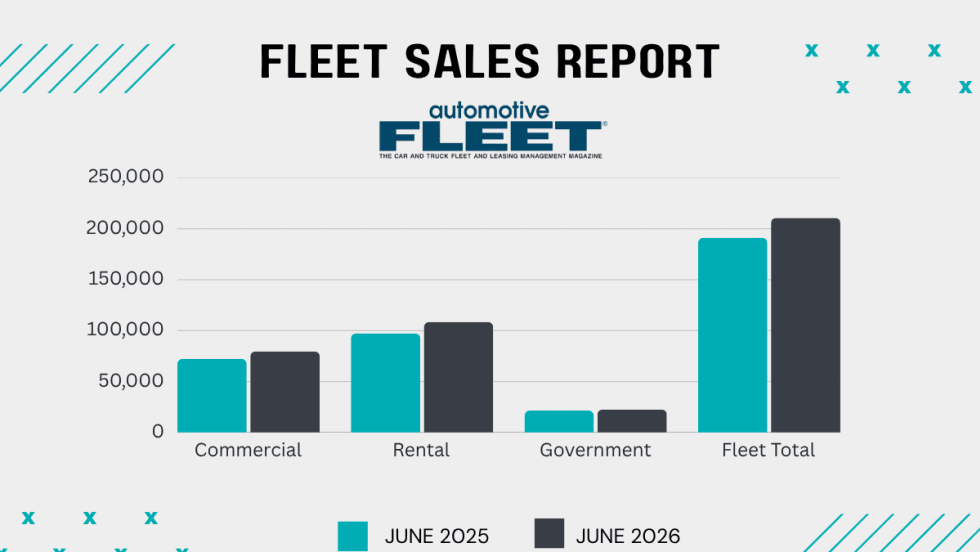
Commercial Fleet Sales Contribute To June, YTD Gains
The fleet sector has boosted its vehicle purchases at a reliable pace in the first half of this year compared with 1H 2025.
Read More →
Used Vehicle Prices Climb Higher As Sales Pace Slows
The higher prices at used retail reflect strong wholesale values earlier in the spring, particularly for older, more affordable vehicles.
Read More →
Wholesale Used Vehicle Market Sustains Moderate Rise In Values, Prices
Trends continue to normalize after a strong start to the year, as consumers contend with higher gas prices in the coming summer months.
Read More →
Commercial Fleet Sales Still Lead Sectors Despite May Mini Dip
The U.S. economy's continued growth and positive business investment are creating a favorable environment for fleet vehicle demand.
Read More →
How Connected Vehicle Data Is Lifting Fleet Resale Values
A vehicle health score could improve the value of fleet vehicles at remarketing. The path to a universal standard is forming, and fleets that understand the process early will be better positioned when it arrives.
Read More →