





Never miss out: Sign up for our eNewsletters!
Fleet in Focus: Ernie Garcia
In the inaugural profile of a new series, Ernie Garcia of Gothic Landscape shares his experience in navigating ZEV mandates, managing TCO, and the strategic integration of technology to enhance fleet operations and safety.
July 22, 2024
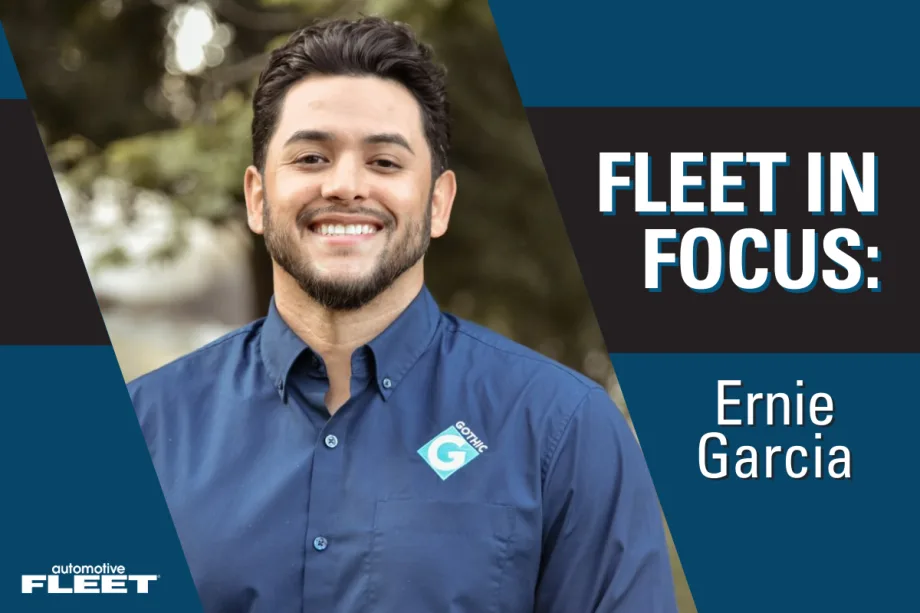
Ernie Garcia’s fleet consists of 2,300 total units, with 1,000 on-road vehicles. Gothic Landscape covers Arizona, Nevada, and California and is the largest family-owned Landscape company in the nation.
Photo: Gothic Landscape / Automotive Fleet
7 min to read
Welcome to Fleet in Focus, Automotive Fleet's ongoing series that highlights fleet managers and brings their perspectives, best practices, and personalities to the fleet community!
In this inaugural Fleet in Focus, Automotive Fleet connects with Ernie Garcia, director of fleet and business systems at Gothic Landscape, to discuss safety concerns, success stories, and key issues in fleet.
Garcia manages 2,300 total units and 1,000 on-road vehicles for Gothic Landscape, which covers Arizona, Nevada, and California and is the largest family-owned landscape company in the nation.
AF: What are the biggest challenges you currently face in your fleet operations?
Garcia: Safety is always an ongoing concern. We want our team members to return home to their families in the same condition as when they arrived. Changing to safer specs, ensuring PMs are done on time, and conducting inspections are all factors in maintaining ongoing safety standards.
ZEV (zero-emission) mandates are a concern. There aren't many units that meet our specifications for our workhorse units, which makes compliance difficult.
We strive to provide an extraordinary product/service to our clients, which can be demanding on the fleet and the shops. Finding balance is crucial to our success; the fleet managers are great at it.
AF: How are your policies and systems evolving to address today's challenges?
Garcia: Vehicles become safer every model year. We have trucks with accident avoidance that no doubt keep our team members safer. Units are being outfitted with safer specs every day to make it even easier for the team to get to the job and back home safely.
ZEVs are a newer (to us) technology that we are still learning about. It's a slow burn, but if/when we see a big push in battery capabilities, people will be more open to adopting them. Many obvious concerns go out the window if we see a considerable range increase.
AF: Can you share a recent success story from your fleet? An initiative that has driven savings, increased efficiency, enhanced sustainability, or boosted team satisfaction?
Garcia: The Ford Maverick hybrid comes to mind. We started to try these out in March of last year in an attempt to cut down on fuel costs for our drivers who weren't hauling much and just needed to get from point A to point B.
We thought there would be some resistance due to the size, but team members took to them well and bragged about the efficiency. We now have 31 and counting after seeing a savings of about 65% from an F-150 monthly usage. That checks all of the boxes.
AF: What are your drivers and fleet's most significant safety concerns, and how are you addressing them?
Garcia: Not too long ago, we changed to mobile device inspections and issue reporting to increase efficiency and safety. Training the drivers to use these tools and report issues as they arise has been challenging, but we have made significant progress.
The other side is now the shop has a figurative express lane for concerns that arise. The issues come electronically into the technician's phone, tablet, or PC, vs. word of mouth or paper log.
Ensuring they are prepared to resolve those concerns has been a different challenge, one the fleet managers have accepted and addressed amazingly. Overall, the process makes the units safer to operate, more efficient, and increases longevity.
AF: Can you share more about the mobile device inspections and issue reporting? Were you previously relying on checklists to go over inspections? How has this technology helped speed up the process and increase safety at the same time?
Garcia: We previously relied on logbooks. Daily inspections on the mobile device allow the drivers to not only instantly report when something fails but also, throughout the day, report any issues with equipment, trailers, etc. The process is much quicker to notify the shop of an issue, which alerts the technicians to resolve those issues, which results in safer units.
AF: Which areas of fleet operations are you focusing on to drive down costs, and what strategies are you considering or implementing?
Garcia: Understanding our cost per mile with specific makes and models has a trickle-down effect. We then put in life cycles and make a conscious effort to make the fleet "younger."
After that, the target is to be more proactive than reactive. Major repairs are minimized if we have a younger fleet, and we can focus on preventive maintenance. If we know what's coming next month, we can have parts ordered and ready to go.
We aren't fully there yet, but we get closer every day. The fleet managers make every effort to keep costs down while keeping the team on the road and safely getting to their destinations.
AF: How are you calculating cost per mile for specific vehicle makes and models?
Garcia: Our FIMS (Fleet Information Management System) does most of the leg work. We try to capture all costs associated with each unit: lease payments, upfit cost, purchase cost, repair labor and parts cost, fuel, etc. The FIMS does the rest, as it's a moving target as costs increase throughout the life of the unit, as does the mileage.
AF: Has working to make the fleet younger had a large upfront cost? If so, how have you navigated that?
Garcia: It does; however, we budget accordingly every year. We plan the year before to know what units to target throughout the next year for replacement and growth. It doesn't always work out as planned, as needs change through the year, but we get close. We also purchase throughout the year vs. frontloading at the beginning of the year.
AF: What measures do you take to make managing data less overwhelming?
Garcia: The saying "Garbage in, Garbage out" comes to mind. The fleet managers and I ensure everything in our system is as accurate as possible to minimize clean-up and data scrubbing. I have a system with every Excel workbook I open to navigate and manipulate data and get the needed information quickly.
Sometimes, I will be on one task and end up seeing something that looks off and going down a rabbit hole to fix it. I am sure the fleet managers love getting a random license plate list from me at 6:30 a.m. on a Wednesday morning.
AF: What creative approaches do you use to recruit, retain, and manage new entrants to the fleet workforce?
Garcia: We try to look for transferable talent. Although fleet experience is a plus, you don't have to know everything to do what we do. I will take drive, determination, and work ethic any day. We have talented people who work for us, and we try to find other individuals with similar traits and a strong cultural fit to fill crucial roles. I call them "Unicorns" to the recruiting team.
AF: What fleet technologies are you watching closely but have not yet implemented?
Garcia: I have seen some tech that ties into the traffic light system and recommends a speed to hit all green lights. I see this as the beginning of a more efficient road experience.
In our lifetime, we will see better hybrids, more efficient solid-state battery tech, fully autonomous driving, and much safer vehicles.
AF: What is your hope for the future of your fleet and the industry at large?
Garcia: "The Jetsons" set high hopes for flying cars, but I will settle for safer, more fuel-efficient units. Autonomy is acceptable as long as they dial it in and get it right. I also foresee some clever automation in processes in the future. Fingers crossed.
AF: What is an accomplishment you are particularly proud of outside of work?
Garcia: My daughter graduated high school not too long ago. She is an intelligent kid, so her future is bright. She makes me and my wife very proud. Now, if I can lower my handicap, I will have two things to be proud of.
AF: What is the most interesting place you have visited?
Garcia: I went to New York City and loved the history and architecture. Running a fleet there must be challenging. New Orleans is a close second.
AF: What is your favorite sport/team?
Garcia: I am a Lakers and Dodgers guy. I tend to be more of a fan of the athlete than the team or sport. Kobe was the man, and Tiger was up there as well. The hard work, determination, talent, and physical ability were so entertaining to watch.
Subscribe to Our Newsletter
More Operations

How Fleets Can Recruit and Train Veterans for Technician Roles
Here's how the technician shortage has affected uptime for fleets, and what to do about it.
Read More →
Avis Budget Group Deploys Neology Toll Management Technology Across Major Brands
Neology’s neoFleet platform will manage toll transactions and toll-authority operations for vehicles across Avis, Budget, Payless, Budget Truck and Zipcar.
Read More →
Fleet Personal-Use Charges Edge Higher in 2026
Nearly eight in 10 surveyed fleets allow personal use of company vehicles, while just over half of respondents report charging employees for the privilege.
Read More →
The Future of Fleet + What’s Changing Right Now | AF News Recap
Could developments overseas offer a preview of what’s coming for U.S. fleets? This week, we’re looking at the future of AI, autonomy, and electrification, plus Ford Pro’s new certified pre-owned program, smarter vehicle offboarding, and a new way for fleets to manage toll expenses.
Read More →
How to Handle Vehicle Offboarding
What do fleet managers need to do when a driver leaves?
Read More →
Sponsored•October 1, 2026
Fleet Manager’s Ultimate Playbook: Navigating the New Standard in OEM Connectivity
Rising operating costs, driver safety concerns, and unplanned downtime are putting unprecedented pressure on modern fleets. Discover how fleet managers use embedded OEM connectivity and real-time vehicle data to cut TCO, prevent downtime, and protect drivers without aftermarket telematics hardware.
Read More →
U.S. Bank Adds Verra Mobility Toll Management to Voyager Fleet Platform
The integration allows U.S. Bank Voyager fleet customers to manage toll payments and violations alongside fuel, EV charging and maintenance expenses.
Read More →
ADAS Prevents Crashes. But Repairs Cost More | AF News Recap
ADAS-equipped vehicles may crash less often, but they can cost more when they do. This week, we’re breaking down what that tradeoff means for fleets, plus Subaru’s first Forester Wilderness Hybrid, Nissan’s new e-POWER Rogue, and why Calstart has become Catalyst Mobility.
Read More →
Moventum Fleet Management Names Mark Iorillo Head of Sales
Iorillo brings nearly 20 years of fleet management and sales experience to the role, including previous positions at Element Fleet Management, CEI, Donlen and Ryder.
Read More →
Fleet Has a Talent Pipeline Problem. What Comes Next? | AF News Recap
Where will fleet’s next generation of leaders come from? This week, we’re looking at the industry’s talent pipeline, what certification can add to a fleet career, how to build an award-worthy track record, and the return of Automotive Fleet’s Personal Use Survey.
Read More →