




Ownership Costs Stay Level for Q2
After 10 months of spikes, ownership costs have leveled off through the second quarter of 2024.

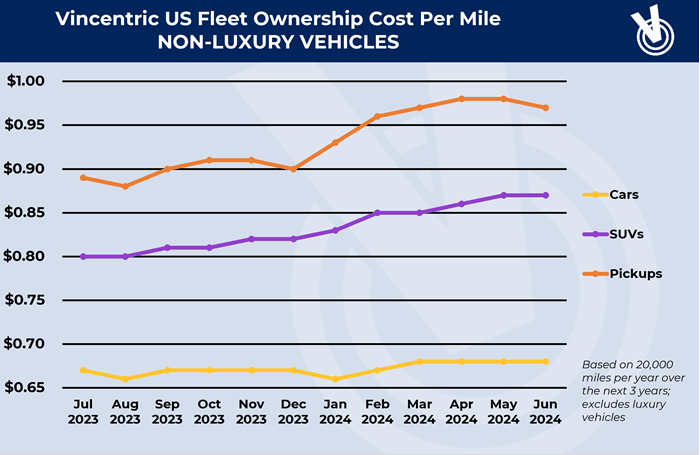
While trucks and SUVs experienced significant hikes in ownership costs over the past 10 months, cars stayed consistent and significantly lower.
Image: Vincentric
Welcome to the latest installment of Fleet Data Depot, which provides snapshots of information, trends, and analysis relevant to the fleet market.
The total cost of ownership experts at Vincentric deliver another quarterly update on ownership costs for fleets. These fleet cost-per-mile calculations are for the second quarter of 2024.
This analysis is based on vehicles driven 20,000 miles per year for three years. As usual, Vincentric calculates its standard eight cost elements: depreciation, financing, fees and taxes, fuel, insurance, maintenance, opportunity cost, and repairs.
Ownership Costs Level Off in Q2
For the last 10 months, costs per mile in all vehicle categories rose at steady but uneven rates. From August 2023 to April 2024, costs per mile in the Pickup category rose 11.4%, Luxury SUVs 9.7%, SUVs 8.8%, and Luxury Cars 7.3%. Cars only experienced slight increases.
However, for the second quarter of 2024, ownership costs leveled off in most vehicle categories:
Luxury Car: decreased by ~0.7%
Luxury SUVs: No change
Passenger Cars: No change
Pickups: No change
SUVs: increased by ~2.4%
This general leveling off occurred against significant increases across all vehicle categories in the fees & taxes cost category, from 2% to 29%.
These cost hikes are primarily a result of Vincentric removing the Commercial Clean Vehicle tax credit from the fees & taxes category, which affected about 800 MY22-MY24 vehicles in the U.S. Fleet database.
This tax credit has complex qualification criteria and does not always apply in every instance for each vehicle model.
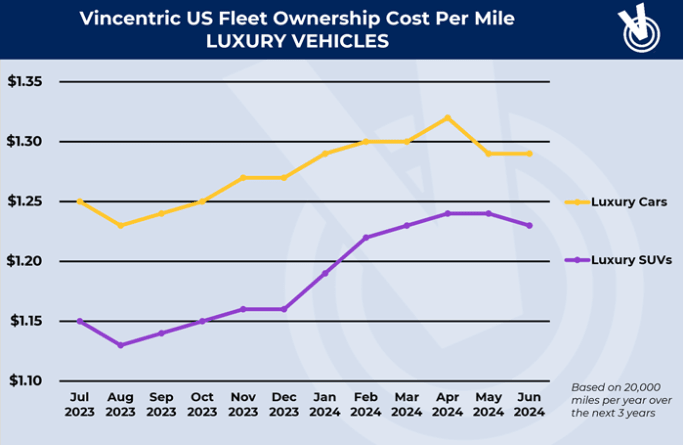
Luxury vehicles experienced the most significant price hikes over the last 10 months, with slight declines in the second quarter.
Image: Vincentric
Depreciation Shows Positive Trend
Additionally, Vincentric has started to receive MY-25 vehicles from its data provider since last quarter, affecting the costs for all vehicle categories. It generally follows that newer model years have slightly higher MSRPs than the previous year, along with higher residual values.
For example, depreciation — the largest of the eight cost elements — improved by 4.8% for Luxury Cars, 3.3% for Luxury SUVs, and 2.2% for Passenger Cars.
These depreciation cost improvements mostly negated the fees & taxes cost increases, resulting in small, if any, fluctuations in overall cost per mile.
More Operations

How Fleets Can Recruit and Train Veterans for Technician Roles
Here's how the technician shortage has affected uptime for fleets, and what to do about it.
Read More →
Avis Budget Group Deploys Neology Toll Management Technology Across Major Brands
Neology’s neoFleet platform will manage toll transactions and toll-authority operations for vehicles across Avis, Budget, Payless, Budget Truck and Zipcar.
Read More →
Fleet Personal-Use Charges Edge Higher in 2026
Nearly eight in 10 surveyed fleets allow personal use of company vehicles, while just over half of respondents report charging employees for the privilege.
Read More →
The Future of Fleet + What’s Changing Right Now | AF News Recap
Could developments overseas offer a preview of what’s coming for U.S. fleets? This week, we’re looking at the future of AI, autonomy, and electrification, plus Ford Pro’s new certified pre-owned program, smarter vehicle offboarding, and a new way for fleets to manage toll expenses.
Read More →
How to Handle Vehicle Offboarding
What do fleet managers need to do when a driver leaves?
Read More →
Fleet Manager’s Ultimate Playbook: Navigating the New Standard in OEM Connectivity
Rising operating costs, driver safety concerns, and unplanned downtime are putting unprecedented pressure on modern fleets. Discover how fleet managers use embedded OEM connectivity and real-time vehicle data to cut TCO, prevent downtime, and protect drivers without aftermarket telematics hardware.
Read More →
U.S. Bank Adds Verra Mobility Toll Management to Voyager Fleet Platform
The integration allows U.S. Bank Voyager fleet customers to manage toll payments and violations alongside fuel, EV charging and maintenance expenses.
Read More →
ADAS Prevents Crashes. But Repairs Cost More | AF News Recap
ADAS-equipped vehicles may crash less often, but they can cost more when they do. This week, we’re breaking down what that tradeoff means for fleets, plus Subaru’s first Forester Wilderness Hybrid, Nissan’s new e-POWER Rogue, and why Calstart has become Catalyst Mobility.
Read More →
Moventum Fleet Management Names Mark Iorillo Head of Sales
Iorillo brings nearly 20 years of fleet management and sales experience to the role, including previous positions at Element Fleet Management, CEI, Donlen and Ryder.
Read More →
Fleet Has a Talent Pipeline Problem. What Comes Next? | AF News Recap
Where will fleet’s next generation of leaders come from? This week, we’re looking at the industry’s talent pipeline, what certification can add to a fleet career, how to build an award-worthy track record, and the return of Automotive Fleet’s Personal Use Survey.
Read More →