





Read More: Nissan Holds Roadshow Events at TopGolf Facilities in August
Nissan Enhancing Headlight Technology to Protect Drivers
Nissan aims to improve headlight performance while reducing glare for oncoming traffic.
December 22, 2023
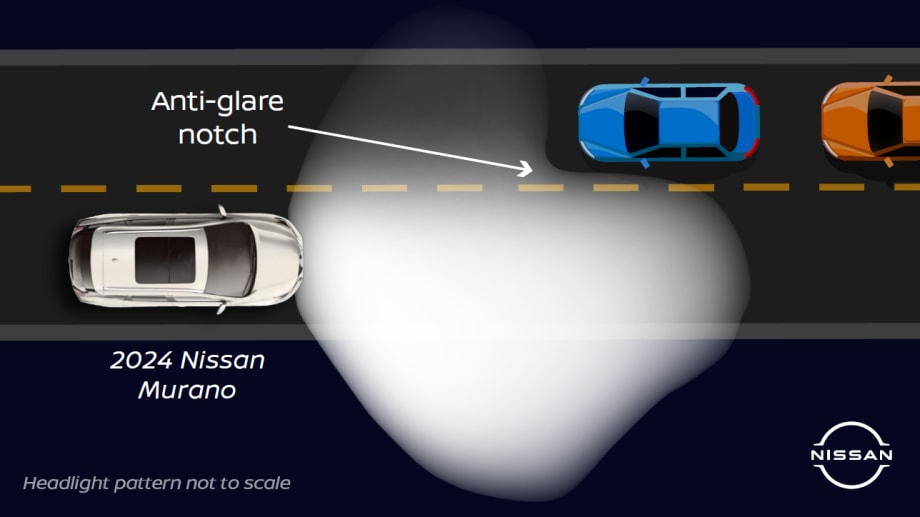
LEDs allow engineers to design a precise low-beam headlight pattern that both illuminates the road and reduces glare.
Photo: Nissan
3 min to read
Nissan announced it is enhancing headlight technology as part of its mission to protect people and help drivers avoid risky situations.
The company cited that more than 90% of accidents are caused by human error, saying increased illumination of LED (light-emitting diode) headlights allows drivers to see more clearly ahead but can cause additional glare for drivers in the oncoming lane.
Brad Chisholm, an engineer on the exterior Lights, Mirrors, and Wipers team at Nissan Technical Center North America in Farmington Hills, Mich., discussed the advancements in LED technology.
"You want to see and be seen. LEDs can help with both," Chisholm said. "We have the ability to carve out that area of the oncoming lane with everything around it being bright and the inside being super dark. We're able to push the limits using LEDs."
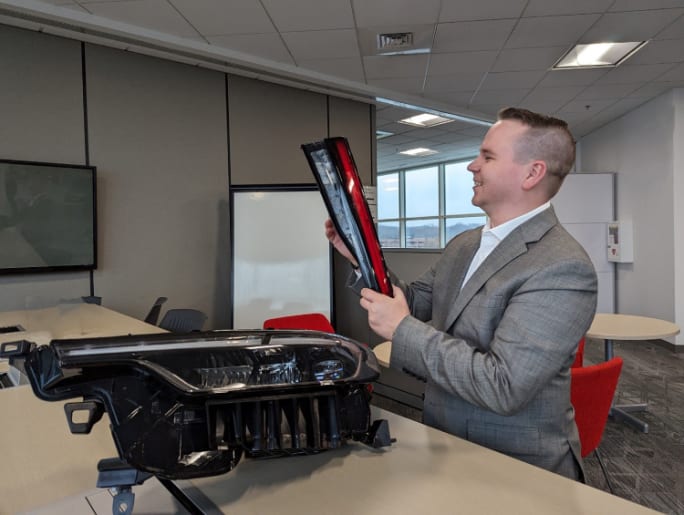
Brad Chisholm, seen here with a headlight and taillight assembly at Nissan Technical Center North America, outlined the advancements in LED technology.
Photo: Nissan
Nissan Finds Precise Patterns Help Drivers
Over the last two decades, LED headlights have gradually replaced halogen and high-intensity discharge (also known as xenon) lamps. Halogen lamps emit a warm, yellow light, while LEDs emit a cool, white light. In addition to being brighter, LEDs are about 80% more energy efficient and last many times longer than halogen bulbs.
Chisholm said LEDs also allow engineers to design a precise low-beam headlight pattern that both illuminates the road and reduces glare. This "anti-glare notch" makes it easier for oncoming drivers to see without being dazzled by approaching lights, according to Nissan. The strongest, brightest light is aimed toward the lane of travel, while dimmer light is cast toward the oncoming lanes.
Engineers create these notches by directing the light in specific directions and creating physical barriers within the headlight housing to block the light in other directions. While these notches exist with halogen lamps and are required by regulations, they are more well-defined with LEDs.
LEDs also allow designers to push the limits of design, largely because they are smaller than halogen bulbs despite being more than twice as bright.
Recently, LED headlights have become even smaller, according to Nissan. Though LEDs produce far less heat than halogen bulbs, they still generate some heat that is absorbed by a piece of aluminum called a "heat sink." Over the past few years, heat sinks have shrunk due to LEDs becoming even more efficient, allowing designers to dream bigger.
"It gives us freedom for styling," Chisholm said. "We're able to do more with LEDs than we were able to do with halogen bulbs, like creating light pipes and swoops in taillamps and daytime running lights."
Nissan offers LEDs as standard or optional equipment on all 2024 U.S. models.
A Look Back 2023 Nissan Announcements
Nissan announced on Sept. 26 the new model year Nissan Versa. The compact sedan comes with the most standard safety technologies in its class, which include class-exclusive Nissan Safety Shield 360 technologies.
Additionally, the company revealed updates on the 2024 Nissan Sentra. Design changes to Sentra for the 2024 model year include a reshaped front fascia with a new interpretation of Nissan's V-motion grille, updated headlights, and a new available 16-inch alloy wheel design.
Nissan made electrification efforts in 2023, as it reached an agreement with Tesla to adopt the North American Charging Standard (NACS) beginning in 2025. This will provide Nissan customers with even more choices when charging their electric vehicles.
More Safety

Sponsored•October 1, 2026
Fleet Manager’s Ultimate Playbook: Navigating the New Standard in OEM Connectivity
Rising operating costs, driver safety concerns, and unplanned downtime are putting unprecedented pressure on modern fleets. Discover how fleet managers use embedded OEM connectivity and real-time vehicle data to cut TCO, prevent downtime, and protect drivers without aftermarket telematics hardware.
Read More →
From Driver Well-Being to EV Charging | AF News Recap
Mental health belongs in the fleet safety conversation. This week, we’re looking at five ways fleets can support employee well-being before a crisis, plus Holman’s expansion in Mexico, new one-day Fleet Forward passes, and why EV charging demand is outpacing infrastructure growth.
Read More →
Nexar-Nauto Merger Aims to Give Fleets Better Safety Intelligence Through Larger Driving Dataset
Stefan Heck tells Automotive Fleet that combining more than 10 billion miles of driving history with Nexar's AI models will give fleets deeper insights into driver risk and roadway conditions than either company could provide independently.
Read More →
Don't Wait for a Crisis: 5 Ways to Build Mental Health Into Your Fleet Safety Program
For Suicide Prevention Month, fleet and safety leaders have an opportunity to put mental health where it belongs: at the center of workplace safety.
Read More →
How Camera Data Can Strengthen a Fleet’s Insurance Renewal
Insights from a commercial insurance carrier and a broker show how fleets can turn video telematic data, driver coaching, and improved claims results into a stronger case at insurance renewal.
Read More →
The Safest Fleets Aren’t the Ones with the Most Technology
You’ve made the telematics investment. Here’s how to capture the other half of its value and build the safest fleet on the road.
Read More →
Sponsored•August 7, 2026
Hidden in Plain Sight: Fleet Compliance Risks
Fleet compliance isn't just about having policies — it's about consistently enforcing them. This practical guide reveals six hidden compliance risks common in public sector and shared fleet operations and outlines proven strategies to improve visibility, accountability, and audit readiness
Read More →
NETS Sets 2026 Fleet Safety Benchmark Conference for Indianapolis
The Sept. 15–17 program will feature fleet benchmarking data, case studies, emerging technologies, and implementation strategies while running alongside the NSC Safety Congress & Expo.
Read More →
Off-the-Job Crashes Account for 43% of Employers’ $61.7 Billion Crash Burden
NETS quantifies costs dispersed across fleet, risk, HR, and other departments while providing new per-crash benchmarks for employers.
Read More →
Ram Recalls More Than 1.27 Million 1500 Pickups for Seat Belt Anchor Issue
The recall affects certain 2019-2026 Ram 1500 pickups that may have improperly attached second-row seat belt buckle anchors.
Read More →