





In 2021, the Volvo XC40 Recharge, as well as the Ford Mustang Mach-E, Audi e-tron Sportback, and Tesla Model 3, also earned safety awards from IIHS.
Fleet Favorite EVs Earn Big Safety Accolades
In 2022, the IIHS recognized several electric vehicles — including those gaining favor with fleets — with its Top Safety Pick+ award.
January 9, 2023
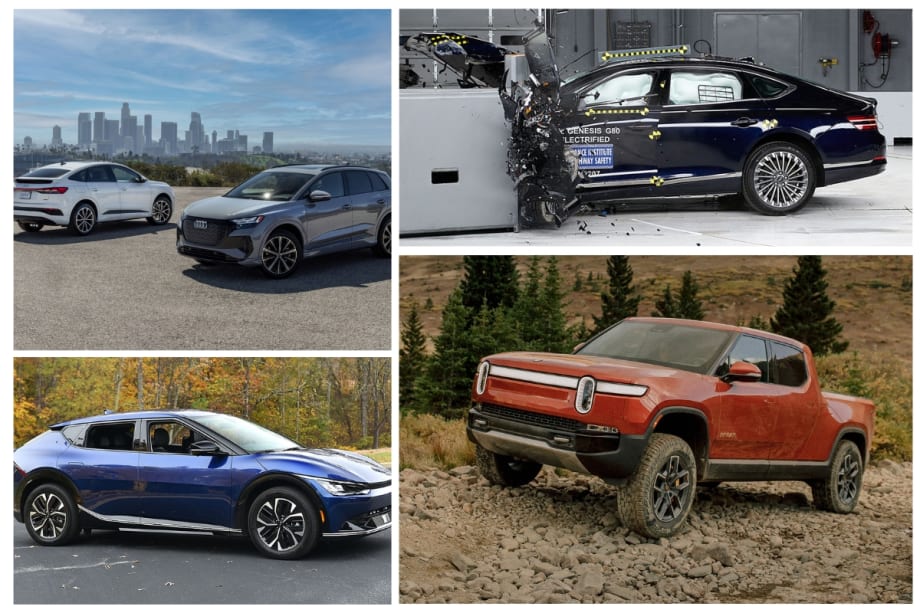
An electric small SUV, the 2023 Kia EV6 captured top safety honors from engineers at the Insurance Institute for Highway Safety. Several other EVs gained safety recognition, too.
Photos: IIHS, Rivian, Audi/Canva
5 min to read
Electric vehicles (EVs) have been gaining popularity with fleet operators for some time now. Environmental concerns are one reason. Research shows that 75% of the 200 largest U.S. fleet operators — responsible for about 1.2 million vehicles — have committed to decarbonization targets for public fleets, and many are starting to invest, according to McKinsey & Company.
However, safety is another good reason for fleets to consider EVs. The Insurance Institute for Highway Safety (IIHS) ran an early insurance analysis for EVs versus identical conventional vehicles and found some key benefits.
“Electric vehicles are proving to be safer for occupants than identical conventional vehicles,” said Joseph Young, director of media relations for IIHS/HLDI. “In a recent study of insurance data, the Highway Loss Data Institute (HLDI) found that rates of injury insurance claims for EVs were about 40% lower than those of identical conventional vehicles. This is likely because electric vehicles are heavier than conventional ones, and that extra weight provides benefits to those inside in a multi-vehicle crash.”
Young notes, however, that the extra weight of an EV can be detrimental to the other vehicle in such a crash scenario. But clearly, EVs are turning out to be up to snuff when it comes to exacting safety standards.
For example, in 2022 the IIHS recognized several EVs with its renowned safety awards, giving them the vote of confidence automakers and fleet operators seek out. Some of the specific EVs that earned the coveted accolades are also models that have gained favor with fleets.
Here is a roundup of EVs that are not only saving the environment, but could also save lives.
2023 Kia EV6
An electric small SUV, the 2023 Kia EV6 captured a Top Safety Pick+ award from the IIHS. The arrival of the EV6 in 2022 — the brand’s first dedicated battery electric vehicle (BEV) — signaled the U.S. launch of Kia’s "Plan S" strategy, which aims to deliver 14 all-new electrified models across the world by 2027, according to the manufacturer.
To earn either of the Institute’s two awards in 2022, a vehicle had to score good ratings in six IIHS crashworthiness evaluations, including the driver-side small overlap front, passenger-side small overlap front, moderate overlap front, original side, roof strength, and head restraint tests.
It also must be available with a front crash prevention system that earns advanced or superior ratings in both the vehicle-to-vehicle and daytime vehicle-to-pedestrian evaluations.
Finally, to capture “plus” status, good or acceptable headlights must be standard across all trims.
The Kia EV6 met every criterion for the IIHS top tier safety award. After acing the six crashworthiness tests, the EV scored a superior rating for available front crash prevention — in both vehicle-to-vehicle and daytime vehicle-to-pedestrian tests.
What’s more, all trims come with good-rated LED reflector headlights. However, some of the earliest 2023 models sold require an adjustment to the headlights to qualify for the award. Kia notified the affected customers by letter, offering to make the adjustment free of charge at its affiliated dealerships.
According to the automaker, the EV6 is rated at an EPA-estimated 310-miles of all-electric range (AER) in its Wind and GT-Line RWD trims and offers features such as an Onboard Power Generator and a flat-floor interior that utilizes innovative materials throughout the cabin. The EV6 also offers a wide array of advanced driver assistance systems, adding a sophisticated level of connectivity and other features.
Volvo: Multiple Models
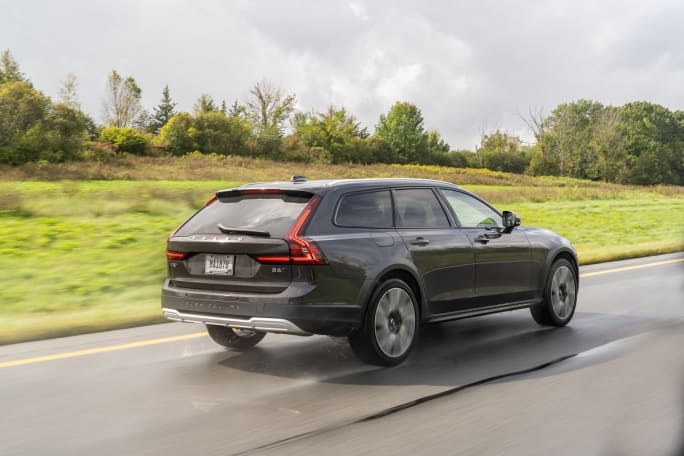
The 2022 Volvo V90 Cross Country is one of 13 vehicles from the manufacturer that won Top Safety Pick+ Awards in 2022 from IIHS.
Photo: Volvo
Volvo Cars earned a whopping 13 Top Safety Pick+ awards from IIHS. Achieving the highest rating from IIHS for every model tested, including the fully-electric C40 Recharge, Volvo was the most awarded brand as of April 2022.
The brand's Top Safety Pick+ honorees for 2022 were:
Volvo C40 Recharge
Volvo XC40
Volvo XC40 Recharge
Volvo S60
Volvo S60 Recharge
Volvo S90
Volvo S90 Recharge
Volvo V60 Cross Country
Volvo V90 Cross Country
Volvo XC60
Volvo XC60 Recharge
Volvo XC90
Volvo XC90 Recharge
Volvo ensures that safety systems such as automatic emergency braking, forward collision warning, pedestrian, and cyclist detection are standard in all of its vehicles
2022-23 Rivian R1T
A new electric large pickup, the 2022-23 Rivian R1T also snagged top safety honors from IIHS. As a Top Safety Pick+ winner, the Rivian R1T aced all six crashworthiness tests, earning good scores across the board.
In addition, the crew cab pickup met all the other requirements for the higher-tier award. For example, all trims come with good-rated LED projector headlights and a standard front crash prevention system that earned superior ratings in both the vehicle-to-vehicle and daytime vehicle-to-pedestrian tests.
2022 and 2023 Audi Q4 e-tron and Q4 Sportback
Two electric midsize luxury SUVs from Audi rolled away with Top Safety Pick+ awards, too. Both 2022 and 2023 model year Q4 e-tron and Q4 Sportback models met the requirements for the highest safety honors.
All models come with a standard front crash prevention system that earned a superior rating in the vehicle-to-vehicle evaluation and an advanced rating in the daytime vehicle-to-pedestrian test. The two electric SUVs are also available with good-rated LED projector headlights and acceptable-rated LED reflector headlights, depending on the trim level.
The Q4 e-tron also offers cargo space comparable to that of the best-selling Audi Q5, notes the manufacturer. Several standard safety and driver assistance features are included like the Audi pre sense, Audi side assist with rear cross traffic assist, and lane departure warning systems. These systems, along with a robust battery structure, are designed to give drivers and passengers alike another reason to go electric confidently and to do so seamlessly, says the automaker.
2023 Genesis GV60 and 2023 Genesis Electrified G8
In 2022, two EVs from Genesis also took top honors from the IIHS. Both the 2023 Genesis GV60, a new electric small SUV, and the 2023 Genesis Electrified G8, a new electric large luxury car, passed the six crash tests with good scores.
Moreover, both EVs feature standard front crash prevention systems that earned superior ratings in both the vehicle-to-vehicle and daytime vehicle-to-pedestrian evaluations. As for headlights, the GV60 boasts good-rated LED projector headlights that are standard across all trims. In the case of the Electrified G80, all trims come with acceptable-rated LED projector headlights.
Moving Forward
When choosing EVs in the future, fleet operators should always keep safety top-of-mind. Fleets considering electric vehicles should look at many of the same things that they would look at with conventional vehicles, notes Young.
“This includes comparing crash test and crash avoidance ratings, as well as purchasing as much crash avoidance technology as possible,” he says. “Tech like automatic emergency braking, good headlights, lane departure warning, and rear-cross traffic alert are all proven to cut crashes.”
More Safety

Sponsored•October 1, 2026
Fleet Manager’s Ultimate Playbook: Navigating the New Standard in OEM Connectivity
Rising operating costs, driver safety concerns, and unplanned downtime are putting unprecedented pressure on modern fleets. Discover how fleet managers use embedded OEM connectivity and real-time vehicle data to cut TCO, prevent downtime, and protect drivers without aftermarket telematics hardware.
Read More →
From Driver Well-Being to EV Charging | AF News Recap
Mental health belongs in the fleet safety conversation. This week, we’re looking at five ways fleets can support employee well-being before a crisis, plus Holman’s expansion in Mexico, new one-day Fleet Forward passes, and why EV charging demand is outpacing infrastructure growth.
Read More →
Nexar-Nauto Merger Aims to Give Fleets Better Safety Intelligence Through Larger Driving Dataset
Stefan Heck tells Automotive Fleet that combining more than 10 billion miles of driving history with Nexar's AI models will give fleets deeper insights into driver risk and roadway conditions than either company could provide independently.
Read More →
Don't Wait for a Crisis: 5 Ways to Build Mental Health Into Your Fleet Safety Program
For Suicide Prevention Month, fleet and safety leaders have an opportunity to put mental health where it belongs: at the center of workplace safety.
Read More →
How Camera Data Can Strengthen a Fleet’s Insurance Renewal
Insights from a commercial insurance carrier and a broker show how fleets can turn video telematic data, driver coaching, and improved claims results into a stronger case at insurance renewal.
Read More →
The Safest Fleets Aren’t the Ones with the Most Technology
You’ve made the telematics investment. Here’s how to capture the other half of its value and build the safest fleet on the road.
Read More →
Sponsored•August 7, 2026
Hidden in Plain Sight: Fleet Compliance Risks
Fleet compliance isn't just about having policies — it's about consistently enforcing them. This practical guide reveals six hidden compliance risks common in public sector and shared fleet operations and outlines proven strategies to improve visibility, accountability, and audit readiness
Read More →
NETS Sets 2026 Fleet Safety Benchmark Conference for Indianapolis
The Sept. 15–17 program will feature fleet benchmarking data, case studies, emerging technologies, and implementation strategies while running alongside the NSC Safety Congress & Expo.
Read More →
Off-the-Job Crashes Account for 43% of Employers’ $61.7 Billion Crash Burden
NETS quantifies costs dispersed across fleet, risk, HR, and other departments while providing new per-crash benchmarks for employers.
Read More →
Ram Recalls More Than 1.27 Million 1500 Pickups for Seat Belt Anchor Issue
The recall affects certain 2019-2026 Ram 1500 pickups that may have improperly attached second-row seat belt buckle anchors.
Read More →