NYC Fleet Presents Preliminary Data on Speed Limiter Pilot
New York City is the first in the nation to equip 50 city fleet vehicles with telematics technology that keeps them moving at the appropriate speed and no faster.
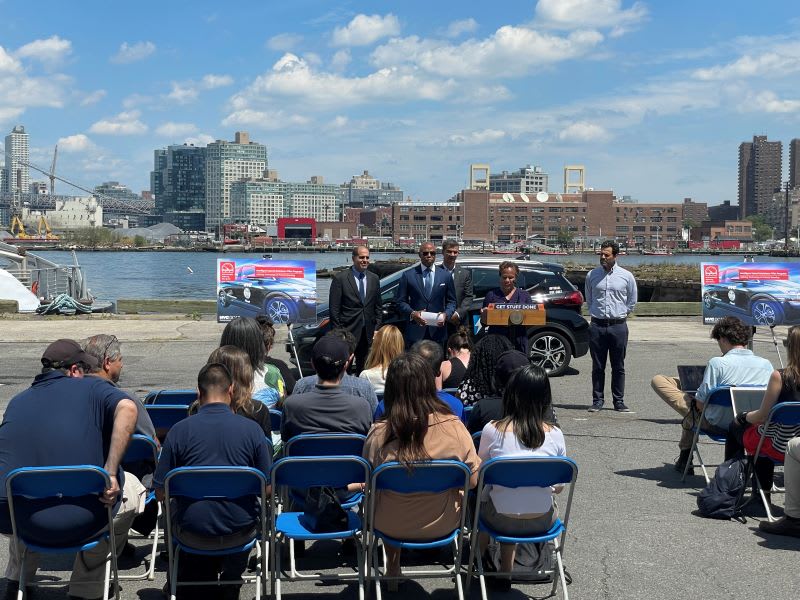
Announcing the program launch in August 2022 are DCAS Commissioner Dawn Pinnock (podium), New York City Mayor Eric Adams (sunglasses), Ydanis Rodriguez, DOT commissioner (left), Keith Kerman, chief fleet officer and DCAS deputy commissioner (far left), and Danny Harris, executive director for transportation alternatives.
Photo: Eric Richardson
3 min to read
After the National Transportation Safety Board urged the federal government to incentivize automakers to equip new cars with speed limiters, the nation’s largest city decided not to wait and took its own action.
Ad Loading...
After New York City suffered its deadliest year in recent history for traffic fatalities with 273 lost lives in 2021, the Big Apple is now the first to use Intelligent Speed Assist (ISA) technology to keep cars driving at — and not above — speed limits in its city-owned fleet vehicles.
Ad Loading...
The initiative launched in August with an announcement by Mayor Eric Adams. Some 50 New York City fleet light-, medium-, and heavy-duty vehicles across nine agencies were outfitted with the technology. The vehicles are engineered to notify drivers with an alarm that the car has reached the speed limit or cut off the accelerator.
Large trucks have been equipped with speed limiters since the 1990s, though the technology had initially only prevented a truck from overcoming a certain set speed.
This new iteration uses telematics to understand the speed limit on any given roadway in relation to the car’s geolocation. The technology combines speed governors with telematics to restrict a vehicle's maximum speed and dynamically adjusts to changing speed limits.
Eric Richardson, deputy chief fleet management officer at the Department of Citywide Administrative Services (DCAS) — the NYC Fleet — shared at the 2022 Fleet Forward Conference initial findings from the pilot program.
Photo: Ross Stewart Photography
Preliminary Results
Eric Richardson, deputy chief fleet management officer at the Department of Citywide Administrative Services (DCAS) — the NYC Fleet — shared at the recent Fleet Forward Conference that total miles driven by the 50 vehicles since the pilot went live this summer already exceeds 70,000 miles. The vehicles traveled within the speed limit parameters set by DCAS 99% of the time. The vehicles to date went from 26.5 hard braking events per 1,000 miles to 20.6 per 1,000 miles — a reduction of 22%.
DCAS plans to test units set to 11 mph above the speed limit and vehicles set to the speed limit. The pilot assessment continues through at least the end of 2022 with another data analysis and case study planned for early 2023.
Ad Loading...
DCAS has submitted a grant proposal for $10 million in funding under the federal Safe Streets For All program. The funding would be used to expand the ISA program to 7,500 light- and medium-duty non-emergency vehicles. Richardson said the city expects a decision by February 2023.
Deputy Mayor of New York City for Operations Meera Joshi referred to the accelerator cut-off as a “a dead pedal” in a CNN report. However, drivers can choose to override the cut-off and manually speed up the vehicle for 15 seconds to merge lanes or keep up with the flow of traffic, for example, with the simple press of a button under the steering wheel. In the ISA pilot, override button had been used 498 times, or 0.13 times for every 1,000 miles driven.
Rising operating costs, driver safety concerns, and unplanned downtime are putting unprecedented pressure on modern fleets. Discover how fleet managers use embedded OEM connectivity and real-time vehicle data to cut TCO, prevent downtime, and protect drivers without aftermarket telematics hardware.
Mental health belongs in the fleet safety conversation. This week, we’re looking at five ways fleets can support employee well-being before a crisis, plus Holman’s expansion in Mexico, new one-day Fleet Forward passes, and why EV charging demand is outpacing infrastructure growth.
Stefan Heck tells Automotive Fleet that combining more than 10 billion miles of driving history with Nexar's AI models will give fleets deeper insights into driver risk and roadway conditions than either company could provide independently.
Insights from a commercial insurance carrier and a broker show how fleets can turn video telematic data, driver coaching, and improved claims results into a stronger case at insurance renewal.
Fleet compliance isn't just about having policies — it's about consistently enforcing them. This practical guide reveals six hidden compliance risks common in public sector and shared fleet operations and outlines proven strategies to improve visibility, accountability, and audit readiness
The Sept. 15–17 program will feature fleet benchmarking data, case studies, emerging technologies, and implementation strategies while running alongside the NSC Safety Congress & Expo.