





See Also: NHTSA Plans Safety Improvements to Strengthen New Car Assessment Program
Nissan Launches New Driver-Assistance Technology
Nissan’s new driver-assistance technology aims to dramatically enhance collision avoidance. In development now, it will first be available on select new models in the mid-2020s and on virtually every new model by fiscal year 2030.
May 2, 2022
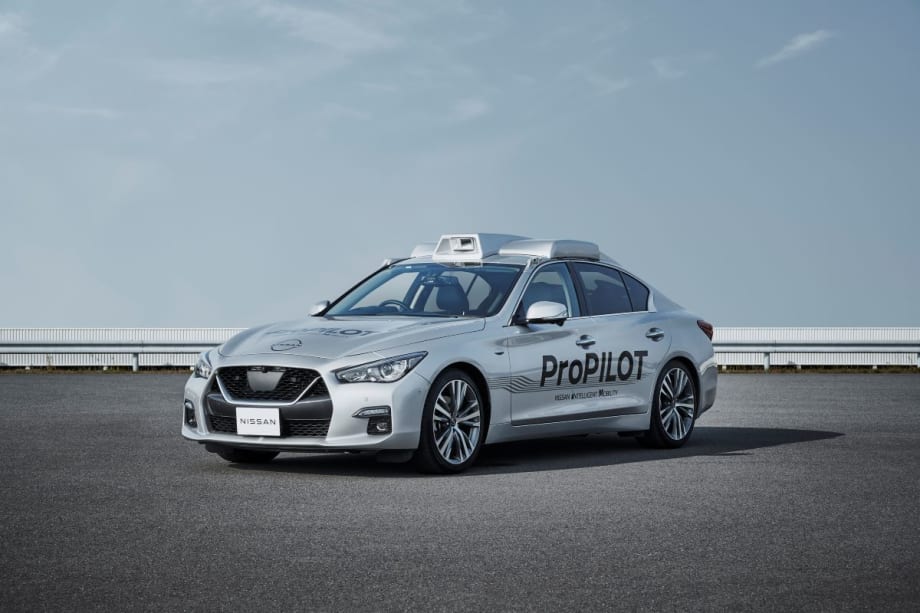
Nissan is partnering with companies like Luminar and Applied Intuition to provide advanced technology solutions for collision avoidance control.
Photo: Nissan Motor Corporation
2 min to read
Nissan announced a new driver-assistance technology that utilizes real-time information about the vehicle's surrounding environment to enhance collision avoidance. A test vehicle was used to demonstrate how the developing technology can automatically perform collision-avoidance maneuvers.
The company's "ground truth perception" technology fuses information from next-generation high-performance LIDAR, radar, and cameras, announced in a statement by Nissan. The technology can detect the shape and distance of objects, as well as the structure of the area surrounding the vehicle, in real time with a high degree of accuracy, according to the statement. Utilizing this information, it is possible for the vehicle to instantly analyze the current situation, judge, and automatically perform required collision-avoidance operations. This technology can also detect slowed traffic and road obstacles in the distance and execute lane changes accordingly. Importantly, the technology can also provide support to drivers in areas where detailed map information is not available.
"Nissan has been the first to market a number of advanced driver assistance technologies," said Takao Asami, senior vice president, leading global research and developmen. "When we look at the future of autonomous driving, we believe that it is of utmost importance for owners to feel highly confident in the safety of their vehicle. We are confident that our in-development ground truth perception technology will make a significant contribution to owner confidence, reduced traffic accidents and autonomous driving in the future."
Nissan has partnered with companies to research and develop this technology and share know-how. The LIDAR, a crucial element, is being integrated into Nissan's system in collaboration with Luminar technologies. In the area of advanced collision avoidance control it is critical to develop highly accurate verification technology in a digital environment. To this end Nissan is teaming up with Applied Intuition's simulation technology.
Under its long-term vision, Nissan Ambition 2030, Nissan is working to develop vehicle control technology aimed to significantly reduce accidents by utilizing next-generation LIDAR technology, available on select new models in the mid-2020s and on every new model by 2030.
More Safety

From Driver Well-Being to EV Charging | AF News Recap
Mental health belongs in the fleet safety conversation. This week, we’re looking at five ways fleets can support employee well-being before a crisis, plus Holman’s expansion in Mexico, new one-day Fleet Forward passes, and why EV charging demand is outpacing infrastructure growth.
Read More →
Nexar-Nauto Merger Aims to Give Fleets Better Safety Intelligence Through Larger Driving Dataset
Stefan Heck tells Automotive Fleet that combining more than 10 billion miles of driving history with Nexar's AI models will give fleets deeper insights into driver risk and roadway conditions than either company could provide independently.
Read More →
Don't Wait for a Crisis: 5 Ways to Build Mental Health Into Your Fleet Safety Program
For Suicide Prevention Month, fleet and safety leaders have an opportunity to put mental health where it belongs: at the center of workplace safety.
Read More →
How Camera Data Can Strengthen a Fleet’s Insurance Renewal
Insights from a commercial insurance carrier and a broker show how fleets can turn video telematic data, driver coaching, and improved claims results into a stronger case at insurance renewal.
Read More →
The Safest Fleets Aren’t the Ones with the Most Technology
You’ve made the telematics investment. Here’s how to capture the other half of its value and build the safest fleet on the road.
Read More →
Sponsored•August 7, 2026
Hidden in Plain Sight: Fleet Compliance Risks
Fleet compliance isn't just about having policies — it's about consistently enforcing them. This practical guide reveals six hidden compliance risks common in public sector and shared fleet operations and outlines proven strategies to improve visibility, accountability, and audit readiness
Read More →
NETS Sets 2026 Fleet Safety Benchmark Conference for Indianapolis
The Sept. 15–17 program will feature fleet benchmarking data, case studies, emerging technologies, and implementation strategies while running alongside the NSC Safety Congress & Expo.
Read More →
Off-the-Job Crashes Account for 43% of Employers’ $61.7 Billion Crash Burden
NETS quantifies costs dispersed across fleet, risk, HR, and other departments while providing new per-crash benchmarks for employers.
Read More →
Ram Recalls More Than 1.27 Million 1500 Pickups for Seat Belt Anchor Issue
The recall affects certain 2019-2026 Ram 1500 pickups that may have improperly attached second-row seat belt buckle anchors.
Read More →
Operation Safe Driver Week: Why the Industry's Oldest Safety Campaign Still Matters to Fleets
A look at how a 2007 enforcement initiative became one of the most consequential weeks on the fleet safety calendar, and what it means for your drivers in 2026.
Read More →