More from the Q1 - Q2 Global Fleet Special Report:
Analysis of Fleet Market Conditions in Brazil
The State of the Australian Commercial Fleet Market
 MENU
MENU SEARCH
Automotive retail sales in Canada hit a record of 1.94 million new vehicles (fleet and retail) sold in calendar-year 2015, an increase of 2.6% over 2014. This is the third consecutive year of record retail sales in Canada.
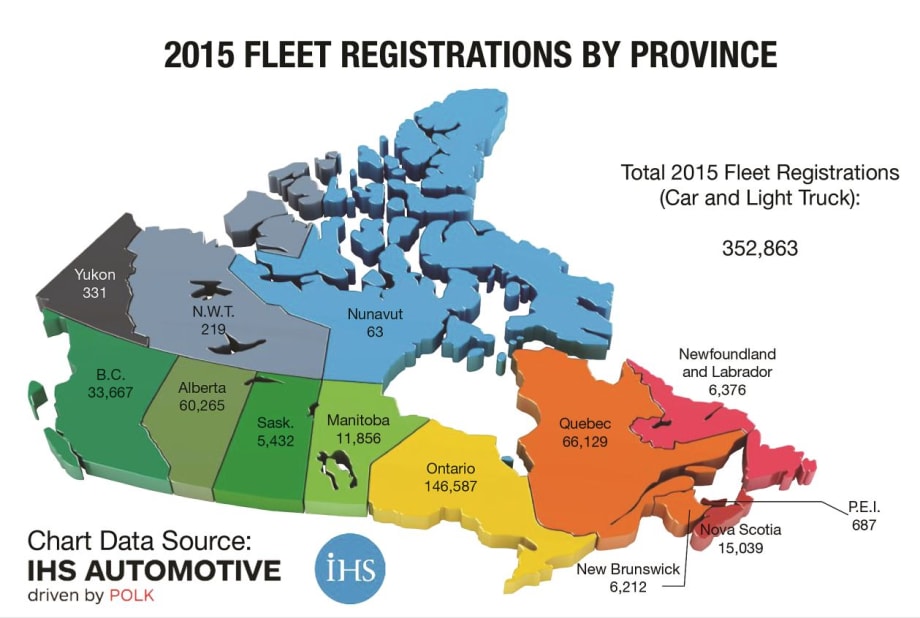
Map courtesy of Canadian Automotive Fleet
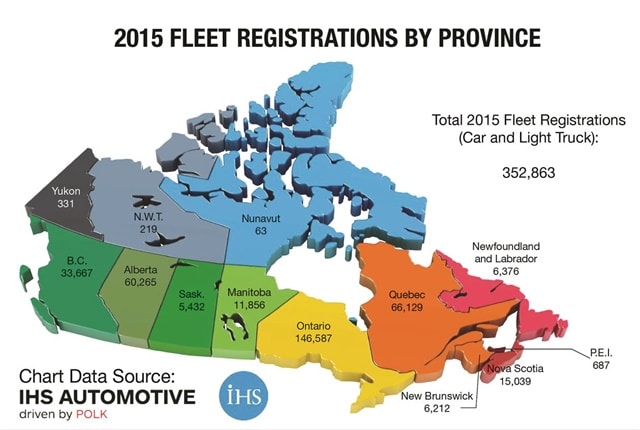
Map courtesy of Canadian Automotive Fleet
Automotive retail sales in Canada hit a record of 1.94 million new vehicles sold in calendar-year 2015, an increase of 2.6% over 2014. This is the third consecutive year of record retail sales in Canada.
Although the commercial fleet business is mature in Canada, fleet sales showed growth in calendar-year 2015, growing 2.8% over 2014-CY.
Canada is primarily a service-based economy, largely driven by small local businesses. As in the U.S., the small fleet segment is the growth engine for fleet sales. For instance, the small business fleet segment in Canada experienced double-digit sales growth in 2015, which was up 18% year-over-year.
“In Canada, it is really the small local businesses that drive our economy. Actually, as the old saying goes up here, ‘over 80% of the commercial customers buy fewer than 30 units per year.’ It is important to truly connect with customers at the local level with a commercially focused dealer network,” said Peter Bagnall, director - fleet and commercial sales for General Motors of Canada.
The strongest vocational segments for commercial fleet sales in Canada are energy and construction. However, with the global oversupply and decreased price of oil, companies in the Canadian energy sector have implemented deep spending reductions. Senior management at oil companies are placing intense pressure on fleet managers to control acquisition and operating expenses.
However, cost containment pressures run throughout the Canadian fleet market. One way Canadian fleets have been looking to reduce acquisition and operating costs is by downsizing to a smaller truck segment.
Canada is a net export nation with 75% of its exports going to the U.S., its largest trading partner. One factor strongly influencing the commercial fleet market is the foreign exchange rate of the Canadian dollar, which has declined against the U.S. dollar. This has positively impacted the Canadian economy, particularly provinces such as Ontario and Quebec, which have a strong manufacturing sector. The weaker Canadian dollar makes their exports less expensive in the U.S.
Despite lower fuel prices in Canada, it is expected that there will be a growing trend for businesses and municipalities in certain parts of Canada to adopt green technologies.
Historically, overall fleet sales in Canada have always been tied to the robustness of the national economy. Overall improvements in sectors such as housing, construction, and infrastructure assisted in modestly growing overall fleet sales. Construction is playing a bigger role in the economic activity Canada is experiencing in Ontario and Quebec, which has stimulated commercial fleet sales.
In addition, GM is expanding its business footprint in Canada with several new initiatives.
First, GM Canada announced it would establish a separate Canadian headquarters office for its Cadillac brand in a new complex in downtown Toronto. This move parallels an earlier decision by General Motors to establish a separate headquarters office in the U.S. for its Cadillac brand in New York City.
In another recent development, GM Canada purchased another site in Toronto to serve as the Canadian headquarters for its Maven car-sharing service.

The Top 300 Commercial Fleets: See the List
Read More →

Part Two: Commercial auto remains one of the most challenging and costly lines of coverage for fleet operators and insurers alike. Continue learning more about how to effectively address these issues from Onur Aksan, Enterprise Business Development Executive, Geotab
Read More →
Commercial auto remains one of the most challenging and costly lines of coverage for fleet operators and insurers alike. Learn more about how to effectively address these issues from Onur Aksan, Enterprise Business Development Executive, Geotab.
Read More →
Departmentally assigned vehicles often create hidden costs through underutilization, poor visibility, and increased administrative burden. This white paper explores how shared motor pool strategies help fleets reduce costs, improve accountability, and optimize vehicle utilization.
Read More →
Fleet leaders are under pressure to reduce costs, adapt to economic uncertainty, and make smarter decisions. See how peers across North America are responding with real data, proven strategies, and forward-looking insights. Download the 2026 Market Pulse Report to benchmark your strategy and uncover where you can gain an edge.
Read More →
Enterprise Mobility connects with mobility solutions around the globe
Read More →
Unlock the secrets to a successful transition to electric fleets with Automotive Fleet's comprehensive Fleet Electrification Guide!
Read More →
Viaduct will join Sumitomo as an independent subsidiary. Partnership strengthens global reach and accelerates AI-driven innovation for fleets and manufacturing.
Read More →
Held in Sydney, the Australasian Fleet Management Association’s 2025 Summit marked ten years of growth as the event expanded its global reach and doubled down on practical, non-commercial fleet leadership programming.
Read More →