




VW's New California Port Should Lower Order-to-Delivery Times
Volkswagen Group of America has begun delivering vehicles through a port of entry in northern California that's expected to improve vehicle delivery times in the area, the company announced.

Photo of the opening of Volkswagen's Port of Benicia facility courtesy of the automaker.
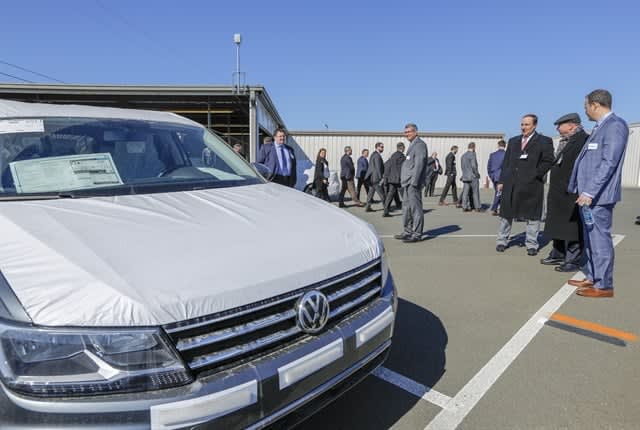
Photo of the opening of Volkswagen's Port of Benicia facility courtesy of the automaker.
Volkswagen Group of America has begun delivering vehicles through a port of entry in northern California that's expected to improve vehicle delivery times in the area, the company announced.
The company has opened a $1.3 million investment in a facility at the Port of Benicia, a privately operated port at the head of San Francisco Bay that's owned by APS West Coast, Inc. AMPORTS, a leader in the vehicle processing industry, operates the terminal facilities.
Volkswagen's facility will support 81 Volkswagen, Audi, Bentley, and Porsche dealers in northern California. The company is creating 38 new jobs.
Volkswagen-branded vehicles imported through the facility include the long wheelbase 2018 Tiguan, e-Golf, 2019 Jetta compact sedan, and 2019 Arteon four-door coupe that debuted in February. Audi vehicles imported will include the A4, A5 Sportback, Audi Q5, and Audi Q7.
"In utilizing the Port of Benicia, we will be able to bring Audi, Bentley and Volkswagen products closer to our California customers and provide enhanced customer service in this key market," said Anu Goel, Volkswagen's executive vice president for after sales and services.
The 645-acre facility provides 140,000 square feet of vehicle processing facilities, and is expected to process 42,000 vehicles in its first year and 220,000 vehicles over the next five years.
The company has been operating a distribution facility at the Port of San Diego since 1990 that supports more than 160 Volkswagen and Audi dealers in the western U.S.
More Operations
Here's When You Should Make an Exception to Fleet Policy
Fleet policies are designed to create consistency, but not every driver or situation fits neatly within standard rules.
Read More →
AI-Native or AI-Acquired: What Should Fleet Managers Look for in an AI Platform?
Six questions can help fleet managers look beyond AI marketing claims to evaluate integration, data access, and real-world operational performance.
Read More →
A buyer's guide to fleet management software in 2027
Buying fleet management software in 2027 means looking beyond features and price. As fleet operations, technology and expectations evolve, this guide explores what today’s fleet professionals should consider when choosing a system that can deliver value now and adapt to what comes next.
Read More →

What Will Shape the Next Era of Fleet Management?
EVs, AI, and autonomous vehicles are reshaping fleet management. Discover what’s ahead—and how fleet leaders can prepare for the next era.
Read More →
How Fleets Can Recruit and Train Veterans for Technician Roles
Here's how the technician shortage has affected uptime for fleets, and what to do about it.
Read More →
Avis Budget Group Deploys Neology Toll Management Technology Across Major Brands
Neology’s neoFleet platform will manage toll transactions and toll-authority operations for vehicles across Avis, Budget, Payless, Budget Truck and Zipcar.
Read More →
Fleet Personal-Use Charges Edge Higher in 2026
Nearly eight in 10 surveyed fleets allow personal use of company vehicles, while just over half of respondents report charging employees for the privilege.
Read More →
The Future of Fleet + What’s Changing Right Now | AF News Recap
Could developments overseas offer a preview of what’s coming for U.S. fleets? This week, we’re looking at the future of AI, autonomy, and electrification, plus Ford Pro’s new certified pre-owned program, smarter vehicle offboarding, and a new way for fleets to manage toll expenses.
Read More →
How to Handle Vehicle Offboarding
What do fleet managers need to do when a driver leaves?
Read More →
Fleet Manager’s Ultimate Playbook: Navigating the New Standard in OEM Connectivity
Rising operating costs, driver safety concerns, and unplanned downtime are putting unprecedented pressure on modern fleets. Discover how fleet managers use embedded OEM connectivity and real-time vehicle data to cut TCO, prevent downtime, and protect drivers without aftermarket telematics hardware.
Read More →