




VW Apologizes, Promises Imminent Diesel Fix
The CEO of Volkswagen's North American automotive business offered a rare public apology at the Los Angeles Auto Show on a press day that's usually filled with glossy vehicle reveals, and said the company is on the verge of revealing its plan to fix the nearly 500,000 diesel vehicles sold in the U.S. with an emissions software cheat.

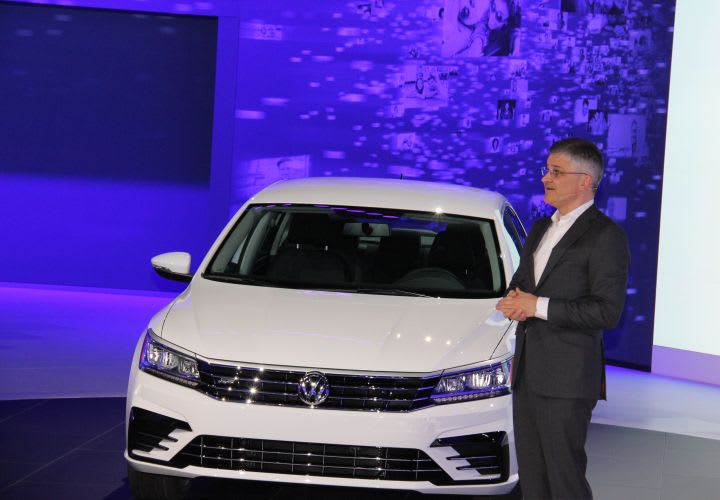
Photo of Michael Horn speaking at the L.A. Auto Show by Paul Clinton.
Photo of Michael Horn speaking at the L.A. Auto Show by Paul Clinton.
The CEO of Volkswagen's North American automotive business offered a rare public apology at the Los Angeles Auto Show on a press day that's usually filled with glossy vehicle reveals, and said the company is on the verge of revealing its plan to fix the nearly 500,000 diesel vehicles sold in the U.S. with an emissions software cheat.
During the Volkswagen press conference, Michael Horn said the company would "announce something soon," as it works to retain goodwill with its dealers and customers. Volkswagen must submit a plan to the California Air Resources Board by Friday about how it plans to fix diesel vehicles with four-cylinder engines that release as much as 40 times the permitted amount of nitrogen oxide.
"Nothing is more important to me than the satisfaction of our customers and to make things right," Horn said. "We understand that apologies are not enough."
Horn said about 120,000 retail customers have taken advantage of a goodwill package that included two $500 gift cards and 24-hour roadside assistance for three years. The company is working separately with its commercial fleet customers.
The EPA has claimed its 3.0L six-cylinder engines included the software cheat. Horn said that issue needs "to be clarified" between the automaker and regulators.
Horn said the company remains committed to the North American market and showed the redesigned 2016 Passat mid-size sedan and the Golf GTE plug-in hybrid concept. Volkswagen AG has indicated earlier that it plans to shift toward electrified powertrains to meet national fuel economy standards.
Audi executives also addressed the diesel emissions scandal that has affected less than 20,000 Audi vehicles in the U.S. It's "a challenge we intent to meet," said Scott Keogh, president of Audi of America.
"Trust is what cements us to our dealers, and we are going to work to restore that trust," Keogh added.
Keogh alluded to a possible shift from diesel to electrified powertrains. The company sees an opportunity and "now is the time to mainstream it." Keogh expects electrified powertrains to make up 25% of Audi sales in the U.S. in 2025.
More Operations

How Fleets Can Recruit and Train Veterans for Technician Roles
Here's how the technician shortage has affected uptime for fleets, and what to do about it.
Read More →
Avis Budget Group Deploys Neology Toll Management Technology Across Major Brands
Neology’s neoFleet platform will manage toll transactions and toll-authority operations for vehicles across Avis, Budget, Payless, Budget Truck and Zipcar.
Read More →
Fleet Personal-Use Charges Edge Higher in 2026
Nearly eight in 10 surveyed fleets allow personal use of company vehicles, while just over half of respondents report charging employees for the privilege.
Read More →
The Future of Fleet + What’s Changing Right Now | AF News Recap
Could developments overseas offer a preview of what’s coming for U.S. fleets? This week, we’re looking at the future of AI, autonomy, and electrification, plus Ford Pro’s new certified pre-owned program, smarter vehicle offboarding, and a new way for fleets to manage toll expenses.
Read More →
How to Handle Vehicle Offboarding
What do fleet managers need to do when a driver leaves?
Read More →
Fleet Manager’s Ultimate Playbook: Navigating the New Standard in OEM Connectivity
Rising operating costs, driver safety concerns, and unplanned downtime are putting unprecedented pressure on modern fleets. Discover how fleet managers use embedded OEM connectivity and real-time vehicle data to cut TCO, prevent downtime, and protect drivers without aftermarket telematics hardware.
Read More →
U.S. Bank Adds Verra Mobility Toll Management to Voyager Fleet Platform
The integration allows U.S. Bank Voyager fleet customers to manage toll payments and violations alongside fuel, EV charging and maintenance expenses.
Read More →
ADAS Prevents Crashes. But Repairs Cost More | AF News Recap
ADAS-equipped vehicles may crash less often, but they can cost more when they do. This week, we’re breaking down what that tradeoff means for fleets, plus Subaru’s first Forester Wilderness Hybrid, Nissan’s new e-POWER Rogue, and why Calstart has become Catalyst Mobility.
Read More →
Moventum Fleet Management Names Mark Iorillo Head of Sales
Iorillo brings nearly 20 years of fleet management and sales experience to the role, including previous positions at Element Fleet Management, CEI, Donlen and Ryder.
Read More →
Fleet Has a Talent Pipeline Problem. What Comes Next? | AF News Recap
Where will fleet’s next generation of leaders come from? This week, we’re looking at the industry’s talent pipeline, what certification can add to a fleet career, how to build an award-worthy track record, and the return of Automotive Fleet’s Personal Use Survey.
Read More →