





Related: Navistar-VW to Bring Integrated Powertrain and Electric Truck to Market
Volkswagen Truck and Bus Reveals Future Transport Vision
Germany's Volkswagen Truck and Bus Group laid out its long-term plans for shaping the future of transportation this week at its Innovation Day Summit, held in Hamburg, Germany.
October 11, 2017
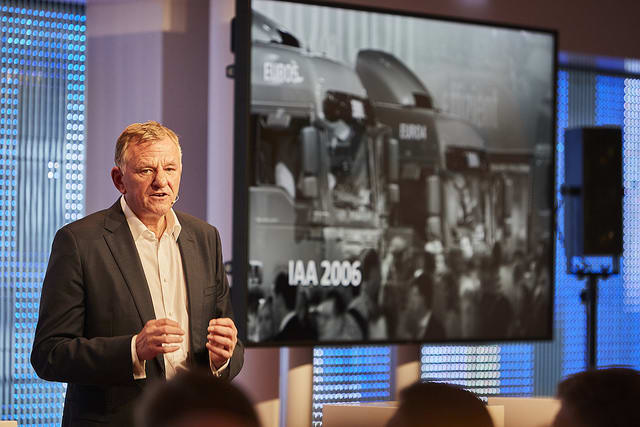
Volkwagen Truck and Bus CEO Andreas Renschler outlines the company's vision of tuture transporation at it Innovation Day summit in Hamburg, Germany. Photo: VW
5 min to read
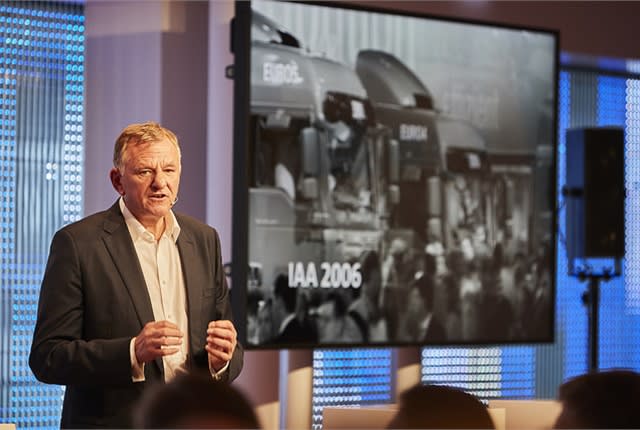
Volkwagen Truck and Bus CEO Andreas Renschler outlines the company's vision of tuture transporation at it Innovation Day summit in Hamburg, Germany. Photo: VW
Germany's Volkswagen Truck and Bus Group laid out its long-term plans for shaping the future of transportation this week at its Innovation Day Summit, held in Hamburg, Germany.
Andreas Renschler, member of the board of management for Volkswagen AG and chief executive officer of Volkswagen Truck and Bus GmbH, made extensive opening remarks at the conference, laying out VW’s vision for what it identifies as the three key areas crucial for the future of trucking, logistics and transporation: autonomous vehicles, connected vehicles, and clean transportation.
Renschler began by noting that Volkswagen Truck and Bus began as a startup just two years ago, with a goal of creating a climate of cooperation among VW’s various brands competing in various transportation and logistics markets, including MAN, Scania, Volkswagen Commercial Vehicles, Volkswagen Brazil, and Rio.
According to Renschler, the effort by VW to coordinate the technological development paths of these brands occurred at “just the right time to shape the future of transportation as a group.”
He added that the company’s research and development group, based in Sweden, was now coordinating and moderating each brand’s technological development efforts to coordinate and synchronize those projects across brands, companies, and countries with notable success.
“We all know that logistics and transportation is changing massively,” Renschler added. “We must consider the needs of our customers – and their customers – as well as environmental issues, technology and infrastructure and the competitive landscape if we are to shape these changes. This challenges us to rethink our business and pursue the fast development of information technology and data processing, which offer us completely new worlds of possibilities. Ten years ago, our business was very much focused on truck hardware. Today, we are focused on both hardware and software solutions. By joining forces and brand competencies in focused areas, we look to massively increase efficiencies not only for our customers, but for the entire transportation system as well as for society as a whole and our environment.”
Renschler said trucking remains a highly inefficient business today, with high shares of empty backhauls for trucks as well as “sub-optimal utilization” of assets. “Only 50% of overall vehicle capacity is actually used for transporting goods today,” he said. “But using very little data from connected vehicles will allow real-time capacity planning and bring supply and demand closer together. If other digital services are added into the equation, it could lead to capacity increases of up to 80%.”
At the same time, Renschler said, connected and automated vehicle technologies would reduce truck-related accidents and corresponding fatalities in Europe.
According to the VW executive, the automated driving “roap map” for VW will center on a “step by step” basis and said that various pilot cases from Level 1 to Level 5 automation were currently being carried out by the company. “We are gaining experience from these projects and will be ready to scale up what we’ve learned as soon as the appropriate regulations are in place,” he said.
Looking ahead, Renschler said that VW would be ready to scale up autonomous vehicles for industrial applications in the next 18 to 24 months, with additional applications such as airport snow-plow trucks ready by 2025.
Platooning will be the first step for long-haul autonomous applications, Renschler said, with mixed platoons running next year and VW autopilot systems in common use as early as 2022. “There is no question this technology will be a huge step forward in making our cities cleaner, safer and less congested,” he added.
Urban applications for autonomous vehicles are more complex, Renschler said. Yet VW expects to have its first urban bus trials running at the “beginning of the next decade,” and sees the development of urban truck platoons transporting goods in specialized corridors as a realistic solution in the short-term future.
“Much has to be done by policymakers to make these technically feasible projects become reality,” Renschler cautioned. “We will need new regulations relating to driver intervention rules and modified driver resting times as different levels of automation dictate different demands from drivers.”
At the same time, Renschler called for accelerated development of road communication systems that are harmonized to communicate more efficiently alongside the increased efforts in vehicle communication systems.
Renschler said that VW now has 300,000 fully connected trucks on the road in Europe and that the “vast majority” of trucks on the road will be connected by 2020. “To that end, we are now ready to rock the industry with our common, open, cloud-based platform developed jointly by MAN and Rio,” Renschler said.
“Our strategic partner in America, Navistar, announced last week at the North American Commercial Vehicle Show in Atlanta that connectivity, including hardware and software solutions will be the next major area of cooperation based on the Rio platform," he continued. "The first step will be the adoption of the in-cab connecting hardware device. This will serve as a major step toward creating a global platform that will connect 650,000 vehicles worldwide. That will make it the largest ecosystem for connected vehicles worldwide, once that migration is complete.”
As these systems come on line, Renschler said cloud-based solutions will create opportunities for fleets and logistics companies in terms of new revenue pools based on data-driven business models, such as dynamic routing and capacity-as-a-service solutions.
Looking at the clean transportation aspect of VW’s future, Renschler said the company was pursuing a wide range of fuel and powertrain options based on local availabilities, social demands, and customer requirements. He urged policymakers to adopt a “technology neutral” approach to future emissions regulations based on that strategy.
Renschler said electrification would likely be key for last mile and city applications in the future, and said he expects the demand for bio-fuels and other alternative fuels to increase in long-haul applications. “But,” he cautioned, “there is no silver bullet that will work for all vehicles and applications. This means a broader and more complex approach must be taken by our businesses that serve these markets.”
He noted that MAN’s EDrive powertrain system would be the “backbone” of a new Navistar medium-duty electric delivery truck in the near future. He also said he expects to see increased use of diesel-electric drivetrains in heavy-duty market segments in common use by 2025.
However, Renschler added, given the demands of heavy duty and long-haul market segments, he expects to see internal combustion diesel engines remain the dominate powertrain in these applications for a “long time to come.”
More Operations

How Fleets Can Recruit and Train Veterans for Technician Roles
Here's how the technician shortage has affected uptime for fleets, and what to do about it.
Read More →
Avis Budget Group Deploys Neology Toll Management Technology Across Major Brands
Neology’s neoFleet platform will manage toll transactions and toll-authority operations for vehicles across Avis, Budget, Payless, Budget Truck and Zipcar.
Read More →
Fleet Personal-Use Charges Edge Higher in 2026
Nearly eight in 10 surveyed fleets allow personal use of company vehicles, while just over half of respondents report charging employees for the privilege.
Read More →
The Future of Fleet + What’s Changing Right Now | AF News Recap
Could developments overseas offer a preview of what’s coming for U.S. fleets? This week, we’re looking at the future of AI, autonomy, and electrification, plus Ford Pro’s new certified pre-owned program, smarter vehicle offboarding, and a new way for fleets to manage toll expenses.
Read More →
How to Handle Vehicle Offboarding
What do fleet managers need to do when a driver leaves?
Read More →
Sponsored•October 1, 2026
Fleet Manager’s Ultimate Playbook: Navigating the New Standard in OEM Connectivity
Rising operating costs, driver safety concerns, and unplanned downtime are putting unprecedented pressure on modern fleets. Discover how fleet managers use embedded OEM connectivity and real-time vehicle data to cut TCO, prevent downtime, and protect drivers without aftermarket telematics hardware.
Read More →
U.S. Bank Adds Verra Mobility Toll Management to Voyager Fleet Platform
The integration allows U.S. Bank Voyager fleet customers to manage toll payments and violations alongside fuel, EV charging and maintenance expenses.
Read More →
ADAS Prevents Crashes. But Repairs Cost More | AF News Recap
ADAS-equipped vehicles may crash less often, but they can cost more when they do. This week, we’re breaking down what that tradeoff means for fleets, plus Subaru’s first Forester Wilderness Hybrid, Nissan’s new e-POWER Rogue, and why Calstart has become Catalyst Mobility.
Read More →
Moventum Fleet Management Names Mark Iorillo Head of Sales
Iorillo brings nearly 20 years of fleet management and sales experience to the role, including previous positions at Element Fleet Management, CEI, Donlen and Ryder.
Read More →
Fleet Has a Talent Pipeline Problem. What Comes Next? | AF News Recap
Where will fleet’s next generation of leaders come from? This week, we’re looking at the industry’s talent pipeline, what certification can add to a fleet career, how to build an award-worthy track record, and the return of Automotive Fleet’s Personal Use Survey.
Read More →