




Virtual Crash Testing Key to Chevrolet Trax Design
General Motors engineers took full advantage of both traditional crash tests and advanced computer simulations while developing the Chevrolet Trax compact SUV.
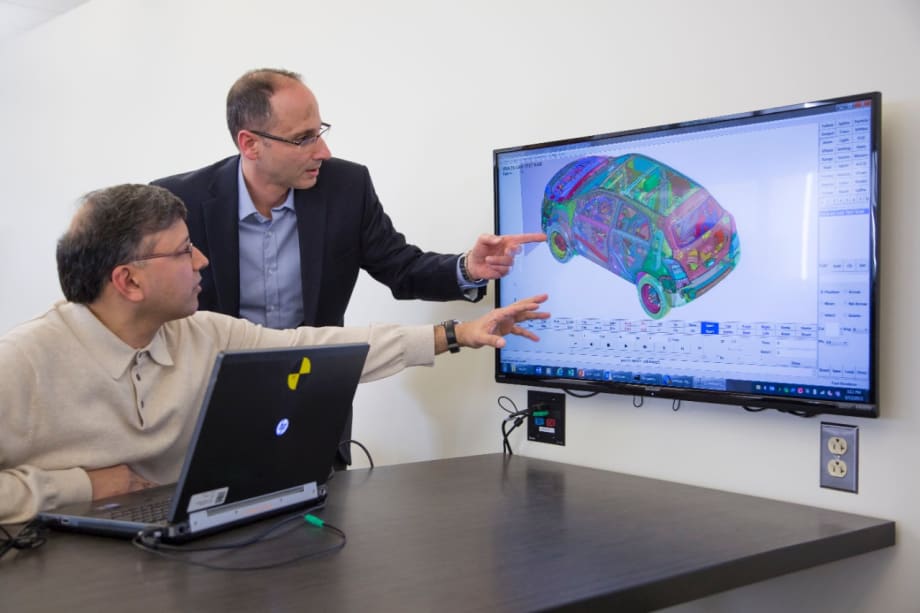
(l-r) GM’s Sajid Syed and Kenneth Bonello analyze computer crash simulations for the Chevrolet Trax. Photo by Jeffrey Sauger for Chevrolet.
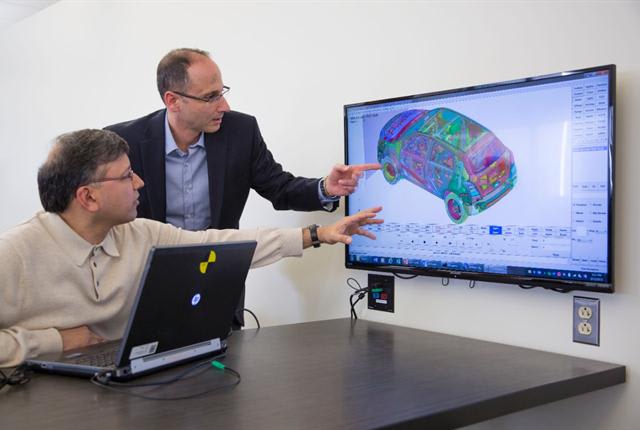
(l-r) GM’s Sajid Syed and Kenneth Bonello analyze computer crash simulations for the Chevrolet Trax. Photo by Jeffrey Sauger for Chevrolet.
With virtual crash testing, engineers at General Motors can use advanced digital models and simulations to address safety challenges early in the vehicle design process. Such testing processes can make vehicles such as the 2015 Chevrolet Trax more road-ready, the automaker said.
“The safety Trax offers is the direct result of exhaustive testing and analysis using both traditional physical tests and advanced computer simulation,” said Al Manzor, GM North America regional chief engineer for small and compact vehicles. “The vehicles in the computer models are complete 3-D replicas of the physical vehicles, so the simulations accurately depict the way all parts of the structure and components would react in a crash. The understanding we gain by using these tests allows us to make more informed decisions regarding the final designs.”
Eight decades after GM engineers developed the first barrier crash test, physical crash testing continues to provide engineers with great insight as to how vehicles perform. But it takes a lot of time. Creating the tooling to build a physical prototype can take weeks or months. Setting up the cameras, test rigs, crash test dummies, sensors and other hardware for a physical test also adds considerable time.
Once a prototype vehicle is used in a crash test, the vehicle most likely can’t be used in another test. If engineers need to test for different variables or evaluate a revised part, a new batch of prototype vehicles needs to be built in order to continue testing.
But virtual crash testing isn’t restricted by such physical considerations.
Rendered directly from digital design files, these virtual vehicle models measure many terabytes in size and can be excruciatingly detailed down to the last nut and bolt found on a physical vehicle. These parts are further broken down into finite elements, which allow engineers to precisely model and evaluate how a physical part will behave once manufactured.
Vehicle crash models may consist of 6 million to 7 million elements, and take advanced supercomputers several hours to put through a simulated test. The result? Engineers can see how a vehicle will perform in a collision, often from angles difficult to replicate with a physical test.
“In a physical crash test, high-speed cameras allow us to see how a vehicle performs in a collision from certain angles – say, from within the passenger compartment,” said Sajid Syed, safety team lead for the Trax program. “But the virtual testing allows us to see much more detail. Not only can we look through the vehicle as if its outer skin was transparent, but we can also view how a single part behaves.”
Engineers can look at the forces applied to the vehicle’s structure, determine what part might be affected next, and design the vehicle so it channels energy in a way that best protects the occupants, explained Ken Bonello, senior manager of safety computer-aided engineering (CAE) integration.
“A crash event may take only 100 milliseconds, but we’re able to step through millisecond by millisecond, and see the sequence of events that might be unfolding beneath the surface,” Bonello added.
Because Trax engineers are located in South Korea and the U.S., digital tests can be performed around the globe at any time. The international engineering team responsible for Trax’s safety performance can collectively test and refine vehicle designs to elevate occupant safety in a crash.
Virtual vehicle models are growing increasingly detailed and more realistic. Not only are the crash simulations constantly being evaluated and checked against real-world test results, but the vehicle models themselves are constantly evolving, according to General Motors.
“Safety is a big part of our simulation efforts, but it’s also a tool used by engineers evaluating noise/vibration, durability, aerodynamics, fuel economy, and other important qualities,” said Bonello. “All these groups are using the same models – the same set of math data. It’s a very integrated and coordinated effort.”
More Safety

Nexar-Nauto Merger Aims to Give Fleets Better Safety Intelligence Through Larger Driving Dataset
Stefan Heck tells Automotive Fleet that combining more than 10 billion miles of driving history with Nexar's AI models will give fleets deeper insights into driver risk and roadway conditions than either company could provide independently.
Read More →
Don't Wait for a Crisis: 5 Ways to Build Mental Health Into Your Fleet Safety Program
For Suicide Prevention Month, fleet and safety leaders have an opportunity to put mental health where it belongs: at the center of workplace safety.
Read More →
How Camera Data Can Strengthen a Fleet’s Insurance Renewal
Insights from a commercial insurance carrier and a broker show how fleets can turn video telematic data, driver coaching, and improved claims results into a stronger case at insurance renewal.
Read More →
The Safest Fleets Aren’t the Ones with the Most Technology
You’ve made the telematics investment. Here’s how to capture the other half of its value and build the safest fleet on the road.
Read More →
Hidden in Plain Sight: Fleet Compliance Risks
Fleet compliance isn't just about having policies — it's about consistently enforcing them. This practical guide reveals six hidden compliance risks common in public sector and shared fleet operations and outlines proven strategies to improve visibility, accountability, and audit readiness
Read More →
NETS Sets 2026 Fleet Safety Benchmark Conference for Indianapolis
The Sept. 15–17 program will feature fleet benchmarking data, case studies, emerging technologies, and implementation strategies while running alongside the NSC Safety Congress & Expo.
Read More →
Off-the-Job Crashes Account for 43% of Employers’ $61.7 Billion Crash Burden
NETS quantifies costs dispersed across fleet, risk, HR, and other departments while providing new per-crash benchmarks for employers.
Read More →
Ram Recalls More Than 1.27 Million 1500 Pickups for Seat Belt Anchor Issue
The recall affects certain 2019-2026 Ram 1500 pickups that may have improperly attached second-row seat belt buckle anchors.
Read More →
How Better Visibility Cut Speeding Violations by 48%
Fleet leaders don't need more data, they need clearer visibility into what the data is saying. This case study explores how one utility replaced speeding-event counts with a single metric — miles driven in violation — to strengthen safety and significantly reduce speeding violations.
Read More →
Operation Safe Driver Week: Why the Industry's Oldest Safety Campaign Still Matters to Fleets
A look at how a 2007 enforcement initiative became one of the most consequential weeks on the fleet safety calendar, and what it means for your drivers in 2026.
Read More →