




Video Safety Tip: Dealing With Black Ice
The Maine Occupational Safety and Health Administration offers advice for dealing with one of the most dangerous winter driving hazards.

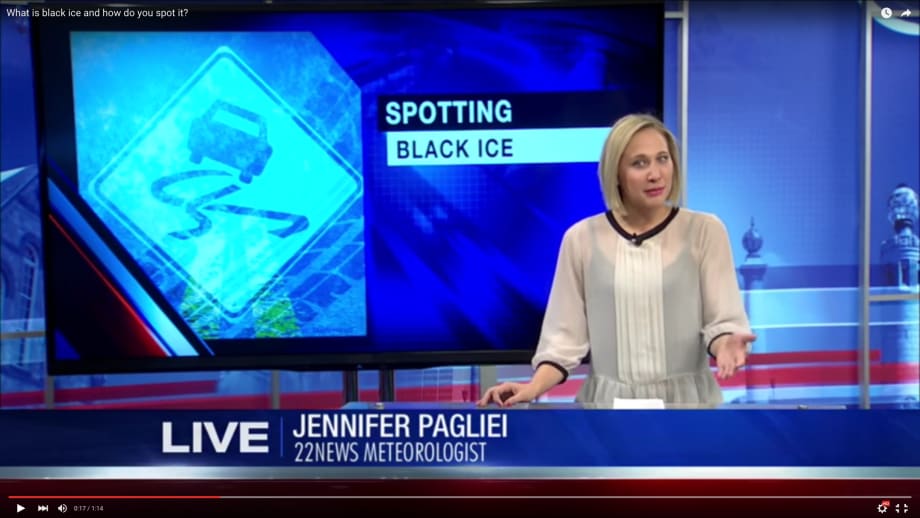
A thin layer of ice can form from melting snow running across the road or even condensation from overnight dew.
Photo: YouTube Screen Capture
It’s black ice season in much of the country — time to remind fleet drivers of one of the deadliest of all winter driving hazards.
What some drivers forget is that black ice can form even when it’s not raining or snowing, and this road hazard is often difficult to spot. A thin layer of ice can form from melting snow running across the road or even condensation from overnight dew.
The Maine Occupational Safety and Health Administration offers these tips for dealing with black ice. You may want to pass this advice along to fleet drivers.
What to Watch out For with Black Ice
Pavement that looks dark, wet or like new asphalt
Low-lying areas that may have standing water or runoff from nearby melting snow banks or puddles
Bridges and underpasses
Any road areas that are shaded from the sun
Any time the temperature is below 40 degrees F
Vehicles that have slid off the road under any of the above conditions.
Safety Precautions Commercial Drivers Can Take
Remember, not all cars respond the same to icy, slippery roads. For that reason, knowing how to handle your vehicle and how it responds in various weather conditions is important. AAA recommends that motorists practice slow-speed maneuvers on an empty snow- or ice-covered parking lot. You should also look through your owner’s manual and familiarize yourself with your vehicle's braking system and other features.
Wear safety belts every time you get into a vehicle. Be sure all children and passengers are secured in proper restraints, too.
Slow down. Posted speed limits are for ideal travel conditions. Driving at reduced speeds is the best precautionary measure against any misfortune while driving on slippery roads. Allow more time to travel. Resist the temptation to drive faster. Allow extra time — not only for the reduced speeds but for potential problems on the road.
When roads are wet or look wet, watch the vehicle in front of you. If it isn’t leaving tracks or its wheels are not “throwing” water, the road is probably covered in black ice and not just wet.
Look well ahead to compensate for the greater distances required when driving on slippery surfaces, and focus your attention as far ahead as possible — at least 20 to 30 seconds.
Drive with your headlights on. This will turn on your taillights and allow others to see you almost twice as far away. Being visible will give others time to avoid hitting you.
Be especially cautious when driving your car into shaded areas, and slow your vehicle down when you encounter such areas.
Avoid driving while fatigued.
Maintain more space. Increase your margin of safety. Don't tailgate. Maintain a minimum of eight to 10 seconds in following distance.
Anticipate problems. On slick surfaces, any abrupt maneuver will increase the probability of losing vehicle control. Skids can best be avoided by anticipating lane changes, turns and curves. Slow down in advance and make smooth, precise movements of the steering wheel.
Use chains in deep snow and on icy surfaces. Check state and local laws before installing chains, and drive at slower speeds to avoid damage to the tires and vehicle.
Don’t use cruise control. Winter driving requires you to be in full control.
Steer with smooth and precise movements. Changing lanes too quickly and jerky steering while braking or accelerating can cause skidding.
Braking Tips for Black Ice
Braking with anti-lock brakes — Apply the brakes. Don’t remove your foot from the brake pedal or pump the brakes. The ABS should keep the brakes from locking while allowing you to steer as you continue to slow the vehicle down.
Braking without anti-lock brakes — Use the heel-and-toe method. Keep your heel on the floor and use your toes to press the brake pedal firmly, just short of locking up the wheels. If the wheels lock, release the pressure on the pedal, and press again in the same way. Repeat this until you come to a full stop.
In both cases, if your vehicle begins to skid, remember to steer in the direction of the skid. You may also find it advantageous to put your transmission in neutral while trying to stop on black ice.
More Safety

Fleet Manager’s Ultimate Playbook: Navigating the New Standard in OEM Connectivity
Rising operating costs, driver safety concerns, and unplanned downtime are putting unprecedented pressure on modern fleets. Discover how fleet managers use embedded OEM connectivity and real-time vehicle data to cut TCO, prevent downtime, and protect drivers without aftermarket telematics hardware.
Read More →
From Driver Well-Being to EV Charging | AF News Recap
Mental health belongs in the fleet safety conversation. This week, we’re looking at five ways fleets can support employee well-being before a crisis, plus Holman’s expansion in Mexico, new one-day Fleet Forward passes, and why EV charging demand is outpacing infrastructure growth.
Read More →
Nexar-Nauto Merger Aims to Give Fleets Better Safety Intelligence Through Larger Driving Dataset
Stefan Heck tells Automotive Fleet that combining more than 10 billion miles of driving history with Nexar's AI models will give fleets deeper insights into driver risk and roadway conditions than either company could provide independently.
Read More →
Don't Wait for a Crisis: 5 Ways to Build Mental Health Into Your Fleet Safety Program
For Suicide Prevention Month, fleet and safety leaders have an opportunity to put mental health where it belongs: at the center of workplace safety.
Read More →
How Camera Data Can Strengthen a Fleet’s Insurance Renewal
Insights from a commercial insurance carrier and a broker show how fleets can turn video telematic data, driver coaching, and improved claims results into a stronger case at insurance renewal.
Read More →
The Safest Fleets Aren’t the Ones with the Most Technology
You’ve made the telematics investment. Here’s how to capture the other half of its value and build the safest fleet on the road.
Read More →
Hidden in Plain Sight: Fleet Compliance Risks
Fleet compliance isn't just about having policies — it's about consistently enforcing them. This practical guide reveals six hidden compliance risks common in public sector and shared fleet operations and outlines proven strategies to improve visibility, accountability, and audit readiness
Read More →
NETS Sets 2026 Fleet Safety Benchmark Conference for Indianapolis
The Sept. 15–17 program will feature fleet benchmarking data, case studies, emerging technologies, and implementation strategies while running alongside the NSC Safety Congress & Expo.
Read More →
Off-the-Job Crashes Account for 43% of Employers’ $61.7 Billion Crash Burden
NETS quantifies costs dispersed across fleet, risk, HR, and other departments while providing new per-crash benchmarks for employers.
Read More →
Ram Recalls More Than 1.27 Million 1500 Pickups for Seat Belt Anchor Issue
The recall affects certain 2019-2026 Ram 1500 pickups that may have improperly attached second-row seat belt buckle anchors.
Read More →