




PORTLAND, Ore. --- Nationally and internationally known highway safety experts will convene Sept. 23-26 in Portland, Ore., for the Governors Highway Safety Association's (GHSA) annual meeting. This year's meeting, themed "Looking Beyond Our Borders," will focus on other nations' strategies and programs that have reduced traffic crashes and fatalities. The international focus of the conference is particularly timely since the United States' standing in global road safety has been slipping. While the U.S. has made much progress, overall the news is not good -- the country now ranks 42nd among the 48 countries measured by fatalities per capita according to the Organization for Economic Cooperation and the International Transport Forum. In what is considered by many experts to be a more precise measure, fatalities per distance driven, the U.S. was number one in 1970, with the lowest death rate among industrialized countries. However, the U.S. now ranks 11th. Monday's keynote address will be delivered by Nicole Nason, administrator of the National Highway Traffic Safety Administration (NHTSA). Nason was appointed as the nation's top highway safety official by President Bush in 2006. She has been asked to discuss her thoughts on what the U.S. can both learn and offer to other developed countries. She's also expected to discuss how NHTSA can help facilitate this exchange of information and ideas. Tuesday's general session features two prominent experts from countries known for their excellence in highway safety. Fred Wegman is the managing director for a key road safety research organization in the Netherlands, and Ian Johnston is a professor at the Monash University Accident Research Center in Australia. Wegman and Johnston are expected to share what their respective nations have done to establish themselves as global leaders in tackling a variety of highway safety issues. These include speeding, drunk driving, safety belt use as well as engineering solutions that result in safer roadways. Wednesday's closing luncheon will feature Brian Jonah, director of road safety programs with Transport Canada. He will discuss Canada's successful seat belt and drunk driving programs. The GHSA meeting will also feature a variety of workshops that focus on current and emerging highway safety issues. Workshop topics include: -- Teens and Distractions: A Dangerous Combination -- Emerging Drunk Driving Technologies -- Buckling Up Tweens and Teens -- Impaired Motorcycling: The Next Big Issue -- Changing the Culture of Speed
U.S. Conference to Focus on Successful Road Safety Strategies Abroad
PORTLAND, Ore. --- Nationally and internationally known highway safety experts will convene Sept. 23-26 in Portland, Ore., for the Governors Highway Safety Association's (GHSA) annual meeting.
More Operations

BBL Fleet Acquires Velcor Leasing Corporation
BBL Fleet expanded its footprint in the fleet management industry with the acquisition of Velcor Leasing Corporation of Madison through a stock purchase agreement finalized Feb. 27, 2026.
Read More →
Lytx Introduces New AI Fleet Technologies at Protect 2026
The company introduced new AI-driven fleet safety and operations technologies during its annual user conference.
Read More →
Fleet Costs Are Rising: Here’s How Leaders Are Responding
Fleet leaders are under pressure to reduce costs, adapt to economic uncertainty, and make smarter decisions. See how peers across North America are responding with real data, proven strategies, and forward-looking insights. Download the 2026 Market Pulse Report to benchmark your strategy and uncover where you can gain an edge.
Read More →
From Waffle House to AI: Fleet Trends You Need to Know
In this AF news recap, host Faith Howell covers how Waffle House stepped up during disaster response and new AI tech on the market.
Read More →
Fleet Operations in the Age of AI: Navigating Ethical and Legal Challenges
AI is no longer a future concept for fleets—it’s already embedded in the tools, data, and decisions that operators rely on every day. In this episode of the Fleet Forward Podcast, recorded live at Fleet Forward, industry leaders take the conversation beyond hype to examine what responsible AI adoption really looks like in fleet operations.
Read More →
Factory Installed vs. Aftermarket: Choosing the Right Telematics Path & Managing the Data
As fleets rethink how they capture, manage, and act on vehicle data, telematics is at a major inflection point. In this episode of the Fleet Forward Podcast, we dive deep into one of the most pressing questions facing fleet leaders today: Should you rely on OEM factory-installed connectivity, aftermarket devices, or a hybrid of both?
Read More →
What Real-Time Data Reveals About EV Cost, Performance, and Scalability
Experts from telematics analytics, fleet-as-a-service operations, and national EV benchmarking share how real-time data is reshaping fleet strategy—dispelling assumptions, validating best practices, and exposing costly missteps.
Read More →
Planning Through Policy Shifts: What Fleets Must Track in 2026
A powerhouse panel featuring experts from the American Automotive Leasing Association, CalSTART, and municipal fleet leadership dives into the realities of navigating shifting emissions rules, regulatory waivers, federal agency actions, the future of the EPA’s endangerment finding, and the push for unified standards. They also examine the impacts of tariffs, autonomous vehicle policy, battery innovation, and the accelerating global EV market.
Read More →
Managing Market Turbulence with Strategic Fleet Insights
This episode kicks off with a deep dive into the technologies and market forces reshaping today’s fleet landscape. Host Chris Brown is joined by Laolu Adeola (Leke Services), Tyson Jomini (J.D. Power), and Richard Hall (ZappiRide) to break down real-world data, shifting incentives, and practical strategies fleet leaders can use right now.
Read More →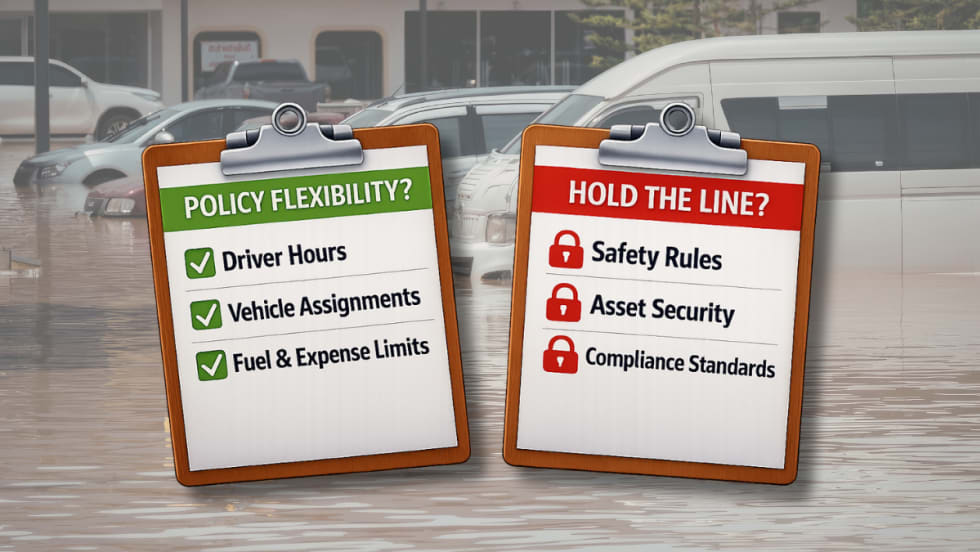
Adapting Fleet Policy When Disasters Strike
In the middle of natural disasters fleet managers must shift priorities to protect people and assets. What policy items should be loosened, and when should the line be held?
Read More →